

Abstract
Forehead augmentation using custom-designed implants has become an increasingly refined procedure in craniofacial and aesthetic surgery. However, optimal outcomes depend on recognizing the fundamental anatomical and aesthetic differences between male and female foreheads. This article outlines the gender-specific skeletal characteristics, aesthetic objectives, and implant design principles that guide successful custom forehead augmentation. Female forehead enhancement prioritizes smooth curvature, softness, and contour continuity, while male forehead augmentation emphasizes strength, flatter planes, and defined transitions. Understanding and respecting these distinctions is essential for achieving natural, gender-appropriate results.
Introduction
Forehead contour plays a critical role in facial aesthetics and gender identity. While forehead augmentation is often discussed as a single procedure, it is inherently gender-specific. Men and women differ substantially in frontal bone anatomy, brow structure, and aesthetic ideals. Failure to account for these differences can result in unnatural or feminized/masculinized outcomes.
The purpose of this article is to define the fundamental aesthetic and structural differences between male and female foreheads and to outline corresponding design strategies for custom forehead implant augmentation.
Anatomical and Aesthetic Differences
Female Forehead Characteristics
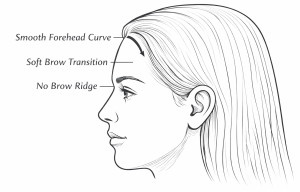 From a lateral profile perspective, the female forehead is characterized by a smooth, gently convex curvature extending from the hairline to the brow. The transition from forehead to brow is soft and uninterrupted, with minimal to no brow ridge prominence or frontal bossing.
Aesthetically, the female forehead is associated with softness, elegance, and harmony. Ideal enhancement seeks balanced projection without angularity and a continuous contour that integrates seamlessly with adjacent facial structures. The desired outcome is subtle and natural, with no visible implant edges or focal areas of prominence.
Male Forehead Characteristics
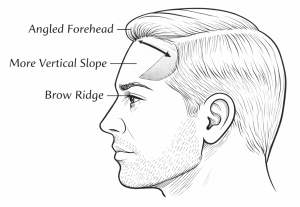 In contrast, the male forehead typically demonstrates a flatter or slightly posteriorly sloped contour. A defined brow ridge and a stronger frontonasal angle are common skeletal features. These elements contribute to a more angular and structurally prominent upper facial appearance.
The aesthetic goal in male patients emphasizes strength, definition, and skeletal clarity. Rather than softness, clear transitions and angular planes are preferred. The ideal result includes a straighter forehead profile, enhanced brow projection, and an overall appearance of increased structural support.
Implant Design Considerations
Female Forehead Implant Augmentation
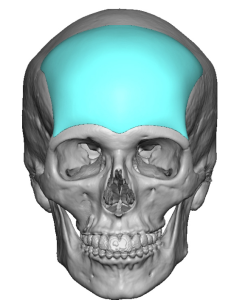
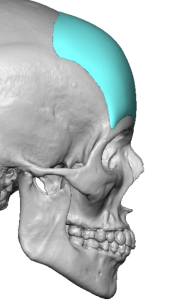 Custom implants for female forehead augmentation are designed to enhance curvature and smoothness. Peak projection is generally modest, typically in the range of 5–7 mm. Augmentation usually begins above the brow region and blends posteriorly toward the hairline to maintain a continuous convex contour.
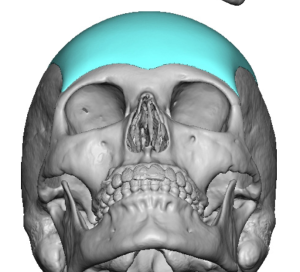 Sharp transitions and brow overprojection are intentionally avoided. The primary design objective is seamless blending, ensuring that the implant is undetectable both visually and palpably.
Male Forehead Implant Augmentation
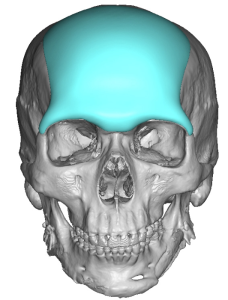
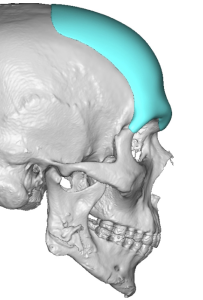 Male forehead implant design prioritizes flatness or controlled angularity. Brow ridge enhancement is frequently incorporated as part of the implant, contributing to a more masculine skeletal appearance. Because brow augmentation contributes to upper forehead projection, the overall implant thickness in male patients may exceed that used in female augmentation.
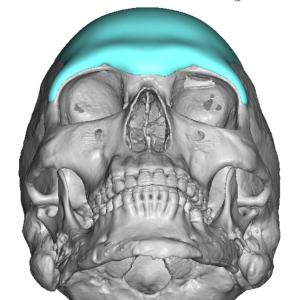 Defined lateral temporal lines and visible structural transitions are acceptable and often desirable in male patients, reinforcing the intended masculine aesthetic.
Custom Implant Design Guidelines
Custom forehead implants allow precise control over contour, projection, and edge transitions, making them particularly well suited for gender-specific augmentation.
For female patients, implants are designed to create a continuous, flowing curvature with soft transitions at all borders. Edge invisibility and smooth blending are paramount.
For male patients, implants are designed to enhance skeletal strength and definition. Incorporation of brow ridge augmentation is common, and the implant design allows precise control of angles, planes, and structural emphasis.
Discussion
Forehead augmentation should not be approached as a uniform procedure. Gender-specific anatomical differences dictate distinct aesthetic goals and implant design strategies. Attempting to apply a single design philosophy across both genders risks producing results that appear unnatural or inconsistent with the patient’s facial identity.
Custom implant technology enables surgeons to address these differences with a high degree of precision, offering predictable outcomes that align with established principles of male and female facial aesthetics.
Conclusion
Forehead augmentation is a highly gender-dependent procedure requiring careful consideration of skeletal anatomy and aesthetic intent.
Female forehead enhancement prioritizes softness, curvature, and contour harmony, while male forehead enhancement emphasizes strength, definition, and structural presence. Custom-designed implants provide the necessary flexibility and precision to achieve these distinct goals reliably and predictably.
Dr. Barry Eppley
World-Renowned Plastic Surgeon