
Back Lifts: Clarifying the Two Primary Types
Back lifts are body-contouring procedures with several variations. These are often grouped together, even though they produce very different contouring effects. The key distinction lies in the direction of skin excision, which determines the aesthetic outcome.
What Is a Back Lift (Posterior Body Lift)
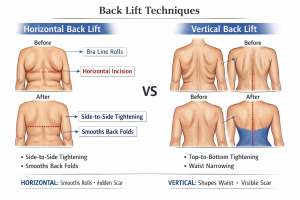 A back lift removes excess skin and fat from the upper, middle, or lower back to improve torso contour. The effect of the procedure depends primarily on whether the excision is horizontal or vertical.
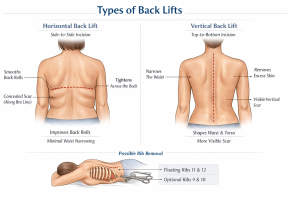
Horizontal Back Lift
Incision direction: Side-to-side, typically along the bra line or lower back
Best for:
- Back rolls and bra-line fullness
- Horizontal skin laxity and folds
Primary improvements:
- Smooths back rolls
- Tightens skin across the width of the back
- Improves fit of bras and fitted clothing
Limitations:
- Minimal waist narrowing
- Limited effect on vertical skin excess
Scar:
- Long but usually well concealed within bra or underwear lines
Most common use:
This is the workhorse back lift and by far the most frequently performed approach.
Vertical Back Lift
Incision direction: Top-to-bottom along the midline of the back
Best for:
- Circumferential trunk laxity
- Excess vertical skin redundancy
- Massive weight-loss patients with a “deflated tube” appearance
Primary improvements:
- Waist narrowing and overall torso shaping
- Improved trunk contour
- Can enhance an hourglass shape when combined with rib modification
Limitations:
- Less effective for true bra-line rolls
- Scar is more difficult to conceal
Scar:
- Vertical midline back scar
- Accepted trade-off for improved contour
Most common use:
Selective cases. Less common, but powerful when appropriately indicated.
Side-by-Side Comparison
|
Feature |
Horizontal |
Vertical |
|
Primary target |
Back rolls |
Trunk laxity |
|
Skin tightening direction |
Side-to-side |
Top-to-bottom |
|
Waist narrowing |
Minimal |
Moderate to significant |
|
Scar concealment |
Easier |
More difficult |
|
Frequency |
Very common |
Selective |
Rib Removal and Back Lifts
Regardless of back-lift type, rib modification can be performed concurrently to improve torso and waistline contour.
Case Study
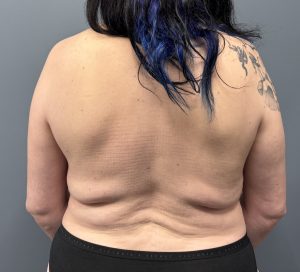
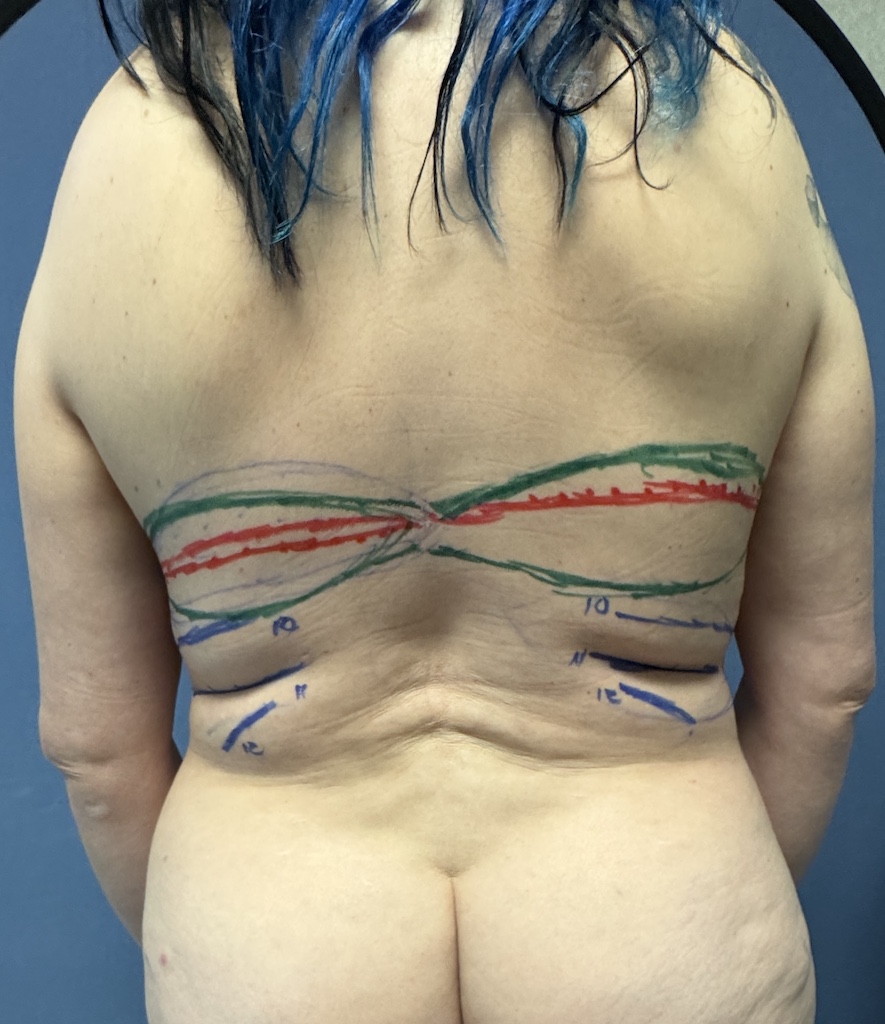
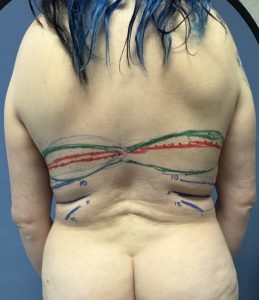 This female patient previously underwent successful shoulder narrowing and pelvic plasty for body reshaping. She presented with persistent horizontal back rolls and sought their removal, along with any potential torso-narrowing benefit achievable through rib modification.
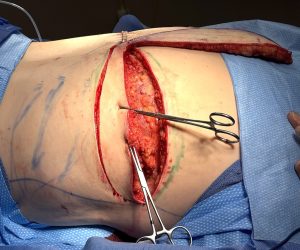
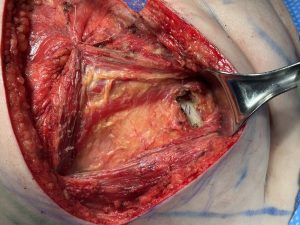
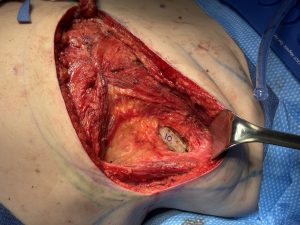 With the patient in the prone position, a horizontal back-lift excision was performed from side to side. Through the back-lift exposure, the latissimus dorsi (LD) muscle was split vertically, allowing subtotal removal of ribs 10 and 11. Rib 12 could not be accessed.
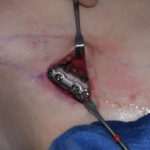
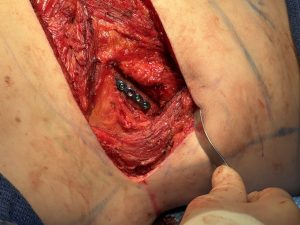 Rib 9 was treated with a shortening osteotomy, involving removal of a 1.5-cm bone segment followed by end-to-end reapproximation using plate fixation.
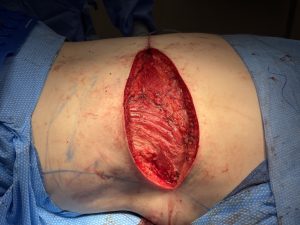 A vertical segment of the latissimus dorsi muscle was excised, and the remaining lateral portion was repositioned medially to significantly shift its lateral border inward.
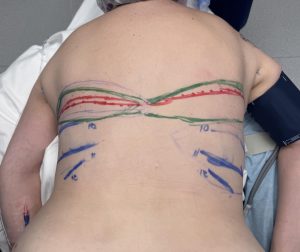
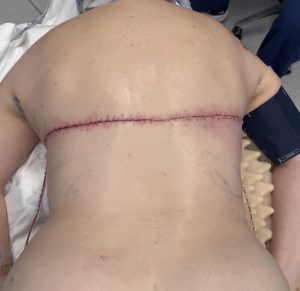 Back-lift closure was performed over drains.
Discussion
Rib removal performed through a back-lift incision—often referred to as a posterior rib approach—is a legitimate and effective technique that takes advantage of the wide exposure provided by the back-lift excision. This approach facilitates torso and waist narrowing while simultaneously addressing excess posterior skin and fat.
What This Approach Involves
Instead of accessing the lower ribs through flank or anterior incisions, the surgeon approaches the ribs from the posterior torso, typically within the back-lift excision. This allows two objectives to be addressed simultaneously:
- Removal of excess back skin and fat
- Structural torso and waist narrowing through rib modification
Ribs typically involved:
- Floating ribs (11 and 12)
- May include ribs 9 and 10 depending on exposure
Advantages
- Incisions are hidden along the bra line
- Avoids visible flank scars
- Provides wide access to the lower rib cage
- Allows potential treatment of ribs 8 and 9
- Enables resection of a long vertical segment of the latissimus dorsi muscle
Conceptually, this approach allows reshaping of the torso through combined removal of skin, fat, muscle, and bone.
Limitations
- Degree of torso narrowing depends on inherent skeletal width
- Rib removal alone produces subtle effects unless combined with muscle resection or plication
- Longer recovery compared with a standard back lift
Candidate Selection
Best suited for:
- Massive weight-loss patients
- Patients already requiring a back lift
- Thick posterior waist anatomy
- Patients with realistic expectations (subtle narrowing rather than dramatic hourglass change)
Poor candidates:
- Patients seeking dramatic waist reduction
- Those expecting rib removal to replace corset training or muscular conditioning
Risks
- Seroma formation (higher incidence with back lifts)
- Prolonged postoperative soreness with movement
- Temporary intercostal nerve irritation
- Asymmetry due to uneven rib exposure
- Minimal waist change if anatomy is unfavorable
Big Picture
 Rib removal combined with a back lift is an opportunistic but effective pairing that can produce superior torso-narrowing results compared with either procedure alone when used in properly selected patients.
Dr. Barry Eppley
Plastic Surgeon