
In custom infraorbital–malar (IOM) implant design, vertical infraorbital rim lengthening can be conceptualized in three different design patterns based on how aggressively the orbital–malar relationship is altered. These patterns are useful during planning because they correspond to different anatomical problems and aesthetic goals.
1. Subtle Vertical Rim Lengthening
(Contour enhancement pattern)
Concept
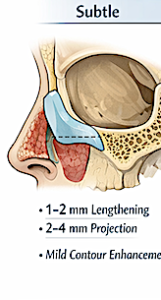 A small inferior extension of the infraorbital rim primarily intended to soften the lid–cheek junction rather than structurally change orbital support.
Typical dimensions
- 1–2 mm vertical lengthening
- 2–4 mm anterior projection
The implant behaves mostly like a rim contour augmentation with a slight downward extension.
Design characteristics
- Thin saddle over the infraorbital rim
- Minimal inferior drop beneath the rim
- Smooth blend into the upper malar surface
- Limited medial extension
The inferior edge usually stops just below the natural rim margin.
What it corrects
- Mild tear trough
- Slight rim retrusion
- Early lid–cheek hollowing
- Minor midface deficiency
Aesthetic effect
- Softens the infraorbital hollow
- Slightly improves eyelid support
- Maintains natural orbital proportions
Ideal patients
- Patients with good midface skeleton but mild under-eye hollowing
- Cosmetic refinement cases
- Female patients where subtlety is important
2. Structural Vertical Rim Lengthening
(Midface deficiency correction pattern)
Concept
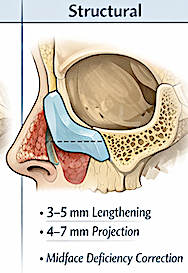 A moderate inferior extension of the infraorbital rim that structurally changes the lid–cheek skeletal relationship.
Typical dimensions
- 3–5 mm vertical rim lengthening
- 4–7 mm anterior projection
Here the implant intentionally lowers the skeletal floor of the orbit relative to the cheek.
Design characteristics
- More substantial rim saddle
- Distinct inferior extension under the rim
- Smooth transition into the malar body
- Broader footprint across the medial and central rim
The inferior border often extends onto the anterior maxilla.
What it corrects
- Moderate tear trough deformity
- Negative orbital vector
- Short midface skeleton
- Infraorbital rim deficiency
Aesthetic effect
- Stronger lid–cheek platform
- Reduction of tear trough depth
- Improved midface balance
- Cheek appears higher and more defined
Ideal patients
- Most midface deficiency cases
- Patients with negative orbital vector
- Male facial structure enhancement
- Patients with prominent eyes due to weak infraorbital support
This is the most commonly used design pattern in custom IOM implants.
3. Orbital Expansion Vertical Lengthening
(Advanced skeletal correction pattern)
Concept
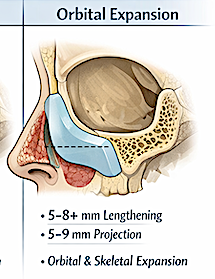 A large superior extension of the infraorbital rim that effectively expands the orbital aperture inferiorly.
Typical dimensions
- 5–8+ mm vertical lengthening
- 5–9 mm projection
This design significantly repositions the skeletal boundary of the lower orbit.
Design characteristics
- Deep inferior extension beneath the rim
- Large footprint on the anterior maxilla
- Strong integration with the malar body
- Often extended medially toward the nasomaxillary junction
The implant creates a new inferior orbital platform rather than just augmenting the rim.
What it corrects
- Severe negative orbital vector
- Prominent eye appearance
- Very deep tear troughs
- Congenital midface deficiency
- Syndromic or developmental skeletal weakness
Aesthetic effect
- Dramatically stronger lower eyelid support
- Eyes appear less protrusive
- Significant reduction of tear trough depth
- Powerful cheekbone structure
Ideal patients
- Severe skeletal deficiency
- Male facial masculinization
- Revision patients with persistent under-eye hollowing
- Patients with prominent globes
Comparison of the Three Design Patterns
|
Feature |
Subtle |
Structural |
Orbital Expansion |
|
Vertical rim lengthening |
1–2 mm |
3–5 mm |
5–8+ mm |
|
Projection |
2–4 mm |
4–7 mm |
5–9 mm |
|
Primary goal |
contour refinement |
skeletal correction |
orbital expansion |
|
Tear trough improvement |
mild |
moderate |
major |
|
Midface structural change |
minimal |
moderate |
major |
|
Typical patient |
mild hollow |
midface deficiency |
severe negative vector |
Key Planning Principle
The amount of vertical rim lengthening should match the skeletal problem, not just the aesthetic complaint.
Many patients request tear trough correction, but the real issue is often:
- a high infraorbital rim
- a short vertical midface
- inadequate lower eyelid skeletal support
In those cases, structural or orbital expansion designs are required to properly correct the anatomy.
? Takeaway
Vertical infraorbital rim lengthening in custom IOM implants exists on a spectrum:
- Subtle ? contour improvement
- Structural ? correction of midface skeletal deficiency
- Orbital expansion ? major orbital–malar structural reconstruction
Understanding these patterns allows the implant design to treat the underlying skeletal architecture rather than simply adding volume.
Dr Barry Eppley
Plastic Surgeon