
chin inferior border bony bumps
Bony bumps along the inferior border of the chin (mandible) are fairly common and can cause visible chin asymmetries with a longer ‘bump’ side. These are usually normal anatomical variations of a developmental origin and are rarely indicative a of more major jaw abnormality.
These normal bony irregularities have the following features:
- The lower border of the mandible isn’t perfectly smooth in everyone
- Small bumps can be:
- Muscle attachment areas (e.g., mentalis, digastric)
- Natural contour variations of the chin bone
- Usually:
- Hard like bone
- Stable over time
- Not painful
- Usually not a true osteoma
- Can rarely have a history of trauma
A 3D CT scan is indicated if:
- The bumps are growing
- They are asymmetric or new
- There is pain or tenderness
- Associated with numbness or skin changes
From an aesthetic standpoint:
- These bumps can affect chin contour aesthetics
- They can be smoothed with burring or a shaving technique
- A submental incisional approach usually provides the best access to do as there is often a vertical component to them.
Case Example
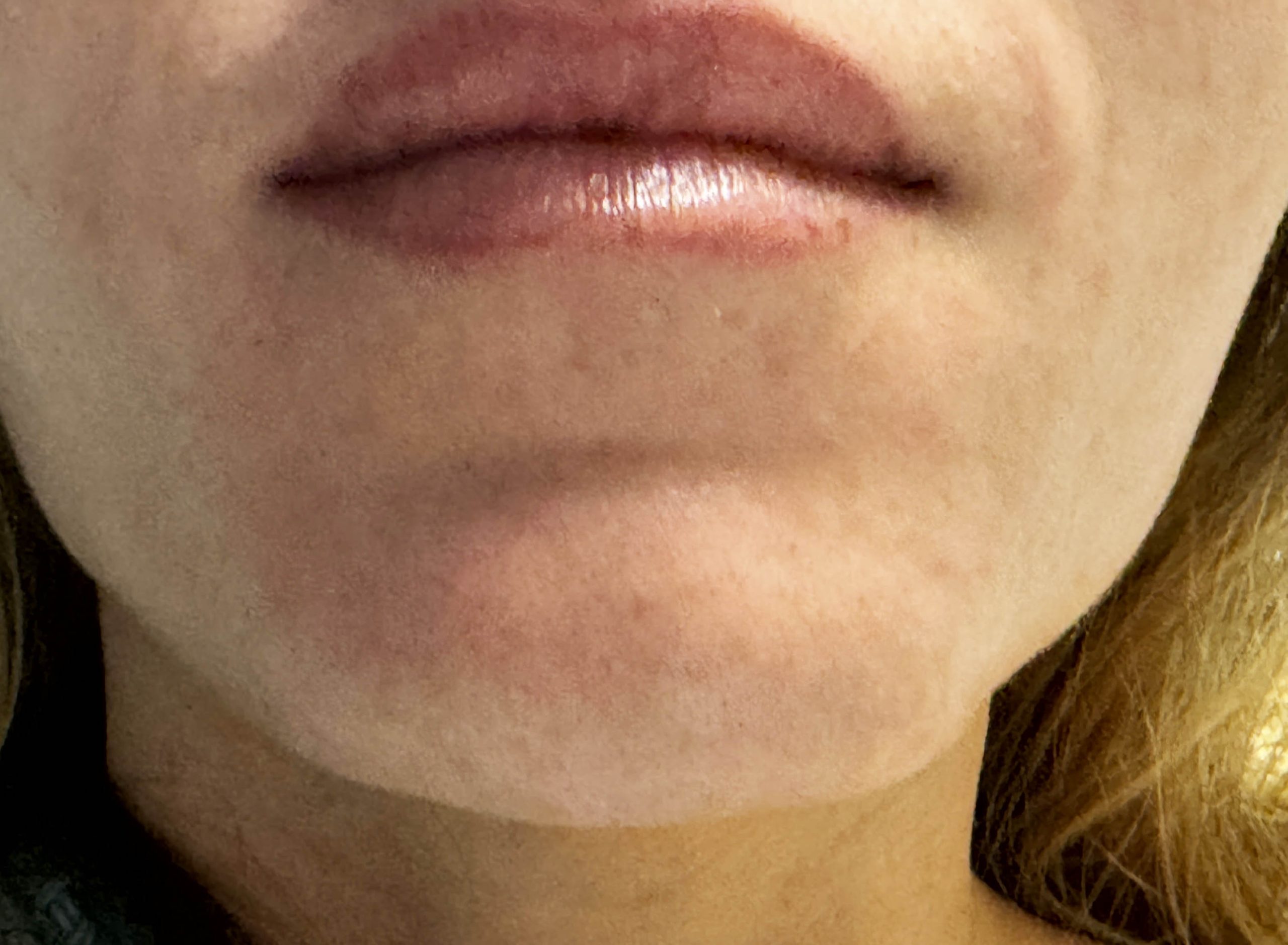
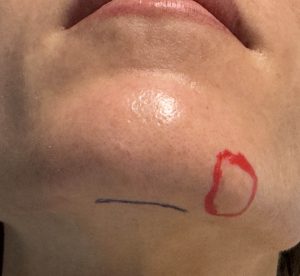 This female had a pronounced chin bump on the left side that stuck out creating chin asymmetry. There was such smaller similar bump at the same location on the opposite side but it was palpable but bot externally visible.
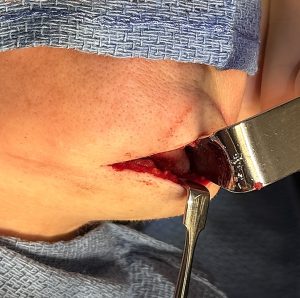
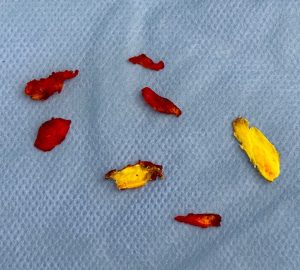 Given its horizontal and inferior projection the submental approach to it was the best method for complete reduction.
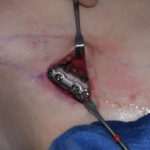
Through the submental incision the bony bump was visibly identified and reduced from both directions using a shaving technique with a reciprocating saw.
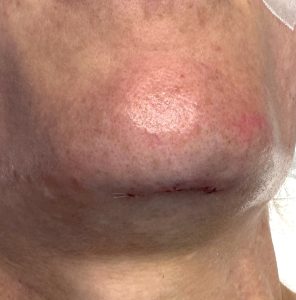 Its immediate reduction eliminated the chin asymmetry.
Discussion
Reduction of a bony chin bump (often an inferior border prominence or irregularity of the mandibular symphysis) is typically managed through variations of reduction genioplasty or bony contouring (osteoplasty). How to do it comes down to two questions: 1) incisional access and 2) what bone reduction technique is ti be used (high speed burring or reciprocating saw shaving).
Here’s a structured surgical overview:
1) Incision
In most cases an external submental incision provides the necessary access to reduce the two dimensions that such bony chin bumps create (width and length). If the chin bump is width only then the intraoral approach can be used.
The submental approach always has less risk of mental nerve numbness, usually none at all as the whole procedure lies inferior to the exit of the nerve from the bone. The submental approach also avoids cutting through the mentalis muscle near its bony origin which eliminates the potential risk of postoperative tightness or chin pad sagging.
2) Bone Reduction
There are two method of surface contour bone reduction, burring and shaving, which are often used interchangeably. But there are important differences
- Burring is done by a high speed handpiece with a rotary burr. This creates a fine bone dust due to the finely participated bone pieces that the burr generates
- Shaving is done by a reciprocating saw which removes larger pieces or segments of bone, shaved bone pieces.
While both bone reduction methods can be effective high speed burring in areas of narrow access has greater risk of causing inadvertent soft tissue trauma and the incision may need to be bigger to use it.
Key points:
- The submental approach with reciprocating saw shaving is safer when the bony bump lies further away from the incision and access becomes more restricted
- The bone burring technique can be safely used when the area of bone reduction is more closer to the incision where the risks of soft tissue trauma can be better controlled.
Dr. Barry Eppley
Plastic Surgeon