
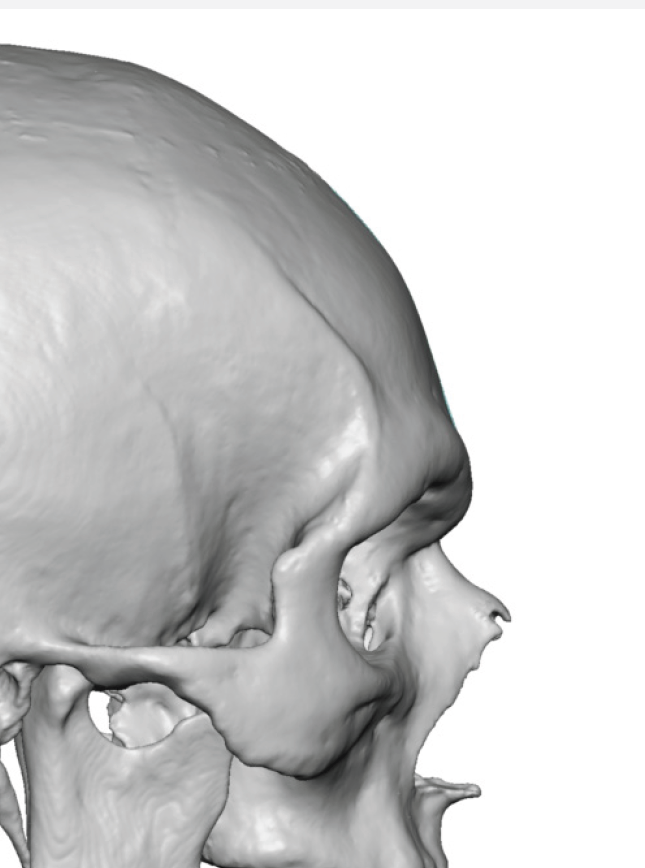
In designing custom forehead implants from CT scans I notice that patients fall into a limited number of recurring skull shape patterns. These patterns determine implant thickness distribution, coverage, and edge design.
Below are 7 common forehead bone shapes that often drive implant design.
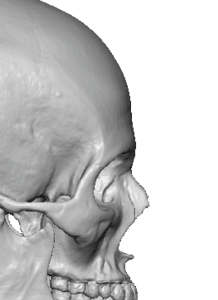
1. Flat Forehead
Description
- Minimal forward projection
- Straight or slightly sloping forehead
 CT characteristics
- Reduced anterior projection of the frontal bone
- Weak curvature
Typical implant design
- Central forehead augmentation
Common implant thickness
- 3–6 mm centrally
Patient concern
“Forehead looks flat in profile.”
2. Receding / Sloped Forehead
Description
- Forehead angles backward noticeably
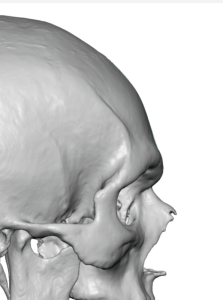 CT characteristics
- Large angle between glabella and upper frontal bone
Typical implant design
- Slope-correction implant
Goal
Create a more vertical forehead profile
3. Weak Brow Ridge
Description
- Minimal supraorbital ridge projection
CT characteristics
- Flattened brow ridge
- Low glabella prominence
Typical implant design
- Brow bone augmentation implant
Goal
Increase supraorbital projection
4. Hollow Upper Forehead
Description
- Depression in upper forehead region
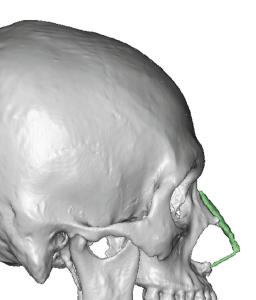 CT characteristics
- Reduced convexity above mid-forehead
Typical implant design
- Upper forehead implant
Goal
Create smooth convex forehead curvature
5. Narrow Forehead
Description
- Forehead width is reduced relative to cheekbones
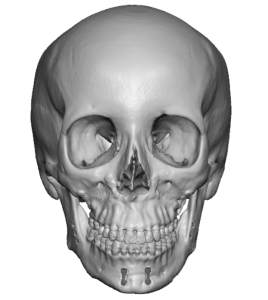 CT characteristics
- Narrow frontal bone width
- Temporal concavity
Typical implant design
- Forehead implant with temporal extensions
Goal
Increase upper facial width
6. Asymmetric Forehead
Description
- One side of the frontal bone is more prominent
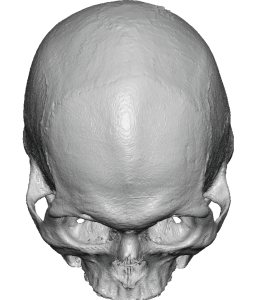 CT characteristics
- Unequal bone thickness or contour betweem the two sides of the forehead
Typical implant design
- Asymmetric custom implant
Goal
Correct contour imbalance
7. Irregular Skull Contour
Description
- Uneven surface due to developmental variation or trauma
CT characteristics
- Localized depressions or bumps
Typical implant design
- Contour-smoothing implant
Goal
Create smooth cranial curvature
Why These Shapes Matter in Implant Design
When I design a custom implant from a 3D CT data, I typically adjust:
1. Projection distribution
- Where the implant is thickest
2. Coverage area
- Brow only vs full forehead
3. Edge taper
- Prevent implant visibility
4. Temporal extension
- Control forehead width
? Interesting design insight
Most CT scans fall into combinations of just three patterns:
- Flat or sloped forehead
- Weak brow ridge
- Temporal narrowing
This is why most custom implants are hybrids, such as:
- Brow ridge + central projection
- Total forehead + temporal widening
- Slope correction + brow augmentation
Dr Barry Eppley
Plastic Surgeon