
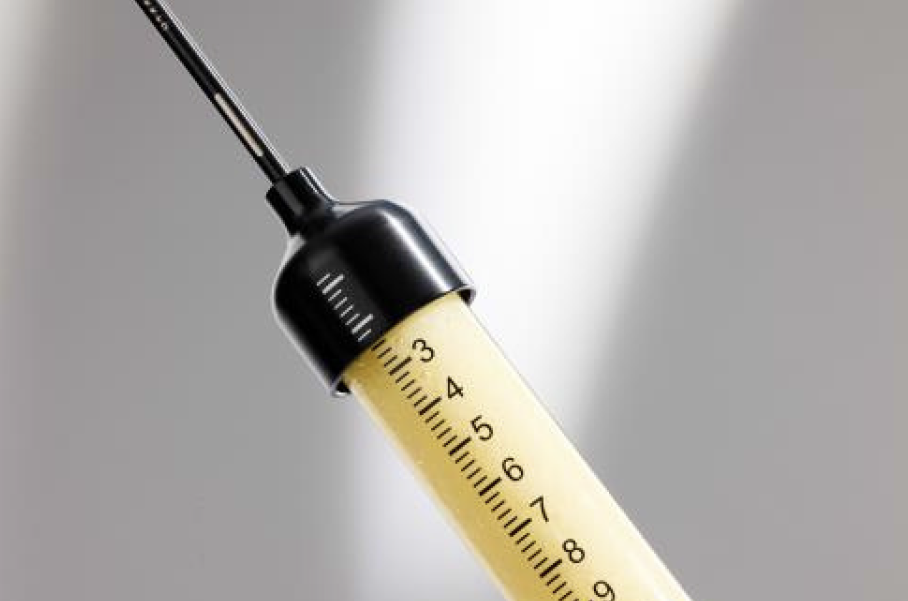


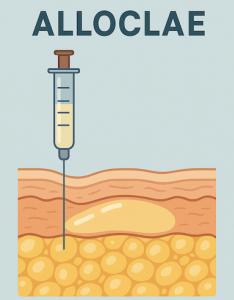
 AlloClae is a structural adipose filler developed by Tiger Aesthetics — a new type of cosmetic injectable.Unlike traditional fillers (e.g. hyaluronic acid) or typical fat-grafting (which requires harvesting your own fat via liposuction), AlloClae uses donor-derived adipose tissue (processed fat tissue) that’s sterilized and purified for safe injection. The processed tissue retains key structural elements — extracellular matrix proteins, collagen, support structure — which act as a scaffold: once injected, they support volume restoration and integration with your own tissue over time.
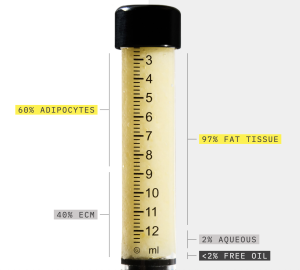
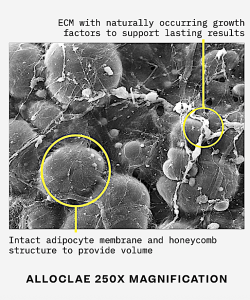 It is sterilized donor-derived fat tissue that uses a novel approach to tissue preparation. The process retains the innate 3D honeycomb structure of the fat cells which provides the immediate volume effect. The extracelllar matrix around the fat cells with its growth factors, proteins and collagen helps to promote cell revascularization and viabiity. It is also processed so that the free lipid content is very low (2%) so little oil is in it.
In short: AlloClae aims to offer a “ready-to-use fat graft” — volume restoration like fat transfer, without needing liposuction or donor-site surgery, making it less invasive than traditional fat grafting.
Intended Uses and Benefits
As an injectable fat grafting substitute:
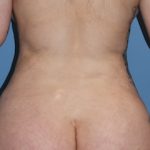
- It can be used for body contouring / volume restoration: e.g. buttocks (liquid BBL), hips (hip-dip correction), breasts (enhancement or shaping), even areas like hands or to fix liposuction irregularities.
- It’s considered an option for patients with limited fat reserves (who wouldn’t have enough fat to harvest for traditional fat grafting) since it doesn’t require donor-site liposuction.
- For body contouring or moderate volume restoration, it may offer less downtime, simpler procedure, and a “ready-made” filler solution compared to traditional surgical fat grafting.
- Because AlloClae includes adipose tissue + extracellular matrix + growth-factor–rich components, the idea is that it may foster a more natural tissue integration and regenerative effect — not just temporary filling, but potentially more stable, long-lasting volume and improved tissue quality.
In other words: AlloClae is marketed as a middle ground between synthetic fillers (convenient but temporary) and traditional fat grafting (natural but invasive).
AlloClae vs Traditional Fat Transfer

Because AlloClae uses donor-derived tissue (not your own harvested fat), and because the processing alters the material — it’s not identical to having your own fat re-injected.
- In donor-derived products, there are trade-offs: The tissue must be sterilized, processed — which may affect viability compared with freshly harvested autologous fat. This implies that the filler may act more like a “scaffold” and less like living fat.
- The amount of “living fat cell graft take” is uncertain compared with autologous grafts; some volume loss or integration variability may occur over time.
- While AlloClae is safe it is important to recognize that because it’s donor tissue — though processed — there is a different biological basis than your own fat.
- Because AlloClae is relatively new, there’s less long-term publicly available peer-reviewed data relative to decades of experience with traditional fat grafting.
Thus: while AlloClae may offer convenience and a lower-threshold entry to fat-like fillers, some of the “permanence” and “natural integration” may not exactly match the gold-standard of autologous fat grafting — and results may vary by provider, injection technique, and volume.
Practical Considerations — Who Might Choose It
AlloClae may make sense for patient who:
- Want volume restoration, body-contouring or aesthetic enhancement (hips, buttocks, breasts, minor contouring) but don’t have enough fat for traditional fat transfer.
- Prefer a minimally invasive, lower-downtime option compared to liposuction + fat-transfer surgery.
- Are comfortable with receiving processed donor-derived fat tissue (rather than their own).
- Seek moderate enhancement, not large-volume dramatic changes — because AlloClae tends to be used for more modest-to-moderate volume c
It may be less ideal if the patient:
- Wants the absolute most “natural fat graft” results (since donor-derived may behave differently).
- Needs very large volume augmentation (traditional fat grafting or implants may still be preferable).
- Are concerned about donor-tissue based procedures (some people are, for ethical or personal reasons).
- Prefer treatments with long-established records and decades of data.
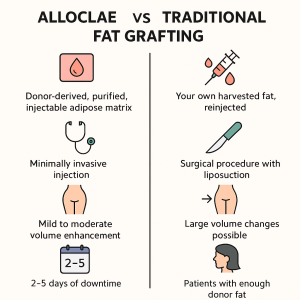
 AlloClae vs Traditional Fat Grafting — Comparison Table
 AlloClae vs Traditional Fat Grafting — Comparison Table
|
Category |
AlloClae (Tiger Aesthetics) |
Traditional Fat Grafting (Autologous Fat Transfer) |
|
What It Is |
Donor-derived, purified, injectable adipose matrix (processed fat scaffolding). |
Your own harvested fat, purified, and reinjected. |
|
Source of Tissue |
Donor fat (sterilized & processed). |
Your own fat (100% autologous). |
|
Procedure Type |
Minimally invasive injection only; no liposuction required. |
Surgical: requires liposuction + reinjection. |
|
Downtime |
2–5 days typically; swelling/bruising mild. |
1–2 weeks; includes liposuction recovery. |
|
Pain Level |
Mild. |
Moderate due to both donor & recipient sites. |
|
Volume Capability |
Mild–moderate volume enhancement (e.g., small hip dips, contour correction). |
Small to very large volume possible (e.g., BBL, breast fat grafting). |
|
Longevity |
Early reports suggest semi-permanent, but long-term data still limited; some resorption may occur. |
Often long-lasting/permanent; 50–70% of fat typically survives long-term. |
|
Cell Viability |
No living fat cells (matrix scaffolding only). Integration relies on tissue ingrowth. |
Contains living adipocytes ? can survive, integrate, and grow with weight changes. |
|
Predictability |
More uniform product; less dependent on surgeon’s fat-harvesting technique. |
Dependent on harvest method, processing, and injection technique (more variable). |
|
Natural Look & Feel |
Natural, but may feel slightly firmer initially due to scaffold structure. |
Very natural — it is your own fat. |
|
Ideal Patients |
Patients with little body fat, or who want non-surgical enhancement or correction of small contour defects. |
Patients who have enough donor fat and want larger or permanent volumization. |
|
Use Cases |
Hip dips, minor buttock shaping, breast shaping tweaks, hand rejuvenation, revision of dents/irregularities. |
BBL, breast enhancement, facial fat grafting, major volume restoration, global contouring. |
|
Risks Unique to Each |
Donor-tissue concerns, possible immune reaction (though rare due to processing), long-term data still emerging. |
Fat necrosis, oil cysts, contour irregularities, donor-site complications. |
|
Cost |
Often lower than full surgical fat grafting. |
Higher because procedure is longer and includes liposuction. |
|
Surgeon Skill Dependency |
Injection technique matters, but product is standardized. |
Highly technique-dependent (liposuction, processing, and placement). |
Summary
Choose AlloClae if one want:
- No surgery / no liposuction
- Mild or moderate volume changes
- Correction of small contour irregularities
- A scaffold-type filler that integrates over time
- Option for people with low body fat
Choose Traditional Fat Grafting if you want:
- Large volume changes (BBL, breast fat grafting)
- A fully natural, autologous result
- Long-term, tissue-based enhancement
- The most established procedure with decades of data
Dr. Barry Eppley
World-Renowned Plastic Surgeon