
Introduction
Hydroxyapatite (HA) forehead augmentation is a skeletal contouring procedure that uses a bone-like material to increase projection, smooth surface irregularities, or reshape the forehead. It is most commonly performed for aesthetic contour enhancement, post-traumatic deformities, congenital asymmetries, and frontal sinus obliteration.
What Is Hydroxyapatite?
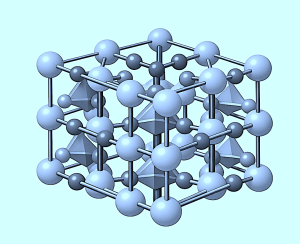 Hydroxyapatite is a calcium phosphate compound that closely mimics the mineral component of natural bone.
Key Properties
- Osteoconductive, allowing bone ingrowth
- Biocompatible and non-allergenic
- Radiopaque, appearing similar to bone on CT imaging
- Capable of long-term integration with the surrounding skull
Hydroxyapatite is most commonly used in the form of a cement or paste, created by mixing a liquid and powder. Initially, the mixture forms a moldable putty that provides sufficient working time for contouring. Once set, it hardens into a firm, bone-like structure.
Why Use Hydroxyapatite in the Forehead?
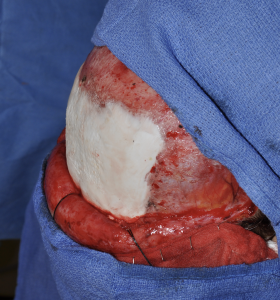 Hydroxyapatite is particularly well suited for forehead and frontal bone augmentation for several reasons.
Advantages
- Produces a very natural, bone-like feel
- Maintains a stable, long-term contour
- Integrates with native bone rather than remaining encapsulated, unlike silicone implants
However, hydroxyapatite is not a perfect material and has notable disadvantages:
- Requires an open surgical field for precise shaping
- Becomes hard and brittle once set, making secondary contouring more challenging
Despite these limitations, the challenges of secondary reduction or reshaping of hydroxyapatite cement in the forehead can be successfully managed with appropriate technique.
Technical Strategies
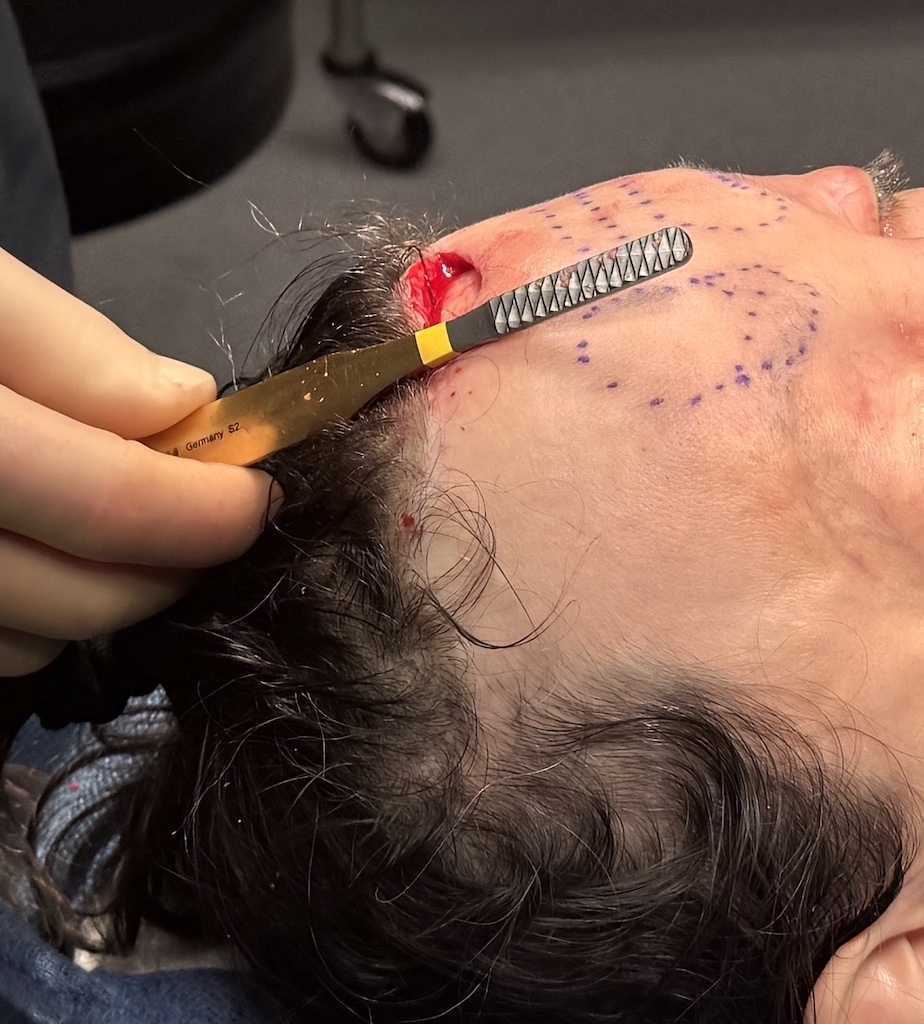
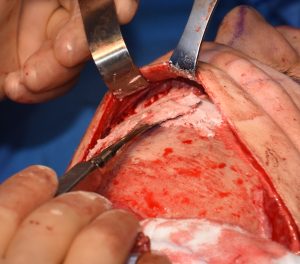 This transfemale patient previously underwent maximal brow bone reduction with frontal sinus obliteration using hydroxyapatite cement. The procedure also included smoothing of the entire forehead contour. Four years later, she returned requesting minor secondary contouring to further smooth select areas of the forehead and brow bones.
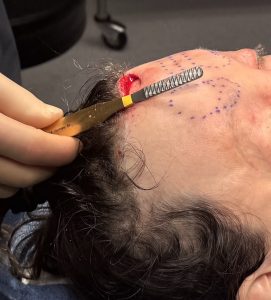
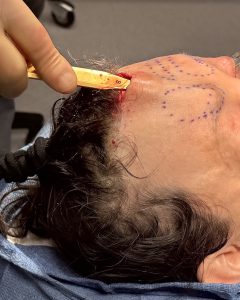 Under general anesthesia, access was obtained through the central portion of the existing frontal hairline scar. The entire forehead and brow bone region were carefully smoothed using large skull rasps applied in a radiating pattern.
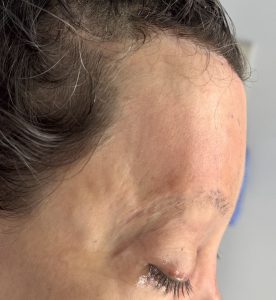 A uniformly smooth forehead contour was successfully achieved.
Discussion
Hydroxyapatite forehead augmentation represents a high-precision, permanent solution for patients seeking the most biocompatible and durable form of bony enhancement. Although it is most commonly used today for modest aesthetic forehead augmentation, in this patient it was employed for maximal brow bone reduction via frontal sinus obliteration. Notably, this was the original FDA-approved indication for hydroxyapatite cement more than thirty years ago, with aesthetic forehead augmentation evolving as an extension of this application.
One advantage of hydroxyapatite cement is its ability to be sculpted before setting, allowing for a smooth outer contour at the time of the initial procedure. In most cases, this produces excellent results. However, when secondary contouring is required, there is little formal guidance on optimal technique.
Unlike native bone, high-speed burring is ineffective and unreliable for reshaping set hydroxyapatite due to its ceramic-like properties, which predispose it to irregular fracture. In my experience, the most effective method for secondary contouring and smoothing of hydroxyapatite cement is manual reduction using medium- and large-tooth rasps. With controlled pressure and gradual technique, the material can be reshaped smoothly without inducing fracture lines or surface irregularities.
Key Points
- Hydroxyapatite cement is a highly biocompatible material for forehead augmentation that provides firm, stable, and permanent bony contour expansion once set.
- Secondary reshaping of set hydroxyapatite cement is best performed with manual rasping techniques to avoid fracture and contour irregularities.
Dr. Barry Eppley
World-Renowned Plastic Surgeon