
Introduction
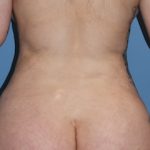
One major factor that contributes to an attractive female figure is a favorable waist to hip ratio. (WHR) Studies have suggested that the ideal WHR is in the 0.6 to 0.7 range. Social and cultural trends today have placed greater emphasis on this aesthetic torso concept that ever before. Waist-to-hip ratio (WHR) and body mass index (BMI) have been the two major determinants to an aesthetically pleasing female body shape. The contribution of fat or BMI in achieving this look can be managed by liposuction, weight loss medications and surgical fat redistribution. (BBL surgery) But at thinner weights or more ideal BMIs the WHR can not be significantly altered by any autologous method. Generally these body shapes are more lean and have straight body profiles (no curves) whether they be cis-female or transgender patients.
Very often these patients have narrow pelvic widths. The widest part of the pelvis or ilium is the iliac crest which spans the upper hip area from the anterior ASIS (anterior superior iliac spine) to the posterior PSIS. (posterior superior iliac spine) Onto this lateral rim are numerous muscle and fascial attachments. The aesthetic relevance of the iliac crest is that it creates the bony width of the pelvis and separates the waist from the hips. If the pelvic width is narrow the torso shape in anterior or posterior views will be more straight. If the pelvic width is wider a more curved torso shape will be seen.
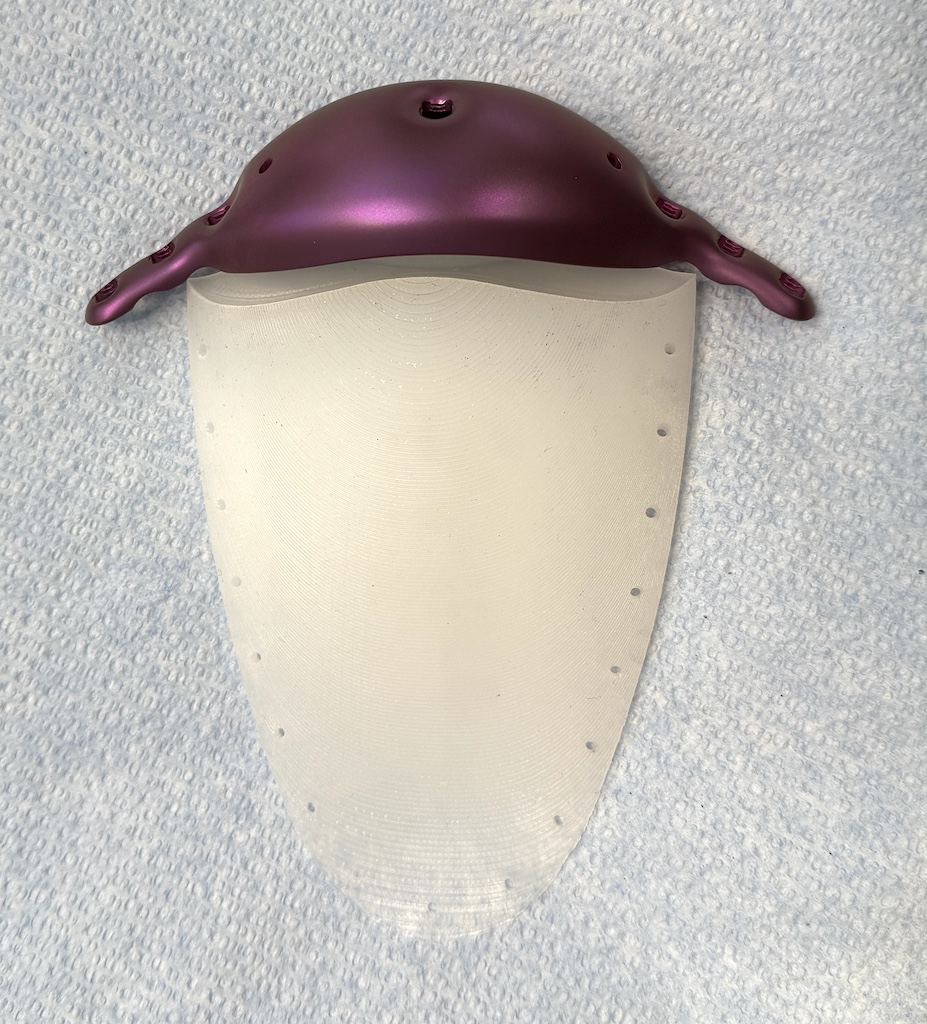
Altering the waist-to-hip Ratio (WHR), a major determinant of female body attractiveness, has historically be done by fat injections. While effective for some patients fat transfer for hip augmentation is prone to unpredictable outcomes. Besides poor fat survival rates some patients have small or narrow pelvic bone size/girth which makes improving the WHR even more challenging and beyond what fat transfer can accomplish. Pelvic Plasty is a new surgical technique for iliac crest augmentation that uses an innovative plate design to widen the pelvic bone and a concomitant silicone hip implant to augment the subiliac area beneath it.
Case Study
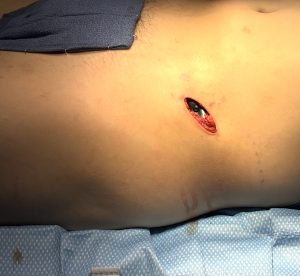
Under general anesthesia the patient and in a supine position the anterior superior iliac spine (ASIS) is palpated and a 3.5 cm curvilinear incision made 2.5cm below and 2.5cm behind to it. Along the side of the iliac crest a deep subcutaneous tunnel (extraperiosteal) is made using elevators and electrocautery to release soft tissue attachments. The dissection is carried back as far as possible which is usually just behind the bend of the iliac crest posteriorly.
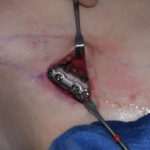
 A 40mm wide iliac plate is inserted and positioned on the side or lateral border of the iliac crest not on top of it. This ensures that increased pelvic width is obtained.The plate only need to be positioned on the widest part of the iliac crest which is the anterior two-thirds of the crest. Three anterior screws are placed through the plate into the bone in a bicortical fashion.
A hooked silicone hip implant is fitted into the hollow chamber of the titanium plate. This prevents any risk of implant migration and implant sag with edge folding. The silicone hip implant pocket is developed at the deep subcutaneous level on top of the deep fascia of the gluteus medius muscle. After a drain is placed soft tissue closure is performed in multiple layers with resorbable sutures. The closure line is covered with micropore tape and a circumferential hip wrap is applied
Postoperative Care
Oral antibiotics are prescribed for a duration of one week after the surgery. The suction drain placed is removed 24 to 48 hours after the surgery. The glued on micropore tapes will remain in place for weeks until they start to loosen and can be removed. The use of the hip wrap is cncouraged until the patient finds it more comfortable on than off. Showering is permitted 48 hours after the surgery once the drain is removed. Immersion in a hot tub, pool, or lake-sea water should be avoided until the incisions are fully healed at one month after the surgery. Patients are advised to avoid strenuous exercise/activities for 6 weeks after the procedure.
Results
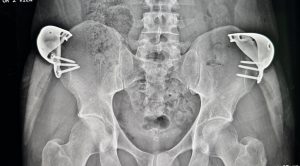 An immediate postoperative x ray was done to check plate and screw position on the bone. The outline of the silicone hip implants could be seen. No infection, seroma or change in implant positions occurred at one year after the surgery.
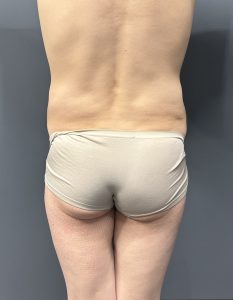
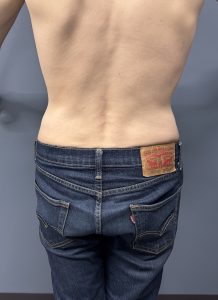
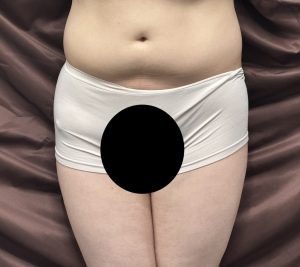
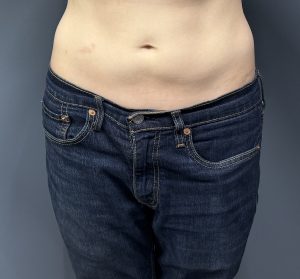 Her hip widening effect was an improvement and the

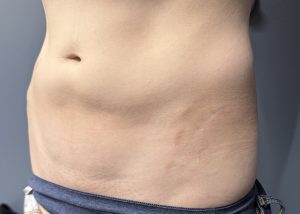 The incisional scars were very minimal and very acceptable to the patient.
Discussion
BBL surgery has spurned a great interest in hip augmentation. Despite a lot of fat injections being done to the hip area a very low percentage of them would be considered highly successful. Unlike the buttocks the hips are a far less favorable site for injected fat survival although the exact biologic reason is unknown. Silicone hip implants are the alternative to fat injections but they have their own unique set of problems. Besides the lack of any standard hip implant to use, which opens the door to a lot of different types of implants being placed which may lead to an increased rate of complications, hip implants are prone to chronic seromas and visible implant edging. These issues are undoubtably related to the use of a deep subcutaneous pocket as the placement of more favorable subfascial or intra/submuscular pockets are not able to be used in the hip area.
Despite the disadvantages of fat injections for hip augmentation it should be the primary WHR procedure provided one has enough fat to harvest to do so. It might be argued that even in cases of questionable fat stores this may still be a good procedure to try since it is an autologous approach.
But there are patients who either have inadequate fat stores or have ‘failed’ BBL surgery that are simply not candidates for autologous fat manipulations. There is no significant fat to harvest or be transferred. In such patients an alternative approach is pelvic bone augmentation which can only be done at the iliac crest level… which is technically the upper hip region.
 The innovative titanium plate design provides an effective lateral iliac crest augmentation that can be performed with a low rate of complications. Subcutaneous dissection along the iliac crest is a safe and direct procedure with no significant neurovascular structures encountered along the way.Because the plate augments only the upper third or skeletal part of the hip it is not unexpected that a hip contour deficiency may be created below it. This would be particularly relevant if the patient has pre-existing hip dips. This has created the need for soft tissue hip augmentation below the plate. This has led to the hooked hip implant design which is an extension of the plate as a two-part hip augmentation system. This allows for an implant of 150ccs volume to fit right up against the underside of the pelvic plate. It is placed through the same incision as the plate. By locking into the plate hip implant stability is assured and inferior edging is largely eliminated because the implant does not have to support its own weight.
Conclusion
While the Pelvic Plasty procedure is innovative, particularly when combined with silicone hip implants, its surgical placement is straight forward with a very low risk of complications seen. In the properly selected patient, it offers permanent visible improvement in the waist-hip ratio that no other surgical technique can reliably provide.
Dr. Barry Eppley
World-Renowned Plastic Surgeon