
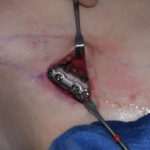
Introduction
Forehead horn reduction is a surgical contouring procedure designed to reduce a localized bony prominence of the frontal bone that can resemble a horn or knob. These prominences have a very characteristic location in the upper lateral region of the forehead and most commonly appear bilaterally. Patients typically seek treatment for cosmetic reasons, particularly because the prominence is noticeable in photographs or profile views.
What Causes a “Horn” on the Forehead?
The most common causes include:
- Frontal bone overgrowth of the congenital frontal eminence, which consistently occurs in the upper lateral forehead.
- Osteomas, which are raised bony growths that differ from forehead horns by being solitary, round, narrow-based, and capable of occurring anywhere on the forehead.
- Prior trauma with subsequent bone remodeling, which can create a broader-based bony prominence.
Because of their distinctive location and frequent bilateral presentation, forehead horns are usually diagnosed clinically. A CT scan can be used to confirm that the prominence is solid bone and to assess its thickness, but imaging is not routinely required for diagnosis.
How Forehead Horn Reduction Is Performed
Surgical Technique
The most commonly used method is burring (shaving) of the bone.
- Reduction is limited to the outer table of the frontal bone
- Bone is carefully reduced using a high-speed surgical burr
- Results are predictable and controlled
Incision Options
- A small frontal hairline incision directly above each horn is preferred, as it provides the most direct access and excellent visibility.
- An endoscopic approach is not effective because bone debris obscures the camera during reduction.
- A direct incision over the prominence is rarely used and generally avoided for cosmetic reasons.
Recovery and Results
- Outpatient procedure
- Most swelling resolves within 7–10 days
- Return to work in less than one week
- Final contour apparent at 6–8 weeks
- Results are permanent
Risks (Uncommon in Experienced Hands)
- Overcorrection or undercorrection
- Contour irregularities
- Asymmetric reduction in bilateral cases
Case Study
 A young male patient sought reduction of prominent bilateral forehead horns. The right horn was larger in both base diameter and projection compared to the left.
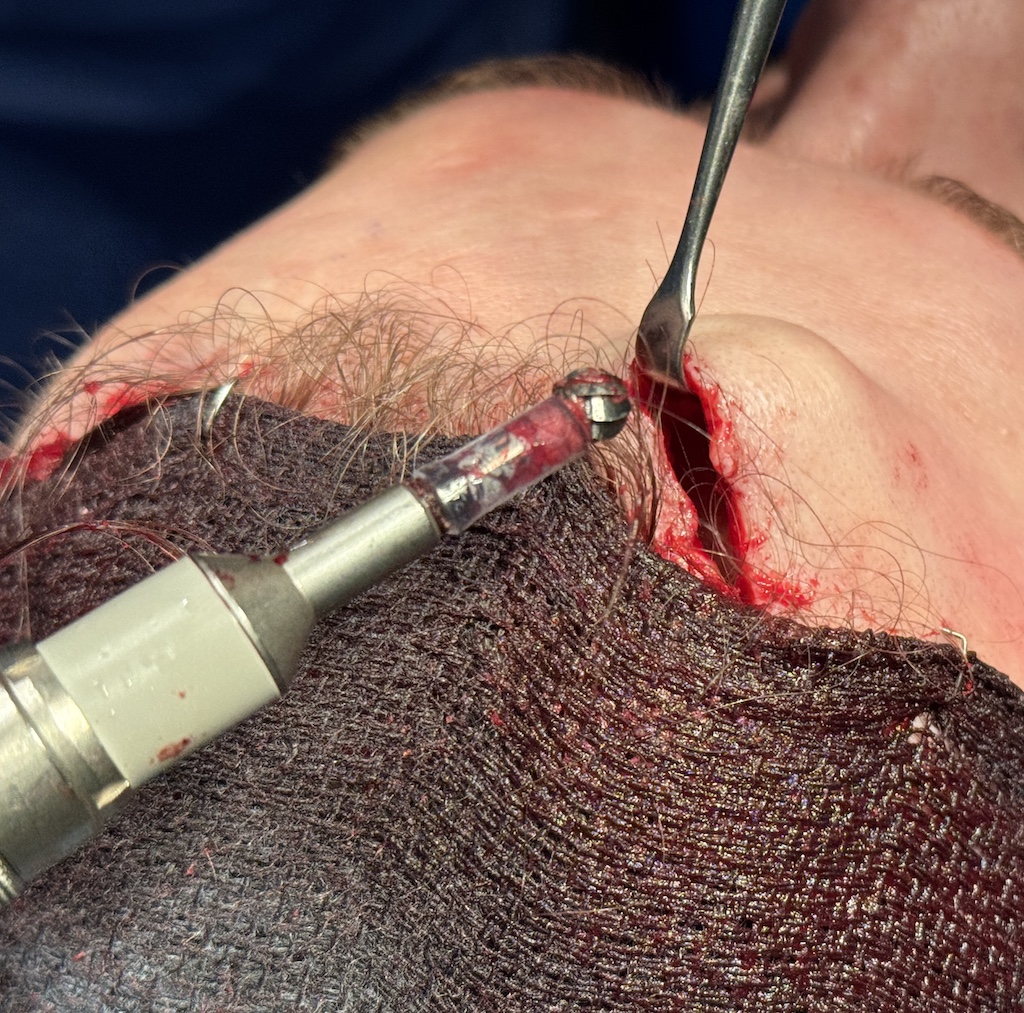
 Through small frontal hairline incisions placed directly above each horn, a guarded high-speed drill set at 5,000 rpm was used to gradually reduce the bony prominences. In some areas, reduction extended into the diploic space.
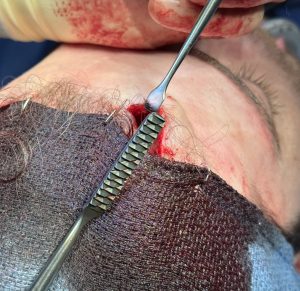 Final contour refinement was performed using a #8 bone rasp. The adequacy and symmetry of reduction were assessed by external palpation and visual inspection through the incisions.
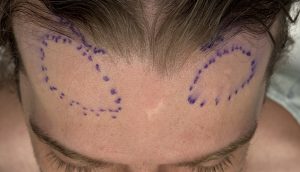
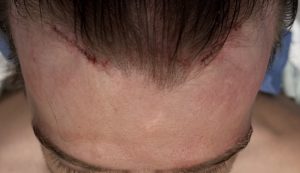
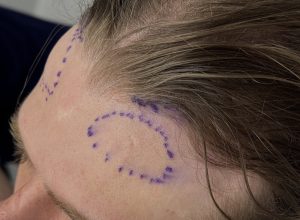
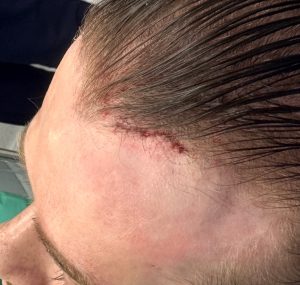 The incisions were closed with small resorbable sutures. No drains were required.
Discussion
Among forehead reshaping procedures, horn reduction is one of the most straightforward for both surgeon and patient due to the localized and limited nature of the bony prominence. These procedures can be considered “spot” forehead reductions. The primary surgical goal is to restore smooth, normal forehead anatomy, which can be reliably achieved through outer-table burring or shaving. The procedure carries a low risk profile, with contour irregularity or undercorrection being the main concerns.
Despite its apparent simplicity, several technical details are critical:
- Because incisions are located at or within the hairline, meticulous hair protection during high-speed burring is essential (e.g., guarded drill shafts and ensuring the shaft is fully within the incision before activation).
- Lower drill speeds help reduce the risk of overcorrection and contour irregularities.
- Final contour smoothing should be performed using large bone rasps.
Key Points
- Forehead horns are typically bilateral and often asymmetric.
- A frontal hairline incision provides optimal access for high-speed burring.
- Hair protection and achieving adequate, smooth reduction are the primary surgical goals.
Dr. Barry Eppley
World-Renowned Plastic Surgeon