
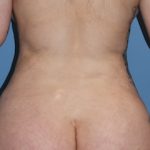
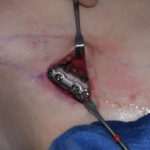
The labiomental fold is an important aesthetic soft tissue component of the chin that is affected by any form of chin augmentation…either favorably or unfavorably. While it may not be the major reason one chooses between the use of any implant or bone movement for their chin augmentation it can have a role to play particularly if one has concerns about its shape befiore surgery.
The following is a direct, fold-focused comparison of chin implant vs sliding genioplasty, written specifically from the standpoint of labiomental fold control, not general chin augmentation.
Bottom line (up front)
If precise control of the labiomental fold is the priority, sliding genioplasty is superior.
Chin implants can work—but only in select anatomic situations and with careful limitations.
1. Mechanism: how each affects the fold
Chin implant
- Works by adding volume anterior and below the fold on the anterior surface of the chin bone
- Does not change muscle insertions
- Relies on soft-tissue stretching over a fixed fold point
 Tends to accentuate or deeped pre-existing folds
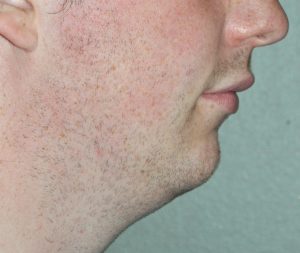
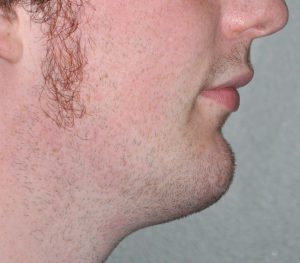 Tends to accentuate or deeped pre-existing folds
Sliding Genioplasty
- Moves the bony platform + mentalis insertion together
- Allows vector control (horizontal, vertical, rotational)
- Alters soft-tissue tension mechanics
- Can soften, maintain, or deepen the fold intentionally
- These difference explains why implants have less predictable effects on the fold
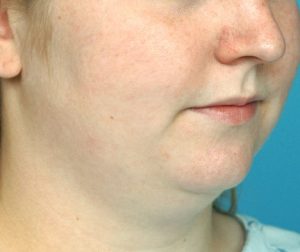
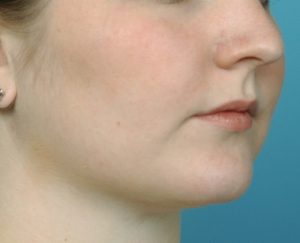 Can soften, maintain, or deepen the fold intentionally
2. Effect on Labiomental Fold Depth
|
Technique |
Fold Outcome |
|
Implant – horizontal only |
Often deepens fold |
|
Implant – vertical height |
Almost always worsens fold |
|
Genioplasty – advancement |
May deepen fold if overdone |
|
Genioplasty – vertical lengthening |
Softens fold |
|
Genioplasty – combined vectors |
Best control |
Key point:
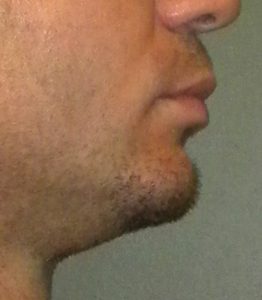
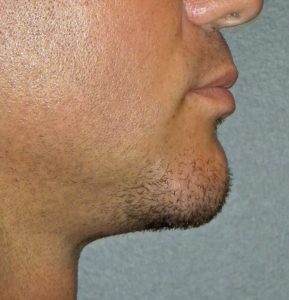 Vertical lengthening—only achievable with genioplasty—is the most reliable way to reduce a deep labiomental crease.
3. Mentalis muscle control
Chin implant
- The insertions of the mentalis muscle is released inferiorly if a submental approach is used and the implant pushes up against the muscle’s origin to the bone
- If an intraoral approach is used the origin of the muscle is cut, the implant pushes out on the muscle and the stretched out muscle must be reattached over these stretched out soft tissues.
- Risk factors:
- Tighter reattachment point
- Increased tension over implant
- Results:
- Tighter soft tissue chin pad
- Potential fold exaggeration/deepening
Sliding Genioplasty
- Mentalis insertion moves with the bone
- Mentalis origin must be cut and reattached
- Bony stepoff can create fold deepening/soft tissue contracture if not grafted
- Lower lip competence could be improved
- Fold often looks more natural in animation
From a muscle physiology standpoint, genioplasty is clearly superior.
4. High-Risk Scenarios for Implants (fold-related)
Avoid implants when:
- Pre-existing deep labiomental fold
- Short lower facial height
- Mentalis strain at rest
- Thin soft tissue envelope
- Need for >6–7 mm projection
- Need for vertical lengthening
These patients are predictable failures from a fold standpoint.
5. When Implants Can Still Work Well
Implants can maintain a good fold if:
- Fold is shallow preoperatively
- Lower face height is normal or long
- Projection needed is modest (?5–6 mm)
- Implant has:
- Minimal vertical height
- Inferior border seating
- Custom designed implant
Even then, fold improvement should not be expected—only preservation.
6. Predictability and Revision Risk
|
Factor |
Implant |
Genioplasty |
|
Fold predictability |
Moderate–Low |
High |
|
Ability to correct deep fold |
Poor |
Excellent |
|
Risk of worsening fold |
High |
Low (if planned well) |
|
Revision difficulty |
Moderate |
Higher, but more definitive |
|
Long-term stability |
Variable |
Excellent |
7. Surgical Planning Pearls (fold-centric)
Evaluate fold in repose and animation
- Short lower face + deep fold = genioplasty
- Use an implant to vertically lengthen the chiin conservatively
- Consider vertical lengthening genioplasty when the length needed is more significant (> 2 to 3mms)
- Mentally plan fold outcome, not just chin position
Practical takeaway
- Implants: acceptable only when the fold is already favorable and the risk is low to deepen iot
- Genioplasty: the only technique that allows intentional control of the labiomental fold from a shallowing effect
If the question is “Which gives me control over the fold?”
? Sliding genioplasty, every time.
Dr. Barry Eppley
World-Renowned Plastic Surgeon