
Introduction
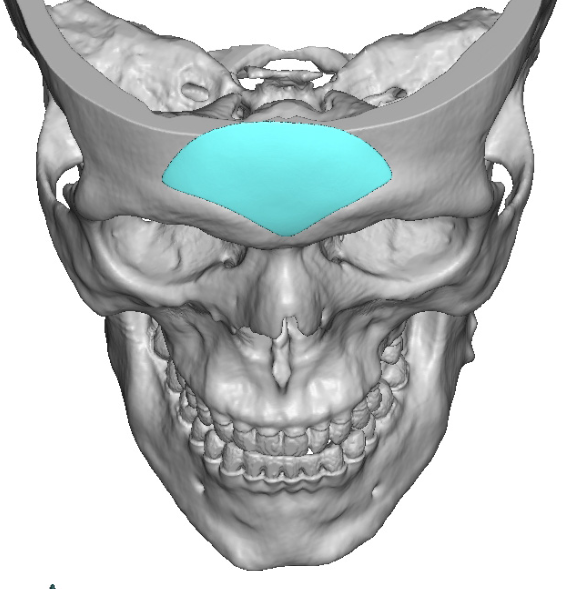
A custom glabellar-forehead implant refers to a personalized facial implant designed to augment the glabellar region (the area between and just above the eyebrows) and potentially the adjacent central forehead to correct flatness, concavity, or lack of projection. While this is typically done as part of aesthetic forehead contouring it is more like the reconstruction of a development forehead defect.
Glabellar vs. Forehead Implants
- Glabellar implant: Focuses on the central brow area between the eyebrows, ideal for flattening or recessed glabella. In essence it is a ‘mini’ forehead implant.
- Custom forehead implant: Designed to address a larger portion of the forehead above the brow region, including central depressions or contour irregularities and usually includes the glabellar area as well,
- In some cases, a custom implant can be designed with extensions that blend into both the glabellar and central forehead region for a combined contouring effect.
Typical Materials & Mechanics
- Such custom implants are made from medical-grade silicone (firm, inert, long-lasting).
- The implant is positioned in a subperiosteal pocket under the scalp through a small incision behind the hairline.
- Because it is custom made it minimizes palpable edges and blends in smoothly into the surrounding forehead bone.
Who Might Be a Candidate
Custom glabellar-forehead implants are often considered when:
- The glabella area shows an overly deep indentation with prominent medial brow bones. (pseudo brow bone protrusion) The central forehead above it is also llacks projection
- Injectable fillers and fat are insufficient for a structural change
- A permanent, structural contour change is desired
Case Study
This middle-aged male had a deep glabellar contour depression (valley) which made his medal brow bone look very prominent. He wanted to soften that appearance by filling in the lower central forehead depression.
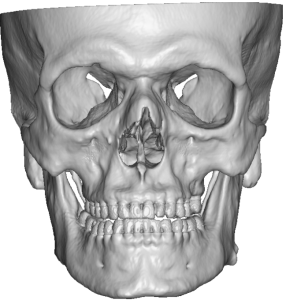
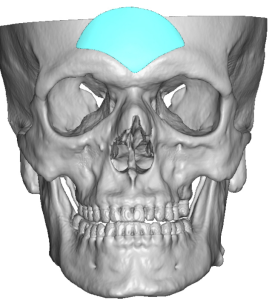
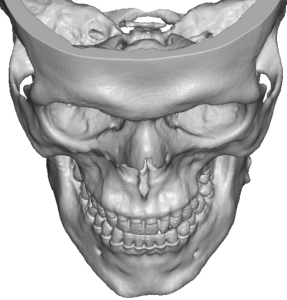
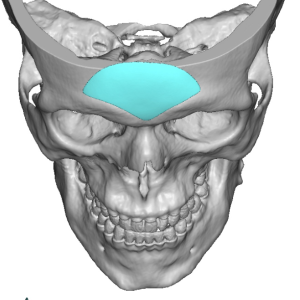 A 3D CT scan was done from which the glabellar valley bone defect was reduced by an implant design. At the depth of the pression the implant thickness was 4.5mms with an implant volume of 3.8ccs.
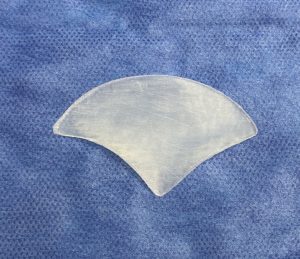
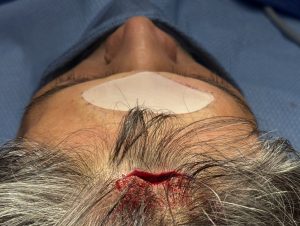 Under general anesthesia and through a small scalp incision behind the front hairline a subperiosteal pocket was created down into the glabellar valley area. The implant was inserted through the incision and positioned as seen in the implant design. Due to the good fit into a defect and its inferior position no screw fixation was used.
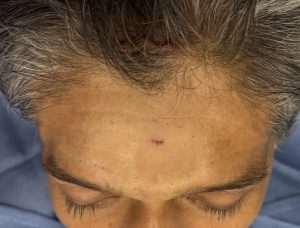 The scalp incision was closed in two layers with resorbable sutures. The reduction in the glabellar valley was immediately apparent.
Discussion
For small isolated forehead contouring, like filling in a glabellar depression, there are different surgical augmentation methods besides a custom implant approach. These include
- Bone cement augmentation can address small depressions but is less precise and usually requires larger incisions.
- Intraoperative hand-carved implants (e.g., ePTFE) can be fashioned during surgery but lack the precision of custom designs.
But even through the glabellar forehead defect is small in size and volume there are numerous benefits of a custom implant approach. These include:
- Maximized control over shape, projection, and symmetry
- Better blending into surrounding forehead contours
- Smaller incision and less tissue disruption compared with intraoperative sculpting materials alone
- Permanent result once correctly placed (no periodic replacement)
- A reshaped implant lessens operative time as the focus is on placement only, it’s shape and effect have been preoperatively determined.
Dr. Barry Eppley
World-Renowned Plastic Surgeon