
Introduction
A direct neck lift is a surgical procedure designed to correct significant neck skin laxity by directly excising excess skin from the anterior neck, rather than relying on indirect skin tightening through a facelift approach.
What It Is
- Excess skin is excised directly from the front of the neck
- The incision is typically placed in the midline of the neck, often following a natural skin crease
- The remaining skin is tightened and closed to create a smoother, improved neck contour
Ideal Candidates
- Patients with severe neck skin laxity, most commonly older individuals
- Patients who are poor candidates for a traditional facelift
- Individuals who prioritize functional and aesthetic improvement over scar concealment
- Commonly performed in male patients with heavy or redundant neck skin
Advantages
- Highly effective for dramatic correction of significant central neck skin excess (“neck wattle”)
- Shorter operative time compared to a full facelift
- Can be performed under local anesthesia in appropriately selected patients
- Directly addresses the primary anatomic problem
Disadvantages
- Presence of a visible anterior neck scar (though it often fades and may be well camouflaged in older male beard skin)
- Does not address jawline contour or lower facial aging as a facelift would
Comparison With Other Neck Procedures
- Traditional Neck Lift / Facelift: Skin tightening from incisions behind the ears, better scar concealment, and overall facial rejuvenation
- Submentoplasty: Small incision under the chin focusing on central neck fat and platysmal muscle management without skin excision
Recovery
- Initial healing typically occurs within 1–2 weeks
- Scar maturation progresses over several months
- Swelling and tightness gradually resolve
Case Study
A 79-year-old male presented with a very large neck wattle that he wished to have removed. His medical history included prior cardiac ablation and chronic anticoagulation therapy. He specifically requested a direct neck lift and fully accepted the trade-off of a visible midline neck scar.
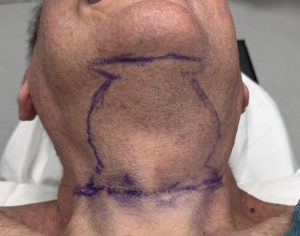
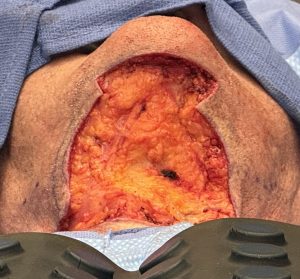
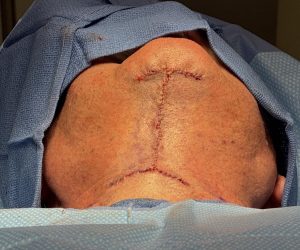 Under general anesthesia, preoperative markings for central neck skin excision were made using an upright pinch test. The excess skin was excised accordingly. Subplatysmal fat was removed, and a midline plication of the widely separated platysma muscle was performed. The neck flaps were advanced medially and closed in an I-shaped pattern using fine resorbable sutures.
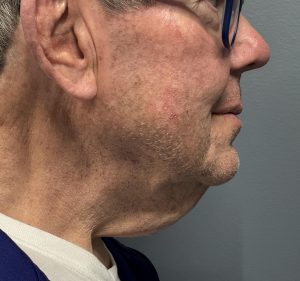
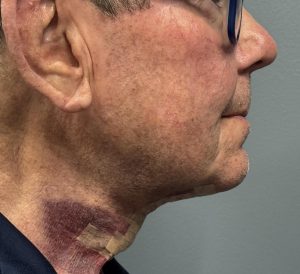 Complete elimination of the neck wattle was evident on postoperative day one. The patient developed significant lower neck bruising due to platelet friability related to prior anticoagulation use, despite discontinuation several days before surgery.
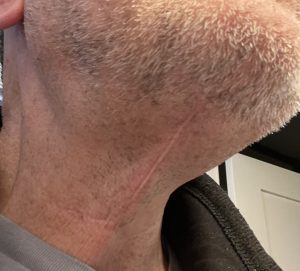 Long-term evaluation demonstrated a stable scar with no banding and only mild hypertrophy. The scar was acceptable to the patient, and he declined any scar revision.
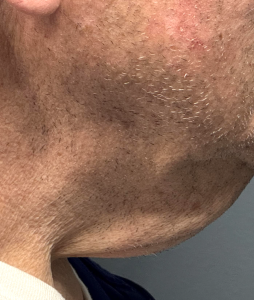
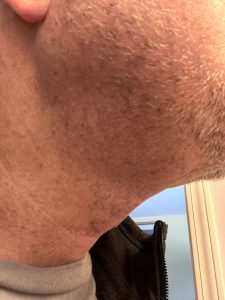 Given the magnitude of neck wattle correction, the scar trade-off was considered well justified.
Discussion
The direct neck lift is often considered the lesser-known cousin of the facelift. It is performed far less frequently due to its more limited indications. However, in properly selected patients, it can provide unmatched correction of severe central neck laxity.
Below is a practical, side-by-side comparison of the Direct Neck Lift versus the Lower Facelift (Lower Rhytidectomy) to guide surgical decision-making.
Primary Goals
Direct Neck Lift
- Direct removal of severe, redundant central neck skin
- Best suited for pronounced “turkey neck” deformities
Lower Facelift
- Repositioning and tightening of the jawline, jowls, and upper neck
- Provides comprehensive lower face and neck rejuvenation
Incisions and Scars
Direct Neck Lift
- Midline anterior neck incision
- Scar is visible but often heals well in older male beard skin
- Trade-off: maximal correction in exchange for a visible scar
Lower Facelift
- Incisions placed around the ears and hairline
- Scars are typically well concealed
- No visible anterior neck scar
Tissue Tightening and Muscle Management
Direct Neck Lift
- Most powerful option for massive central neck skin excess
- Effective even with very poor skin elasticity
- Does not improve jowls or jawline
- Allows unparalleled access for direct platysmal muscle tightening due to wide exposure
Lower Facelift
- Best for mild to moderate neck laxity
- Significant improvement in jowls and jawline
- Harmonizes the neck with the lower face
- Effective platysmal management through limited submental access and posterolateral skin redraping
Anesthesia and Operative Time
Direct Neck Lift
- May be performed under local anesthesia in select patients
- Shorter operative time
Lower Facelift
- Typically performed under general anesthesia or deep sedation
- Longer operative time, especially with extended SMAS or deep plane techniques
Ideal Patient Selection
Direct Neck Lift
- Severe neck skin laxity
- Older patients
- Males with heavy neck skin
- Patients unconcerned with a visible scar
- Medically limited patients requiring a shorter operation
Lower Facelift
- Mild to moderate neck laxity
- Prominent jowls or jawline blunting
- Patients prioritizing scar concealment
- Those seeking balanced facial rejuvenation
Recovery Comparison
Direct Neck Lift
- Faster early recovery
- Long-term focus on scar maturation
Lower Facelift
- More initial swelling and bruising
- Longer overall recovery but no anterior neck scar
Bottom Line
A Direct Neck Lift is the procedure of choice when the primary issue is excess central neck skin and the patient prefers a shorter, more limited operation and accepts a midline neck scar. This is most commonly the case in older male patients (typically over age 65).
A Lower Facelift is preferred when improvement of the cheek, jawline, and neck is required and scar concealment is a major priority—most commonly in female patients and many males.
Barry Eppley, MD, DMD
World-Renowned Plastic Surgeon