

Introduction
Nostril base lowering refers to surgical maneuvers that reposition the base of the nostril (alar base and nostril sill) to a lower position on the upper lip. This technique is distinct from alar rim lowering and is performed far less frequently. However, in carefully selected patients, it can be a highly effective solution for specific nasal base deformities.
Indications for Nostril Base Lowering
Nostril base lowering is designed to address:
- Nostrils positioned too high relative to the upper lip
- Excessive nostril show on frontal view
- An “over-rotated” or short-nose appearance
- Vertical asymmetry in which one nostril base sits higher than the other
- Secondary deformities following prior rhinoplasty
Surgical Technique
Nostril base lowering is technically challenging due to the limited amount of allowable skin excision and the need to conceal scars within natural facial junctions. The amount of skin removed must precisely match the millimeters of lowering required. Surgical release of the alar base attachments is necessary, followed by controlled inferior repositioning of the alar base. Closure is performed meticulously to maintain nostril shape and symmetry.
When Direct Base Lowering Is Avoided
Direct nostril base lowering may not be appropriate in patients with:
- Thin skin and a high risk of visible scarring
- A known tendency toward hypertrophic or unfavorable scarring
- Minor nostril show that can be corrected through tip support or rotation alone
Risks and Limitations
Potential risks and limitations include:
- Visible scarring at the alar–facial junction
- Nostril distortion if excessive lowering is performed
- Residual or new asymmetry
- A limited amount of safe correction, typically only a few millimeters
Typical Candidates
Appropriate candidates often include patients with:
- Congenital nasal base asymmetry with differing vertical nostril base levels
- Elevated nostril bases following prior nostril narrowing procedures
- Nasal base asymmetry related to paranasal augmentation
Case Study
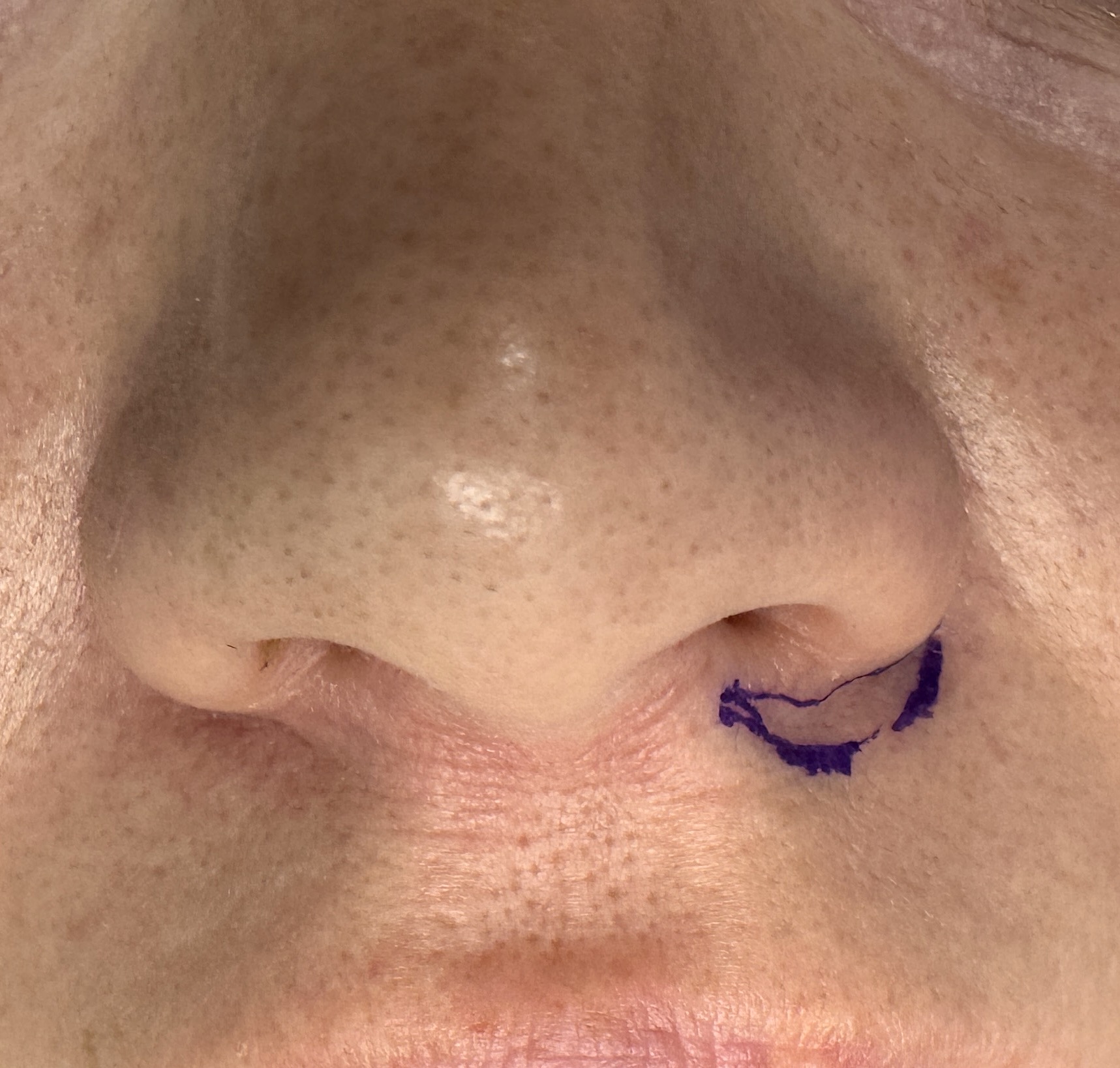
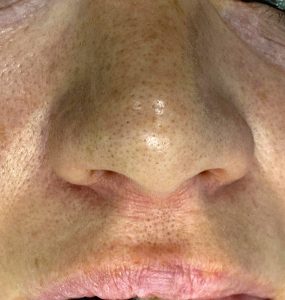 This female patient sought correction of a left-sided nasal base asymmetry, with the left nostril base positioned higher than the right. Although she had previously undergone rhinoplasty, the asymmetry was congenital and present both before and after her prior nasal surgery.
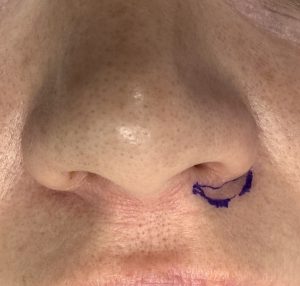
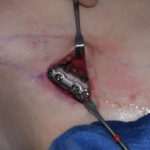
 A small crescent-shaped excision was designed using the alar–facial junction as the superior margin. After removal of the marked skin segment, the nasal base was released, repositioned inferiorly to the lower skin edge, and closed with fine resorbable sutures.
Discussion
Nostril base lowering is performed far less frequently than nostril narrowing (alar base reduction). While both procedures involve movement of the nostril base, they do so in fundamentally different directions.
Goals of Nostril Base Lowering
- Moves the entire nostril base downward
- Corrects nostrils positioned too high on the face
- Addresses vertical asymmetry between nostrils
- Alters the vertical position of both the alar base and nostril sill
Goals of Alar Base Reduction (Nostril Narrowing)
- Moves the nostrils inward
- Narrows an excessively wide nasal base
- Reduces nostril flare
- Decreases excessive alar width, particularly on smiling
- Corrects nostrils extending beyond the medial canthi
Scarring Considerations
Nostril Base Lowering
- Higher risk of visible scarring
- Scars may distort nostril shape if overcorrected
Alar Base Reduction
- Scars are typically well concealed within the alar–facial crease
- Generally more forgiving when properly designed
What These Procedures Do Not Do
- Nostril base lowering does not narrow the nostrils
- Alar base reduction does not lower the nostrils
Key Surgical Principle
Alar base reduction is a common and relatively forgiving procedure.
Nostril base lowering, by contrast, is uncommon, technically demanding, and allows only limited degrees of safe correction.
Barry Eppley, MD, DMD
World-Renowned Plastic Surgeon