
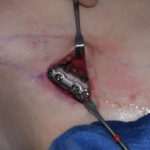
Aesthetic augmentation of the lower jaw can be incomplete or complete. Incomplete augmentation is isolated chin or jaw angle augmentation for which there are standard implant styles for each to do so. Complete jaw augmentation involves the entire jawline (chin + jaw angles + mandibular body)) where numerous implant options are available.
What “standard” jaw augmentation usually means
Typically this is:
- Chin implant (preformed sizes/styles)
- Jaw angle implants (left/right, preformed)
- Sometimes a third mandibular body implant may be placed between the two but there are no standard implants to do so (hand carved in surgery)
Strengths
- Readily available (off-the-shelf)
- Lower cost than custom
- Effective for modest jaw augmentation effects (e.g., weak chin + underprojected angles in a fairly symmetric face)
- Easier revisions/size changes/replacements
Limitations (especially for “total jaw” goals)
- Creates “points,” not a continuous jawline: angles can look stronger, but the jaw body (between chin and angles) may still look flat.
- Fit is generic ? more reliance on intra-op shaping, positioning, and soft-tissue stretch.
- More visible edges/step-offs in lean patients or those wanting a crisp mandibular border.
 Much higher risk of postoperative implant asymmetry as each implant is not keyed to the other one during placement
- Harder to correct asymmetry (most faces have some).
 Much higher risk of postoperative implant asymmetry as each implant is not keyed to the other one during placement
What “custom jawline implant” usually means
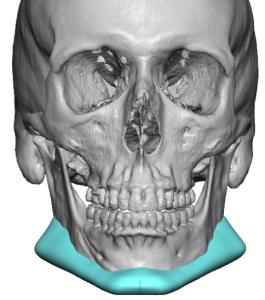
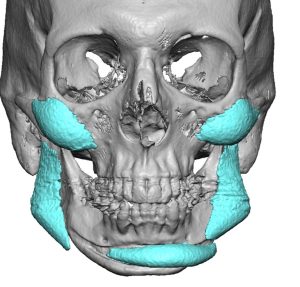
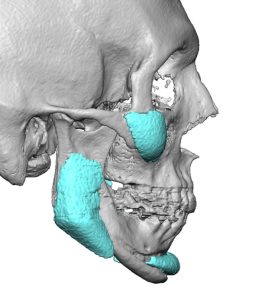
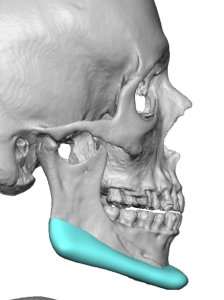 A single continuous implant (or a 2–3 piece system) designed from CT/3D planning to address:
- Chin (symphysis)
- Mandibular body/border (the “jawline” segment)
- Angle/ramus region
…all in one cohesive geometry.
Strengths
- Best for “total jawline change” (a continuous, connected mandibular border)
- Exact fit to your bone ? less guesswork, fewer edge issues when done well
- Better control of shape: width vs length, taper, definition, gonial flare, chin width/shape, etc.
- Best option for asymmetry correction
- Often more stable positioning because the implant “keys in” to anatomy
Limitations
- More expensive
- Longer lead time (CT ? design ? manufacture)
- Design matters a lot: a bad design can give an unnatural “helmet jaw,” over-widening, or a square look when you wanted sleek.
- Revision can be more complex than swapping a standard implant (though still doable)
Which tends to look better?
If the goal is truly “total jaw augmentation”—a stronger chin and a more defined jawline from front to angle—custom jawline implants usually win aesthetically, because they can blend the entire mandibular border rather than creating separate highlights (chin + angle) with a flat mid-body.
The question is never whether a custom jawline implant is better than the use of standard implants, as it always is. The more pertinent question is how close or far from a custom implant result can the use of standard implants achieve. That answer will vary for each individual patient.
Who is a good candidate for each?
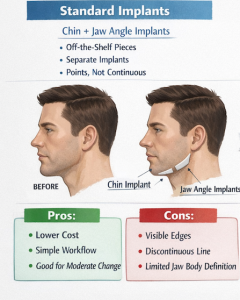 Standard chin + angle implants can be effective if:
- Only a moderate jaw augmentation effect is desired
- No preoperative jaw or facial asymmetry is evident
- A smooth linear jawline is not needed (no connection between the chin and jaw angles
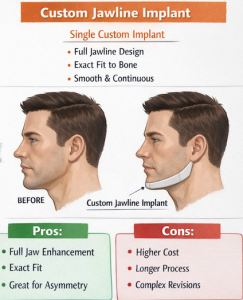 Custom jawline implants are usually better if:
- A major jawline transformation is desired
- Strong shape changes at the chin and jaw angles is needed
- Jaw angle asymmetry or uneven angles exists
- A smooth continuous or connected jawline look is important
- Desire to control or have knowledge of the exact dimensions of the implant.
- Want to see the implant on the facial skeleton before surgery
Surgical “realities” that matter either way
- Soft tissue thickness and skin quality can limit how sharp results look.
- Masseter muscle size affects angle visibility (some people need consideration of hypertrophy vs deficiency).
- Occlusion/skeletal base: if there’s a significant bite/jaw discrepancy, sometimes orthognathic surgery (or genioplasty) gives a better foundational change than implants alone.
- Genioplasty vs chin implant: sliding genioplasty can be better for certain vertical/3D chin changes; implants are great for projection/shape but may have limitations caused by the tightness of the overlying soft tissue chin pad
Quick decision shortcut
- If your mental picture is “stronger chin + slightly stronger angles” ? standard can be enough.
- If your mental picture is “a new jawline from front to back” ? custom is usually the right tool.
Dr. Barry Eppley
World-Renowned Plastic Surgeon