
Introduction
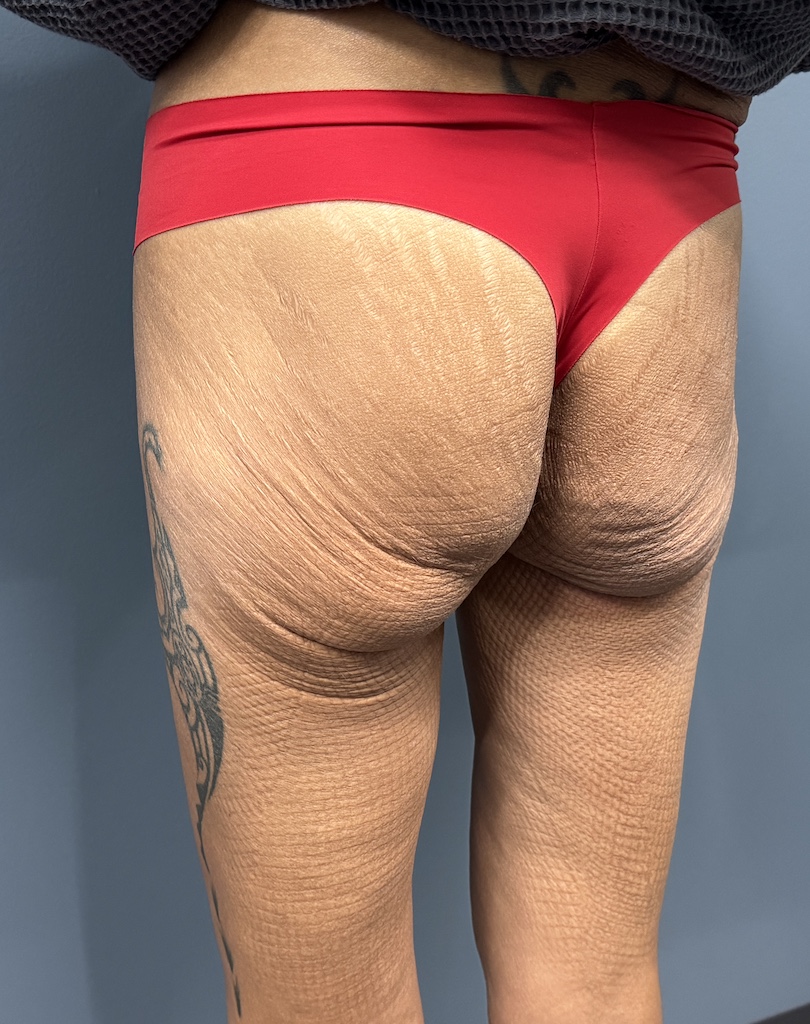
A lower buttock lift is a body-contouring procedure designed to tighten and elevate sagging tissue in the lower portion of the buttocks, particularly at the junction where the buttock meets the upper thigh (the infragluteal or buttock crease).
Indications
A lower buttock lift is used to address:
- Loose or sagging skin of the lower buttock
- A droopy or flattened appearance below the buttock crease
- Skin laxity following weight loss or aging
- Poor definition of the buttock–thigh transition
Surgical Concept
The procedure focuses on lift and contour, not volume.
- Excess skin and superficial fat are removed from the lower buttock
- The remaining tissue is elevated and tightened
- The incision is placed within or just above the natural buttock crease to remain well concealed
- Volume enhancement (fat grafting or implants) is performed separately if needed
What the Procedure Does Not Do
- It does not add volume to the buttocks
- It does not reshape the upper buttock (this requires an upper buttock lift or Brazilian Butt Lift)
Risks and Considerations
- Wide or hypertrophic scarring, occasionally requiring revision
- Localized wound-healing issues in the crease during early recovery
- Crease asymmetry or residual looseness
- Best outcomes occur in patients with stable weight and reasonable skin quality
Case Study
A thin female patient experienced significant weight loss and subsequently developed marked lower buttock laxity with inferior migration of the infragluteal fold. Her upper buttocks were also notably flat. A two-stage approach was planned: a first-stage lower buttock lift followed by buttock implants three months later.
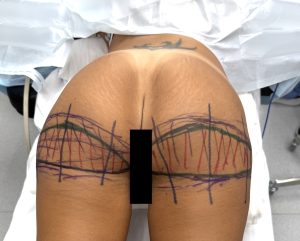
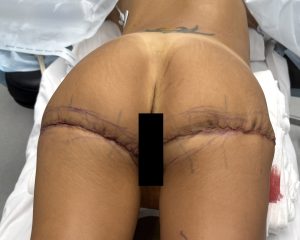 With the patient in the prone position under general anesthesia, a wide, extended lower buttock excision was performed. Closure involved elevating the inferior buttock and upper posterior thigh tissue to re-establish a more defined infragluteal fold.
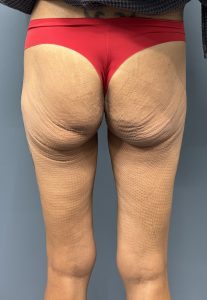
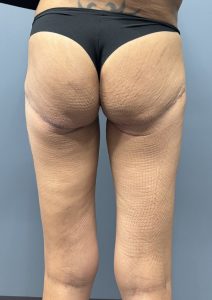
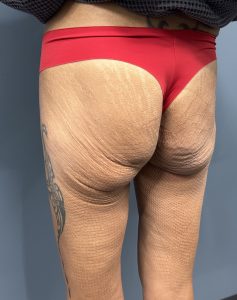
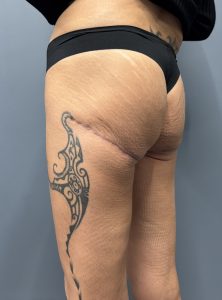
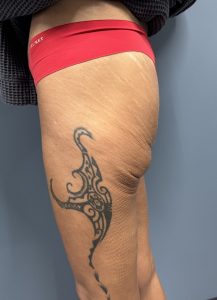
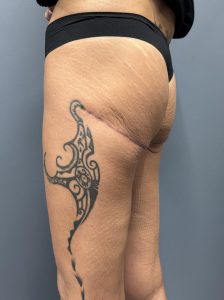 At three months, when she returned for the second-stage buttock implant procedure, there was clear improvement in the shape of the lower buttocks. The infragluteal scars were still red, as expected, given their early stage of maturation.
Discussion
Goals of the Lower Buttock Lift
- Correct inferior buttock ptosis (“bottoming out”)
- Recreate or sharpen the infragluteal fold
- Improve definition of the buttock–thigh junction
Lower buttock ptosis most commonly results from weight loss, during which tissue laxity and inferior descent of the buttocks develop.
Surgical Technique
Preoperative Markings
Markings are critical and must be performed with the patient standing.
Infragluteal fold
- Identify the true native fold, not the migrated crease
- The incision is typically placed slightly superior to the existing fold
Skin excision pattern
- Crescent or elliptical excision
- Typical width: 2–5 cm, depending on laxity
- Conservative markings are essential to avoid over-resection and excessive tension
Lateral extent
- May extend toward the posterior thigh or lateral buttock as needed
- Excessive lateral extension should be avoided to prevent scar migration
Patient Positioning
- Prone position
- Hips slightly flexed to reduce closure tension
- Careful padding to prevent pressure injury
- Buttocks may be gently taped apart to improve fold visualization
Operative Steps
1. Incision and Skin Excision
- Incision made along the pre-marked infragluteal line
- Full-thickness excision of skin and superficial subcutaneous fat
- Dissection remains superficial to the deep fascia
Key Point:
This is a direct excision skin–fat lift, not a deep flap procedure. Aggressive undermining should be avoided.
2. Anchoring / Suspension (Critical Step)
This is the defining step for long-term durability.
- The superior buttock flap is anchored to deep fascia:
- Gluteal fascia
- Deep investing fascia over the hamstrings or ischial region
- Interrupted permanent or long-lasting sutures are used
These sutures must:
- Bear tension
- Offload the skin closure
- Re-establish a stable infragluteal fold
Failure to anchor deeply is the most common cause of early recurrence.
3. Fold Recreation
- The dermis or Scarpa’s fascia is secured to deep fascia
- This creates:
- A crisp buttock–thigh junction
- Prevention of scar descent onto the posterior thigh
Surgeons often underestimate that structural support—not skin removal—determines success.
4. Closure
Layered closure is mandatory:
- Deep fascial anchoring sutures (tension-bearing)
- Deep dermal sutures
- Subcuticular skin closure
Drains are optional.
Skin closure must be tension-free.
Postoperative Management
- Limit prolonged sitting initially
- Avoid excessive hip flexion for 2–3 weeks
- Compression garments if combined with body contouring
- Scar maturation takes months; properly placed infragluteal scars typically conceal well
Common Pitfalls and Complications
- Inferior scar migration onto the posterior thigh
- Recurrent ptosis due to inadequate deep fixation
- Widened scars from excess tension
- Contour irregularities from uneven excision
- Patient dissatisfaction when volume enhancement was expected
Buttock Volume Enhancement
- Fat grafting can be safely performed concurrently without significantly increasing recovery
- Implant augmentation should always be delayed to a second stage, as simultaneous placement increases recovery difficulty and the risk of scar widening
Key Takeaways
- This is a structural lift, not a skin-tightening procedure
- Deep fixation determines longevity
- Conservative excision minimizes complications
- Optimal results often require volume enhancement, either with fat grafting or staged implants
Barry L. Eppley, MD
World-Renowned Plastic Surgeon