
Introduction
There are two primary implant concepts used for testicular enlargement: wraparound implants and side by side (displacement) implants.
The side?by?side technique uses a solid testicular implant placed adjacent to the natural testicle. Implant size is determined by how much volume is required to adequately displace the native testicle.
The wrap?around technique uses an implant that partially or fully envelops the natural testicle. These implants are subdivided into:
- Partial wraparound (cupped) implants
- Full wraparound implants
This case study evaluates a patient who was dissatisfied with the outcome of a cupped wraparound implant and elected to undergo conversion to a solid side by side displacement implant.
Case Study
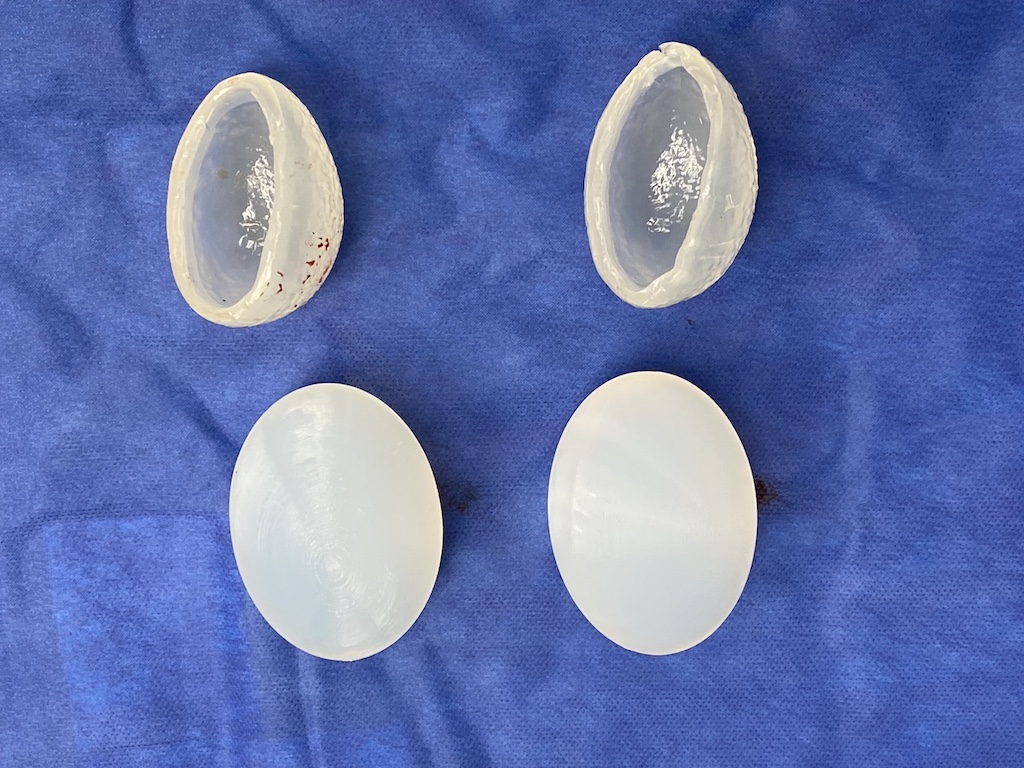
This middle-aged male had a prior history of bilateral cupped testicular implants for aesthetic enlargement. Although he did not experience implant detachment, he was dissatisfied with the outcome due to:
- A desire for greater testicular size
- Palpability of the implant edges
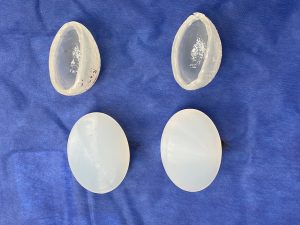
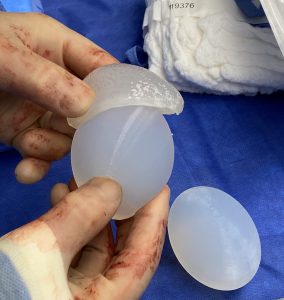 The cupped implants were surgically removed and replaced with custom 7.0cm solid silicone testicular implants using the side?by?side displacement technique.
At one year follow-up, the patient demonstrated:
- Noticeable improvement in overall scrotal size
- Smooth contour without palpable edges
- A well healed midline scrotal incision
Discussion
While both implant techniques can be effective, they differ significantly in design, biomechanics, and ideal indications.
Cupped (Partial Wraparound) Testicular Implants
Cupped implants are half shell devices that encompass approximately 180 degrees of the native testicle. As the name suggests, the implant functions like a cup, leaving half of the natural testicle exposed.
Advantages
- Conceptually intuitive — uses the native testicle as a structural scaffold
- Can provide a modest increase in apparent testicular size
Disadvantages and Limitations
- Risk of separation: Despite fixation techniques, detachment from the native testicle may occur postoperatively
- Edge palpability: The transition edge of the implant may be felt or seen
- Limited enlargement: Since the native testicle defines most of the final volume, dramatic size increases are not possible
Best suited for: Patients seeking mild to moderate enlargement with acceptance of limited long?term predictability.
Solid Side by Side (Displacement) Testicular Implants
Solid side?by?side implants are custom silicone devices placed adjacent to the natural testicles. The native testicles are intentionally displaced upward and/or posteriorly behind the implants.
Advantages
- No risk of implant-testicle separation, as nothing is wrapped around the native testicle
- Capable of substantially larger size increases through custom fabrication
- Solid silicone construction eliminates risk of mechanical failure
- Softer feel compared to cupped implants due to internal hollow chamber design
Critical Technical Consideration
To prevent a visible “four testicle” appearance (two natural testicles plus two implants), the implants must be at least 50–75% larger than the native testicles. Insufficient implant size will fail to fully displace the natural testicles, making them visible or palpable.
Disadvantages and Limitations
- Requires custom implant sizing; standard prosthetic sizes are inadequate for displacement
- Incorrect sizing risks incomplete displacement and aesthetic compromise
Side?by?Side Comparison
|
Feature |
Cupped / Wrap?Around |
Solid Side?by?Side |
|
Attachment to native testicle |
Yes |
No |
|
Risk of separation |
Higher |
None |
|
Maximum size potential |
Modest |
Large, customizable |
|
Edge palpability |
Possible |
Smooth contour |
|
Suitable for significant enlargement |
No |
Yes (preferred) |
Summary
Cupped testicular implants provide a moderate cosmetic enhancement by partially enveloping the native testicle but are limited by edge palpability, separation risk, and restricted size potential.
Solid side by side implants rely on displacement rather than attachment, allowing for substantially larger and more predictable enlargement outcomes. When properly oversized relative to the native testicle, they offer superior contour, stability, and patient satisfaction.
Clinical Considerations
- Implant sizing is critical, particularly for side by side displacement, to avoid a four testicle appearance
- Both techniques require thorough preoperative counseling regarding aesthetic goals and limitations
- Solid displacement implants require custom manufacturing due to size requirements
Dr. Barry Eppley
World-Renowned Plastic Surgeon