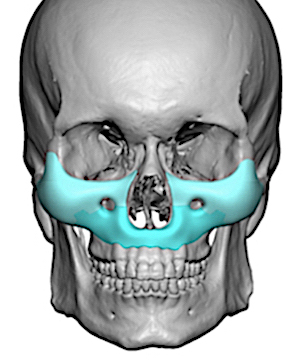
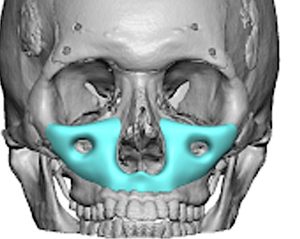
 Custom midface mask implants are a specific subtype of custom facial implants that act as a single, continuous skeletal “overlay” for the central face rather than separate cheek or infraorbital pieces. Think of it as a one-piece midface framework that sits on top of the maxilla and along the infraorbital rims and cheeks.
What a “midface mask” implant is
A custom midface mask implant:
- Is designed from a 3D CT scan
- Covers the infraorbital rims + malar bodies + paranasal/maxillary region
- Functions as a continuous facial skeleton augmentation
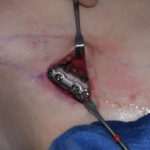
- Is screw-fixated to bone
- Primary effect is forward projection, lateral cheek width augmentation can be included but often is not a primary objective or may not be wanted at all.
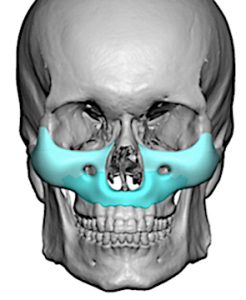 It’s essentially a structural advancement of the midface without moving the bones.
Key indications
Best used for patients with:
- Global midface hypoplasia
- Flat central face with poor cheek + paranasal support
- Negative vector midface (eye projects more than cheek)
- Long-standing tear trough deformity due to skeletal deficiency
- Patients not wanting orthognathic surgery but needing multi-zone correction
What it improves (aesthetically & structurally)
- Under-eye support (infraorbital rim)
- Tear trough depth
- Cheek projection (malar body)
- Nasolabial fold support
- Paranasal hollowing
- Overall facial convexity
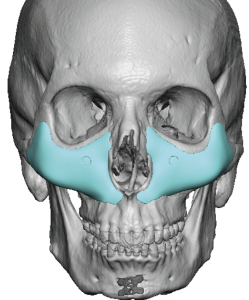 Because it’s one continuous implant, it:
- Eliminates step-offs between implants
- Maintains smooth contour transitions
- Improves placement and symmetry control
Design characteristics
Custom design allows control of:
- Forward projection of the entire midface(most critical)
- Vertical height of the infraorbital rim
- Malar prominence (avoid over-round cheeks)
- Paranasal thickness
- Edge feathering for invisibility
- Can be designed as one or two pieces
Typical thickness ranges:
- 2–4 mm infraorbital
- 3–6 mm malar/paranasal
(varies by anatomy and goals)
Materials
Most commonly:
- Silicone (preferred for mask implants)
- Easiest placement with less risk of infraorbital nerve injury
- Precise geometry
- Feathered edging
- Excellent for large, thin, multi-zone constructs
- Can be intraoperratively modified/adjusted if needed
- Most cost-effective material
Surgical approach
- Intraoral incision for maxillary/paranasal portion
- Lower eyelid incision (subciliary or transconjunctival) for infraorbital rim placement (uncommonly needed
- Multiple screw fixation points
- May be combined with:
- Buccal fat flap transposition for coverage
Advantages over separate implants
 Better structural continuity
- Stronger midface support
- Less risk of visible implant edges
- More predictable aesthetic outcome
- Ideal for severe or global deficiency
 Better structural continuity
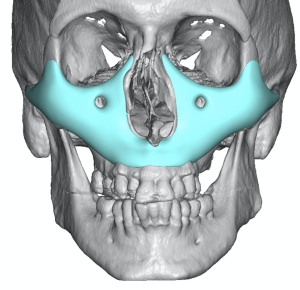
The midface mask implant illustrates the benefits of a custom design process where large facial skeletal areas can be augmented previously thought only possible by bone movements with less risk and better aesthetic outcomes wbile still being reversible.
Dr Barry Eppley
World-Renowned Plastic Surgeon