
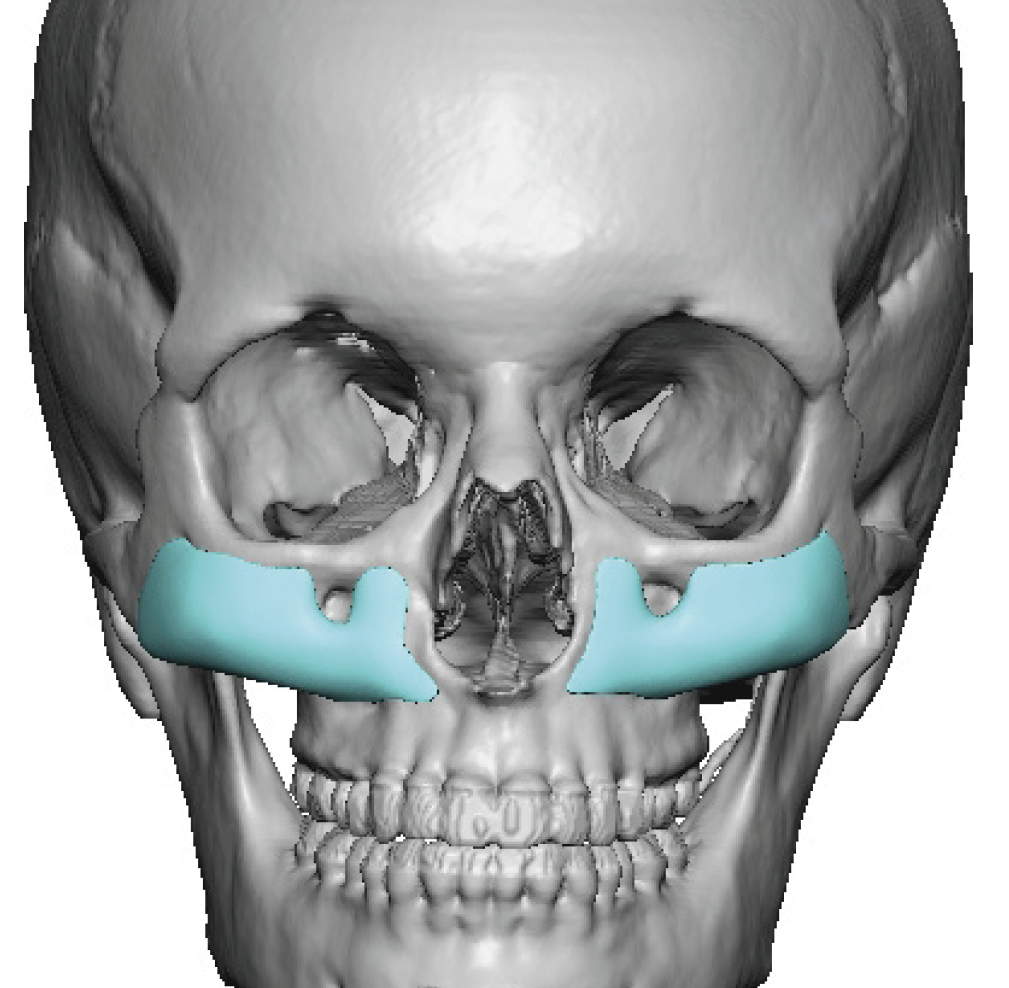
Cheek implants are a well known permanent facial augmentation method that was originally developed for true skeletal deficiencies. Such congenital or developmental deficiencies include:
- Flat or under-projected cheekbones
- Poor midface projection despite normal weight
- Long faces
- Class II skeletal patterns
- Patients with weak zygomatic prominence
- Sunken mid faces
- Cheek volume loss
- Cheekbone asymmetries
Implants restore or create increased structural projection, which fillers can’t permanently or predictably do.
While effective for many patients there is a need for revisional surgery in some patient for cheek implant removals or replacements. Such revisional cheek implant surgery is rarely about the device itself; they’re almost always about indication, placement, and expectation management.
Why Cheek Implant Revisions/Removals Happen
1. Improper Implant Style
Why it happens
- The different types of cheek implants and their use is often not well understood.
- Inadequate understanding of the patient’s desired cheek augmentation effects (no preoperative imaging)
- Cheek implants are viewed as simple surgery with a unisexual approach
Result:
Patient with an unnatural or unexpected result. An implant that does not fit the face.
1. Implant Malposition (Too Low, Too Anterior, or Too Lateral)
Why it happens
- Submalar implant placed too inferiorly ? “chimpanzee” or swollen look
- Over-anterior placement ? chipmunk cheeks
- Lateral edge not seated on zygomatic body ? visible step-off
Result:
Patient feels bulky, unnatural, or asymmetrical—even if others can’t articulate why.
2. Implant Oversizing
Why it happens
- “More is better” mentality
- Patient asks for dramatic change
- Surgeon underestimates how little projection is needed
Result:
- Masculinization in women
- Permanent “made-up” look
- Patient tires of the result over time
3. Soft-Tissue Mismatch Over Time
Why it happens
- Face continues to age
- Implant stays fixed while soft tissues descend
- Creates the illusion the implant is “moving” (it’s not)
Result:
- Lower eyelid issues
- Worsening nasolabial folds
- Implant becomes more obvious with age
4. Implant Edge Visibility or Palpability
Why it happens
- Thin skin
- Thin subcutaneous fat
- Poor implant selection or positioning
Result:
Patient can feel or see edges ? constant awareness ? dissatisfaction
5. Implant Infection or Chronic Inflammation
(Least common but can happen))
Why it happens
- Intraoperative inoculation/contamination
- Hematoma
- Prior filler or biofilm issues
Result:
Persistent swelling, pain, or infection ? removal
6. Psychological / Expectation Mismatch
Why it happens
- Patient expected implants to:
- Change identity
- Fix aging
- Replicate filtered photos
- Difficulty articulating goals
Result:
Technically fine result ? emotionally unacceptable ? removal request
Big Picture: Cheek Implant Revisions
Most revisions happen:
- 1–5 years post-op
- After the “newness” wears off
- As the face continues to age
- When expectations evolve
Very few are immediate technical failures.
Case Study
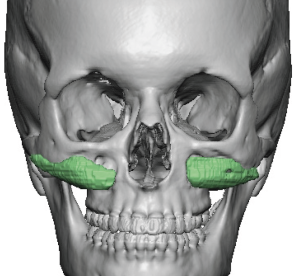
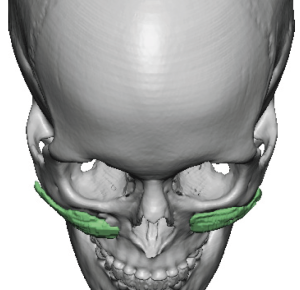 This patient had cheek implants placed previously which gave her an overly full/puffy midface appearance which was not her goal. She lived with it for awhile and then decided to seek a change. A 3D CT scan showed submalar cheek implants that had been placed under the infraorbital nerve in the central midface. There were multiple areas of bony overgrowths which is unusual for cheek implants.
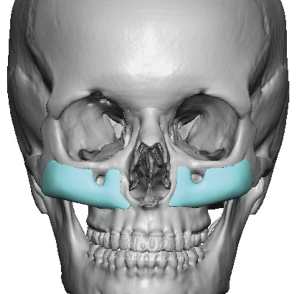
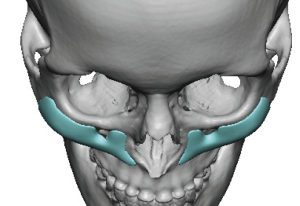 Custom midface implants were designed that covered the similar midface area but with a concave shape rather than a convex one that the standard cheek implants had. The implant design also flowed smoothly into the medial paranasal and lateral anterior malar area.
In effect the custom midface implant takes the natural shape of the bone and expands it forward by a few millimeters creating an increased but natural augmentation effect.
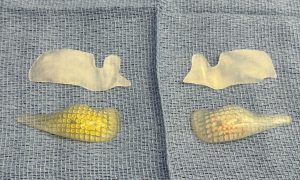
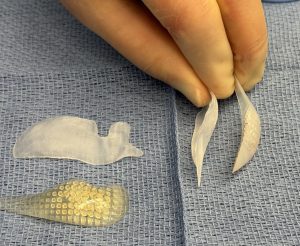 In replacing the standard cheek implants with the custom midface implants the significant change in the shape of the implant (concave rather than convex) could be appreciated by comparing their side profiles.
In this case the standard cheek implants failed because of reason #1…not a good shape or style for the augmentation effect the patient was seeking.
Discussion
In comparing custom midface implants versus standard cheek implants — including how they differ in design, surgical planning, indications, and outcomes.
1. What They Are
Standard Cheek Implants
- Pre-manufactured “off-the-shelf” implants in set shapes and sizes (e.g., malar, submalar).
- Generally made of silicone or other common materials and inserted intraorally.
- Designed to augment the cheekbone region only — projecting forward or downward in a limited anatomical area.
- While often placed in adjoining maxillary areas the aesthetic effect may be undesired.
Custom Midface Implants
- Individually designed based on a patient’s 3D CT scan to match their bone anatomy and aesthetic goals.
- Can span multiple adjoining midface zones — cheek, infraorbital rim, maxilla, and zygomatic arch — depending on the design.
- Aim to create a more comprehensive midfacial augmentation rather than a “spot” cheek effect.
2. Differences in Fit & Aesthetics
Fit to Anatomy
- Standard cheek implants are “one size fits many.” Surgeons select a size/style that best matches the patient, but the fit is inherently less precise.
- Custom implants are tailored to the exact 3-D bone contours, improving conformity and symmetry.
Surgical Precision & Predictability
- Standard implants rely more on intraoperative positioning and surgeon judgment for symmetry.
- Custom implants allow preoperative planning and simulation, often resulting in more predictable 3-D changes.
Aesthetic Outcome
- Standard implants mainly enhance anterior cheek projection (e.g., fuller cheeks).
- Custom designs can add projection at different heights and planes — e.g., high cheekbones, infraorbital support, or even help with under-eye hollows when needed.
- They can also avoid undesired effects (e.g., “apple cheek” fullness) that standard implants might produce, especially in male aesthetic goals.
3. Cost & Planning
Standard Implants
- Lower cost — no CT scan requirement or custom fabrication.
- Readily available and simpler to schedule surgically.
Custom Implants
- Higher cost and longer lead time, due to imaging, 3D modeling, and custom manufacturing.
- Planning time includes virtual design sessions and vendor fabrication.
4. When Each Is Typically Used
Standard Cheek Implants
? Mild to moderate cosmetic cheek enhancement
? Patients with symmetrical facial bones
? First-time cheek augmentation with predictable goals
? Limited budget or preference for simpler surgery
Custom Midface Implants
? Complex midface deficiencies (e.g., flat midface or underdeveloped midface skeleton)
? Asymmetry or skeletal irregularities not well addressed by stock shapes
? Desire for precise contours, high cheekbone definition, or undereye support
? Revision cases after unsatisfactory standard implants
5. Pros & Cons at a Glance
|
Feature |
Standard Cheek Implants |
Custom Midface Implants |
|
Fit precision |
Moderate |
Excellent |
|
Anatomical coverage |
Cheek only |
Cheek + midface zones |
|
Cost |
Lower |
Higher |
|
Surgical complexity |
Straightforward |
More involved |
|
Ideal for simple augmentation |
? |
? (overkill) |
|
Ideal for complex/unique facial anatomy |
? |
? |
Final Thoughts
- Standard cheek implants remain a reliable option for many patients seeking classic cheek augmentation with predictable results and lower cost.
- Custom midface implants provide a uniquely tailored result that can address more extensive anatomical and aesthetic concerns — particularly helpful in patients with asymmetry, skeletal deficiency, prior failed standard implants or specific contour goals.
- The choice should be guided by careful clinical evaluation, imaging, and discussion of goals versus cost and complexity.
Dr. Barry Eppley
World-Renowned Plastic Surgeon