
What are soft-tissue jaw angle implants?
Soft-tissue jaw angle implants are designed to enhance the contour of the jaw angle by adding volume to the soft tissues and muscle area rather than altering the bone itself. They sit on top of the masseter muscle, underneath the skin and fat, to create a fuller, more natural jawline appearance.
How are they different from traditional jaw angle implants?
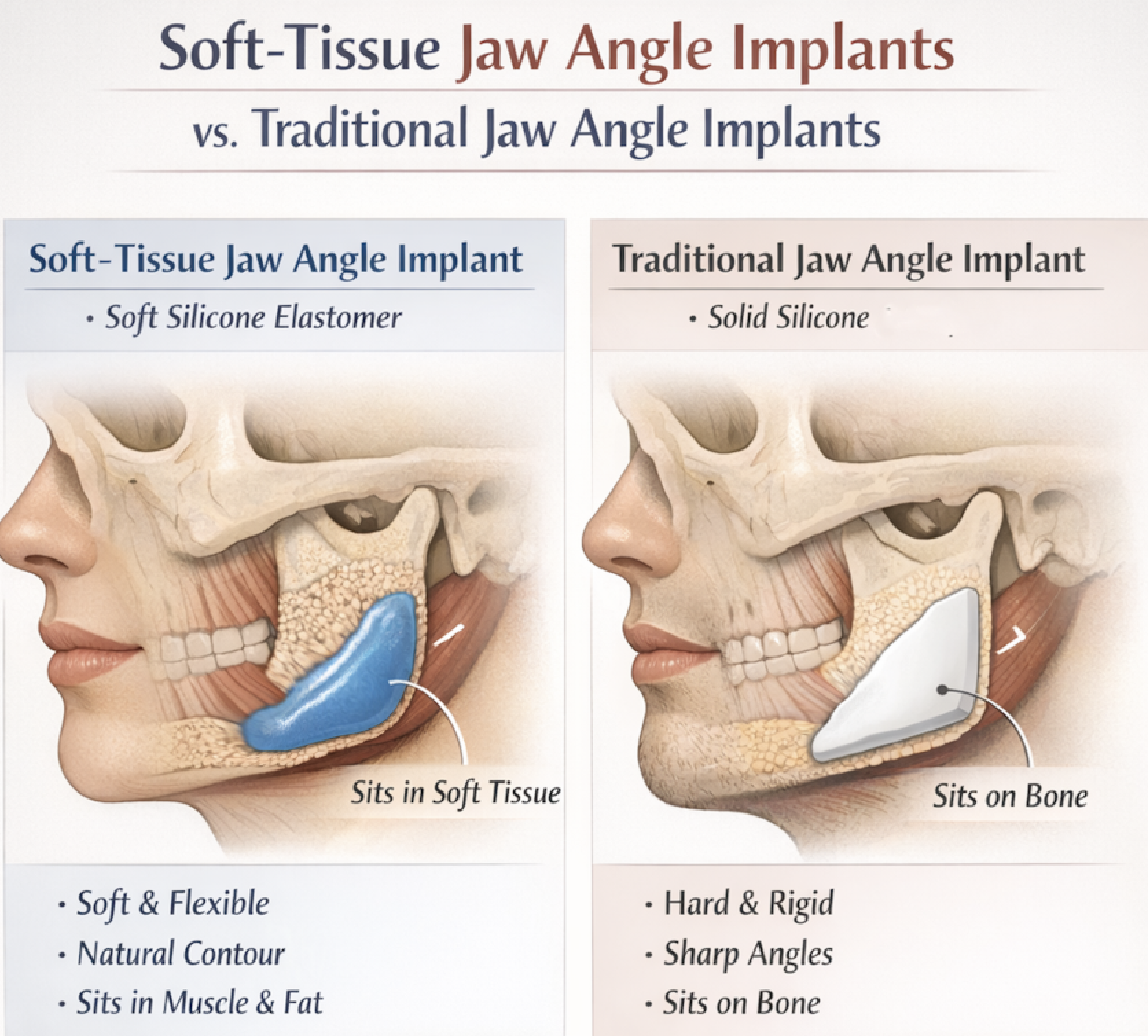
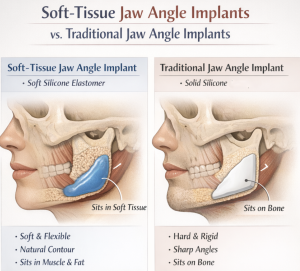 Traditional jaw angle implants are rigid and placed directly on the bone through an incision inside the mouth. Soft-tissue jaw angle implants:
 Are much softer and more flexible, feels more like muscle
- Enhance muscle and soft-tissue contour rather than bone structure
- Are placed through a small external incision instead of inside the mouth
- Create a smoother, more natural look rather than sharp angles
- Learned experience with them in the restoration of the soft tissue contour from jaw angle implants that have masseteric muscle dehiscence
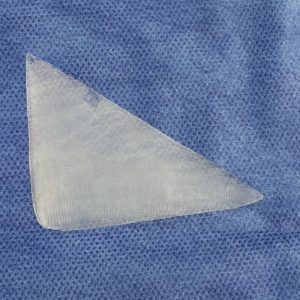
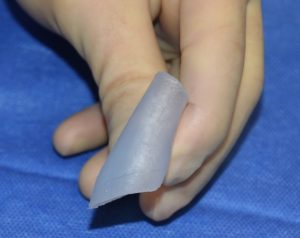 Are much softer and more flexible, feels more like muscle
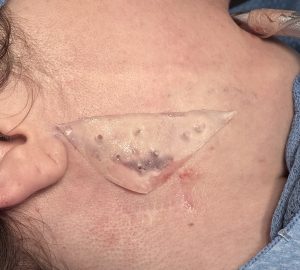 Are placed through a small external incision instead of inside the mouth
Who is a good candidate for soft-tissue jaw angle implants?
These implants are ideal for patients who:
- Want subtle widening or fullness, not a sharply defined or “chiseled” jawline
- Have mild jaw angle asymmetry where one side already looks acceptable
- Do not want bone-based implants or are not good candidates for them
- Have had prior jaw angle implants and now have soft-tissue deficiencies
- Prefer a more natural appearance over dramatic structural change
What kind of results can I expect?
Soft-tissue jaw angle implants provide:
- Gentle contour enhancement
- Improved balance and symmetry
- A softer, more natural jawline appearance
They are not intended to create sharp or angular jawlines. Injectable fillers can sometimes be used beforehand to help preview the type of contour change you can expect.
What are the advantages of soft-tissue jaw angle implants?
Some key benefits include:
- A more natural look and feel
- Lower risk of infection compared to intraoral implants
- No pressure on the jawbone
- No risk of masseter muscle separation
- Reduced chance of an artificial or “stuck-on” appearance
- Especially effective in patients with thicker facial tissues
What are the limitations?
Soft-tissue jaw angle implants:
- Cannot create sharply defined jaw angles
- Produce less dramatic changes than solid bone-based implants
- Are not ideal for patients seeking a very strong or angular jawline
How is the surgery performed?
- A small incision is made on the outside of the skin at or just behind the jaw angle
- The implant is placed in a precise pocket beneath the skin and above the muscle
- The procedure can often be performed under local anesthesia
- Implant size and shape can be customized or adjusted during surgery
Will there be a visible scar?
The incision is small and placed discreetly near or behind the jaw angle. In most patients, the scar heals very well and becomes inconspicuous over time.
What is recovery like?
Recovery is typically easier than with traditional jaw angle implants. Because the incision is external and the implant is not placed under the muscle, swelling, discomfort, and downtime are usually reduced.
Are soft-tissue jaw angle implants permanent?
Yes. The implants are made of medical-grade silicone and are designed to be long-lasting. Unlike fillers or fat grafting, they do not gradually disappear over time.
Bottom Line
Soft-tissue jaw angle implants are best for patients who want natural contour enhancement and subtle fullness, not sharp skeletal definition. They are especially useful for revision cases and for patients who prefer a softer, more blended jawline appearance.
If your goal is bold jawline structure, traditional jaw angle implants may still be the better option.
Dr. Barry Eppley
Plastic Surgeon