
Mouth widening surgery (also called oral commissuroplasty or lateral commissuroplasty) is a cosmetic procedure designed to increase the horizontal width of the mouth by repositioning the corners (oral commissures) outward.
- What It Does
- Increases mouth width
- Creates a broader smile
- Improves facial balance in patients with a narrow lower face
- Can enhance dental show when smiling
- Good Candidates
- Patients who feel their mouth looks too small or narrow
- Individuals seeking better facial proportion
- Patients with congenital mouth asymmetry (one side more narrow than the other)
- How It’s Done
- Performed under local anesthesia when done as a stand alone procedure
- Small incisions are made at the corners of the mouth
- The oral commissure is repositioned laterally
- Internal mucosa and external skin are carefully closed
- Fine sutures are used to minimize visible scarring
The key to success is precise design and layered closure to avoid:hypertrophicv/wide mouth corner scars
- Recovery
- Swelling and tightness for 1–2 weeks
- Sutures removed in about 5–7 days (if permanent sutures used but most commonly dissolvable sutures are used)
- Final scar maturation: 3–6 months
- Patients must avoid excessive mouth stretching early on (wide mouth opening)
- Risks
- Visible scarring at mouth corners
- Asymmetry
- Scar contraction pulling the corners inward
- Wound dehiscence/separation/delayed healing
- Important Consideration
This procedure requires very careful aesthetic judgment in terms of amount of attempted widening . An effective and safe amount (safe defined as not a high risk for hypertrophic scarring) is 5mms per side. An aggressive amount of corner widening is 7mms.
Case Study
This middle-aged male previously had a combined subnasal lip lift with upper lip lateral and lower lip very,ilion advancements. He wanted to do mouthy widening at the same time but that is ill-advised with vermilion advancements. Thus the mouth widening was done as a second stage procedure three months later.
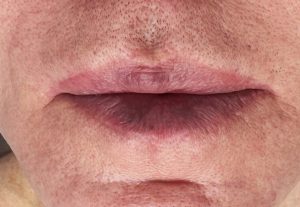 He had good scarring from the vermilion advancements so this was a favorable sign for the corner widening.
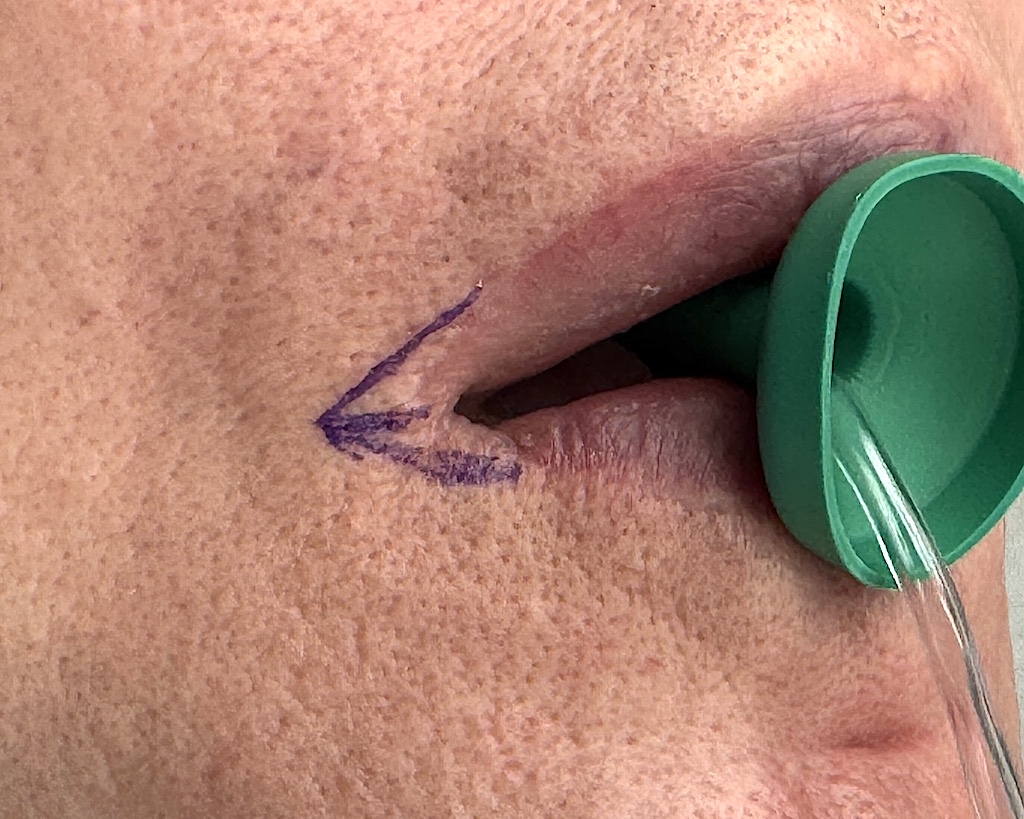
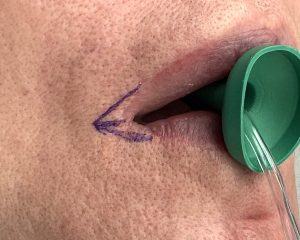 He wanted to be aggressive so a 7mm widening was marked with an arrow pattern to it. (central line out to the 7mm width and upper and lower skin triangles)
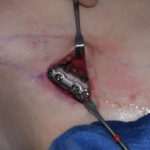
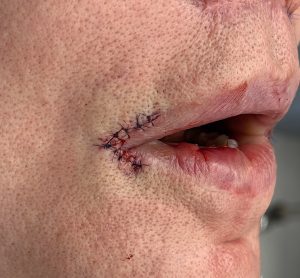 The center line was incised from the existing corner vermilion out to the 7mm skin width mark. Upper and lower triangles of skin were excised create adequate vermilion height so the mouth widening wwer not not just slits in the skin. A wedge of orbicularis muscle was excised to ereate space for the corner tissues to move into it. Closure was done in multiple layers (muscle and dermis) up to the skin where permanent sutures were placed.
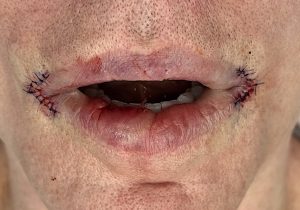 The bilateral effect was an incerased intracommissure distance with adwquate vermilion fullness.
Discussion
Determining if mouth widening will improve facial appearance/balance requires proper analysis.
1. Check Facial Proportion First (Static Analysis)
A. Interpupillary Line Reference
In balanced faces:
 The oral commissures typically align vertically near the medial limbus or mid-pupil when smiling.
- If the corners fall clearly medial to the medial limbus even during a full smile, widening may help.
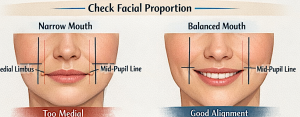 The oral commissures typically align vertically near the medial limbus or mid-pupil when smiling.
If they already reach the mid-pupil ? widening will likely look artificial.
B. Lower Third Width Comparison
Compare:
- Mouth width
vs - Alar base width (nose width)
Aesthetically balanced mouths are often:
- Equal to or slightly wider than the alar base.
If the mouth is noticeably narrower than the nose base at full smile, widening may improve proportion.
C. Bizygomatic Width Ratio
The mouth width typically equals about:
- 35–40% of bizygomatic facial width.
If significantly under this range, widening could be considered.
2. Dynamic Smile Analysis
Many patients appear narrow at rest but normal when smiling.
Evaluate:
- Does the smile look constrained?
- Do the teeth show laterally?
- Do the corners pull naturally outward?
If the smile already shows adequate dental width, widening usually won’t improve balance.
3. Rule Out Common Misdiagnoses
Often the issue is not lack of adequate horizontal width, but:
?? Downturned corners ? needs corner lift
?? Long upper lip ? needs lip lift
?? Thin lips ? needs augmentation
?? Weak lateral smile pull ? congenital limited muscle excursion, no treatment is available
Mouth widening won’t fix these.
When It Truly Helps
Ideal candidate:
- Naturally small oral aperture
- Minimal lateral tooth show
- Narrow lower facial third
- Good tissue quality
- Realistic expectations
- Comfortable with permanent commissure scars
Dr. Barry Eppley
Plastic Surgeon