
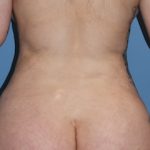
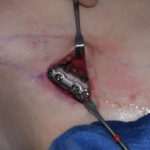
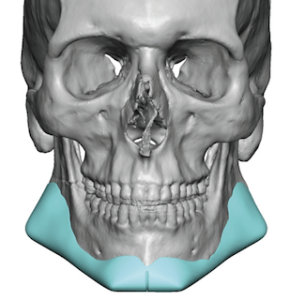
 Surgeons sometimes observe that large custom jawline implants improve neck appearance even in patients in their 40s–50s, which seems counterintuitive because neck aging is usually thought to require a neck lift. The mechanism is largely due to skin recruitment and tension along the mandibular arc.
The “Mandibular Arc Skin Recruitment” Effect
1. The mandible acts as the attachment frame for neck tissues
The skin and soft tissues of the upper neck attach and transition along the inferior border of the mandible.
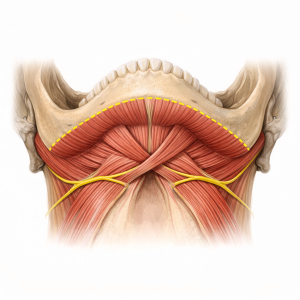 Important structures influenced by the jaw border include:
- Submandibular skin
- Platysma muscle
- Cervicomental fat
- Retaining ligaments
When the mandibular border is enlarged, these tissues must redistribute over a longer and more projected skeletal arc.
2. Large implants increase the mandibular arc length
A custom jawline implant can increase:
- Horizontal projection
- Mandibular body length
- Jaw angle width
- Vertical jaw angle height
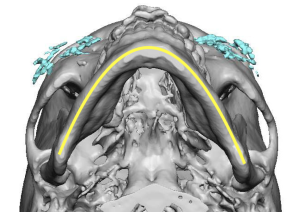
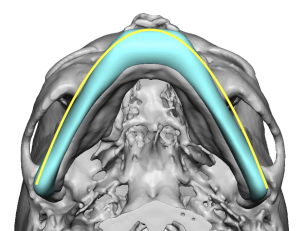 This increases the perimeter of the mandible, especially along the sides and posterior jaw.
What happens to the skin
The skin envelope must stretch across this larger arc.
This creates:
- upward tissue recruitment from the upper neck
- lateral tightening beneath the jaw
- improved cervicomental angle.
3. Skin recruitment effect
The key concept is skin recruitment.
When the jawline becomes larger, the body must borrow skin from adjacent areas to cover the new contour.
Much of this recruited skin comes from:
- the submandibular region
- the upper neck.
This effectively pulls the upper neck tissues upward toward the jawline.
The result can resemble a mild neck lift.
4. Why larger implants produce stronger effects
Small implants create minimal soft-tissue displacement.
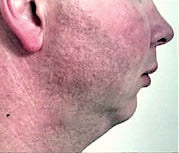
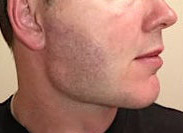 Large implants create:
- greater skeletal expansion
- more surface area
- stronger soft-tissue tension.
The relationship is roughly proportional:
|
Implant size |
Skin recruitment |
Neck improvement |
|
Small |
Minimal |
Little change |
|
Moderate |
Moderate |
Mild improvement |
|
Large |
Significant |
Visible improvement |
5. The posterior jaw angle effect
Large jawline implants often include vertical and lateral augmentation of the jaw angles.
This region is critical for neck contour because:
- it defines the posterior boundary of the jawline
- it supports the lateral platysma.
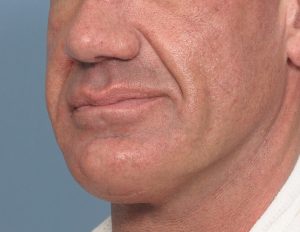
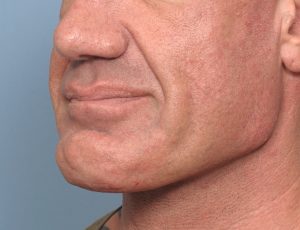 Increasing posterior jaw angle projection:
- tightens tissues along the lateral neck
- improves jaw–neck separation.
6. Why this works in some patients in their 40s–50s
Even though skin elasticity decreases with age, many patients in this age group still have:
- moderate skin elasticity
- limited platysma banding
- early skin laxity rather than severe redundancy.
In these patients, skeletal expansion alone can improve tissue positioning.
However, if there is:
- heavy platysma laxity
- large skin excess
- significant submental fat
then a neck lift or submental procedure is still required.
7. Visual illusion also contributes
Jawline implants enhance contrast between the jaw and neck.
By:
- strengthening the mandibular border
- deepening the jawline shadow
the neck appears sharper and tighter, even if the actual tissue change is modest.
Summary
Large jawline implants can improve neck contour in middle-aged patients because they:
- enlarge the mandibular arc
- recruit skin from the upper neck
- increase tension along the submandibular tissues
- enhance posterior jaw angle support
- strengthen jaw–neck separation.
This phenomenon is sometimes described as a skeletal neck lift effect.
Dr. Barry Eppley
Plastic Surgeon