
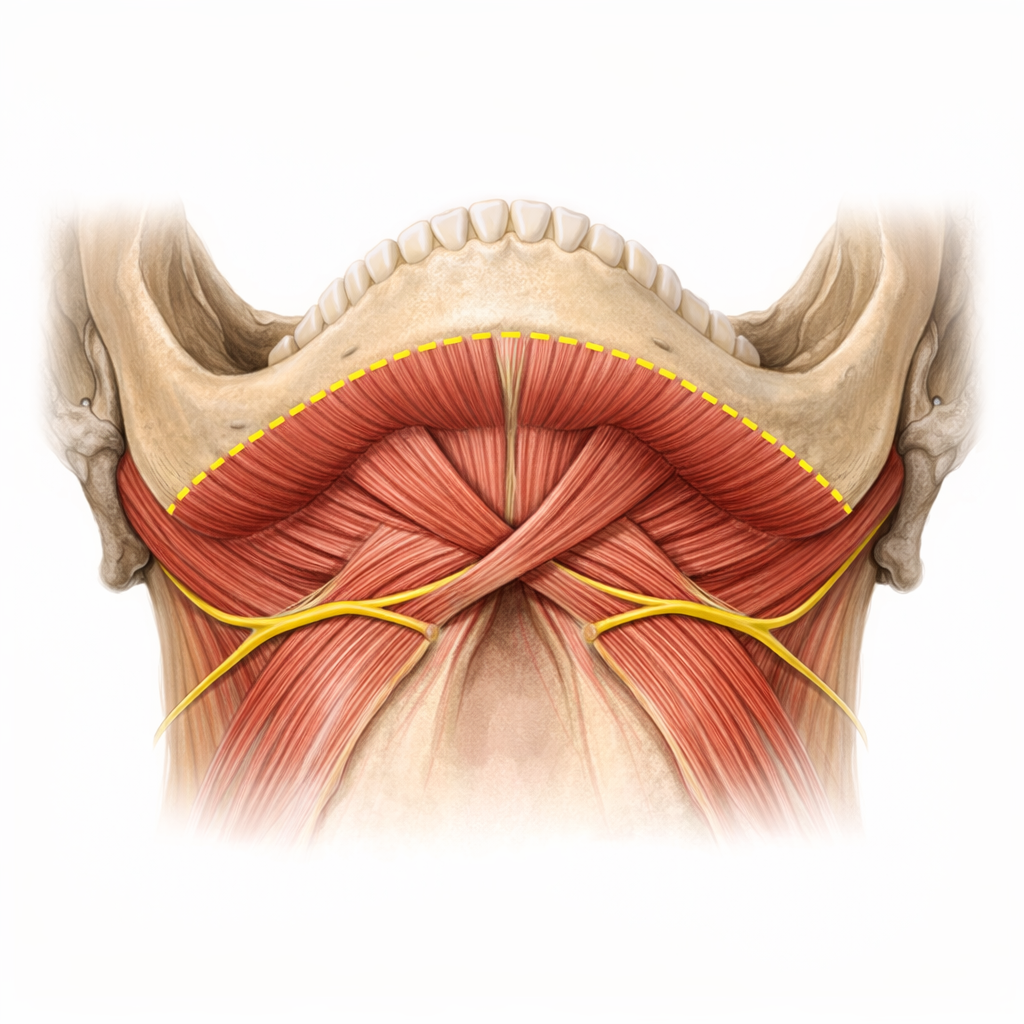
When I have reviewed post-operative photos and some with CT scans after large custom jawline implants I sometimes notice a repositioning of the submental soft-tissue envelope. This helps explain why some patients report that their neck looks better 6–12 months after surgery than it did initially.
This is not just swelling resolution; it reflects long-term soft-tissue adaptation to a new skeletal framework. This occurs because:
1. The soft-tissue envelope adapts to the skeleton
The lower face and upper neck behave like a continuous soft-tissue envelope that drapes over the mandible.
Key components include:
- skin
- subcutaneous fat
- platysma muscle
- subplatysmal fat
- fascial attachments.
 When the mandible becomes larger, these tissues must redistribute across the new contour.
Immediately after surgery they are compressed and swollen, but over time they gradually settle into a new equilibrium.
2. CT observations after large jawline implants
On follow-up CT scans (often done for implant evaluation), I sometimes observe:
- slight upward migration of submental soft tissue
- thinning of the submental fat layer
- improved definition of the submandibular contour.
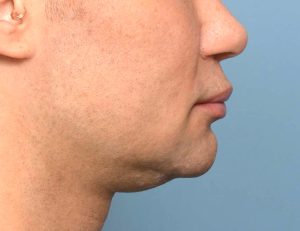
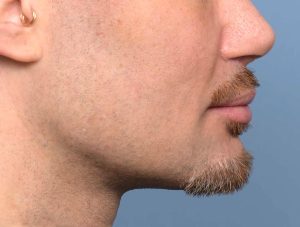 This occurs without any surgery on the neck itself.
The reason is mechanical redistribution of the soft-tissue envelope.
3. Skin recruitment along the mandibular arc
As discussed earlier, large implants increase the mandibular perimeter.
Over time:
- skin stretches over the new jawline
- excess tissue beneath the chin redistributes laterally
- the upper neck becomes slightly tighter.
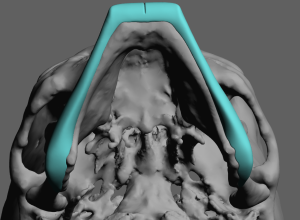 Because the mandible forms a long curved arc, the soft tissues shift gradually along that arc.
4. Fat redistribution under tension
Submental fat is not rigidly fixed; it can shift under changes in tension.
When the jawline expands:
- the soft-tissue envelope becomes tighter
- fat spreads over a larger surface area.
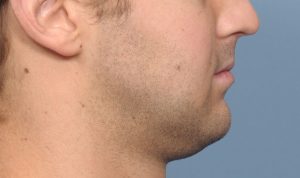
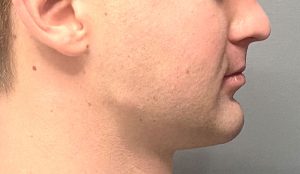 This can make the submental fat pad appear thinner.
It’s similar to stretching a thin layer of clay across a larger surface.
5. Scar and fascial remodeling
During implant placement, the periosteum and soft tissues are elevated.
During healing:
- scar tissue forms between implant, periosteum, and soft tissues
- fascial structures adapt to the new skeletal contour.
This remodeling can stabilize the redraped soft tissues, maintaining improved neck definition.
6. Why the improvement can increase over time
Patients often notice:
- swelling resolves by ~6–8 weeks
- jawline definition improves over 3–6 months
- neck contour sometimes continues improving up to 12 months.
This delayed improvement reflects soft-tissue remodeling and tension redistribution rather than immediate surgical change.
7. Limits of this phenomenon
This effect only works when the neck has:
- mild to moderate laxity
- relatively elastic skin
- limited platysma separation.
It does not replace a submentoplasty or a neck lift when there is:
- significant skin redundancy
- heavy platysma banding
- large submental fat deposits.
Summary
Large jawline implants can produce gradual neck improvement because:
- the mandible becomes a larger structural scaffold
- the soft-tissue envelope redistributes upward
- submental fat spreads across a larger surface
- fascial remodeling stabilizes the new contour.
This explains why surgeons sometimes see better neck definition months after surgery than immediately post-op.
Dr. Barry Eppley
Plastic Surgeon