


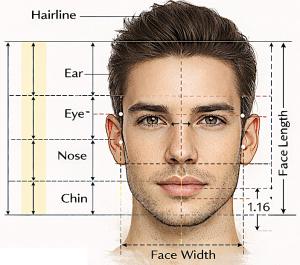
 The Golden Ratio has been applied to facial aesthetics for a long time for both facial analysis as well as surgical treatment planning. While it is not a mathematical formula to be universally applied for every surgical procedure it does have some use in facial and skull implant planning as well. Let’s dive in and see how it can used in the custom jawline implant, the most powerful structural enhancement procedure for the male face.
The “Golden Ratio jawline template” is a proportional guideline that can be used to plan balanced mandibular augmentation relative to the rest of the face. It does not mean the jaw dimensionally always has perfect golden ratio proportions, but that key facial widths and proportions approximate golden-ratio relationships that tend to look harmonious.
Below is the conceptual template used when planning custom jawline implants.
1. Facial Width Hierarchy (Golden Ratio Guideline)
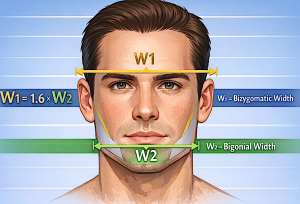 The lower face should relate proportionally to the midface. Numerically this means:
Soft Tissue Cheekbone Width (Bizygomatic W1) to Bony Jaw Width (Bigonial W2) equals 1.6:1
Typical aesthetic male relationship:
Bigonial width = 0.60–0.65 × Bizygomatic width
Example
Bizygomatic width = 140 mm
Ideal jaw width = 84–91 mm
This ratio helps to prevent making excessively wide jaw implants.
2. Posterior Mandible Projection Ratio
Aesthetic balance often places the gonial angle at or slightly outside the vertical cheek line.
Typical guideline:
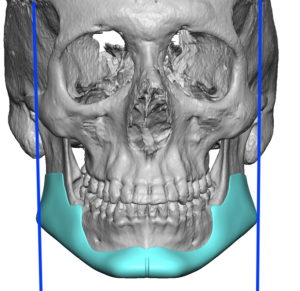 Angle projection = at or just outside the cheek vertical line
Too much beyond this creates overly square faces.
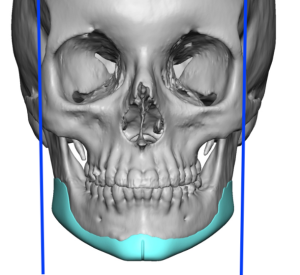 In females it is more proportionate to keep the jaw angle width inside these vertical lines.
3. Jawline Length vs Chin Projection
The lower face should not appear flat.
Proportional concept:
Mandibular body length (1.6) to chin projection(1.0)
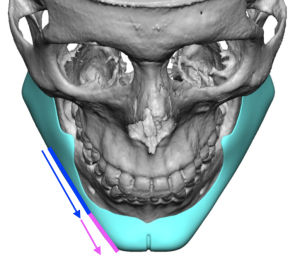 Meaning the jawline length visually dominates the chin.
If chin projection becomes too strong relative to the body, the face appears “pointed” rather than structured.
4. Inferior Border Slope Ratio
An aesthetic jawline often forms a subtle geometric flow.
Angle height = 1.6 to mandibular body drop
Example:
Angle drop: 6 mm
Body drop: 3–4 mm
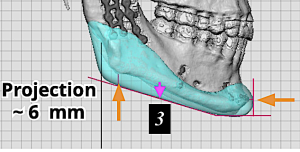 This produces a natural taper toward the chin.
5. Jaw–Chin Continuity Triangle
The jawline can be visualized using a triangular frame.
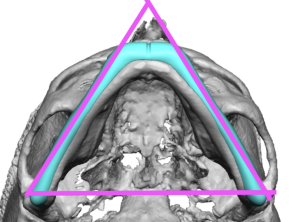 Balanced triangles generally follow golden-ratio proportions between:
• base width (bigonial)
• height (chin to angle line)
6. The “Masculine Jaw Rectangle”
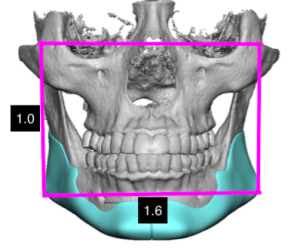 For strong male jawlines, I sometimes use a rectangular template where the lower face approximates golden proportions. The bigonial width is 1.6 to that of the gonial-cheek height. This may look boxy on the implant design but on the outside translates into a balanced masculine frame.
7. Frontal Jaw Width Triangle
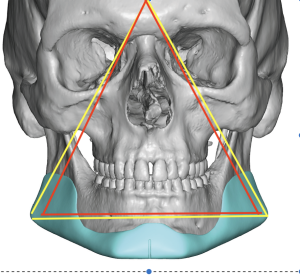 Evaluating jaw width in the frontal view a triangle can be created between the glabella and the implant’s angle widths. If it is more of an equilateral triangle the jaw widths may be too wide (yellow). A more proportionate jaw width would be less width (red) makingm the triangle more golden.
8. CAD Implementation in Custom Implant Design
When designing implants digitally, these ratios guide maximum augmentation limits.
Typical workflow:
- Measure bizygomatic width
- Calculate ideal bigonial width range
- Determine augmentation needed at angle
- Distribute implant thickness gradually toward chin
Example:
Bizygomatic = 140 mm
Existing jaw = 78 mm
Target jaw = 88 mm
Required angle augmentation = 5 mm per side
Key principle
Golden ratios are not rigid rules. Instead they act as a visual harmony guidelines to prevent:
• over-wide angle implants
• excessive chin projection
• disproportionate heavt/boxy lower faces
They are just another tool to consider in an implant design. Successful custom jawline implants follow balanced facial geometry rather than maximum augmentation.
In practice:
The focus of the implant design should be more on jawline continuity and posterior dominance than exact mathematical ratios.
Dr Barry Eppley
Plastic Surgeon