
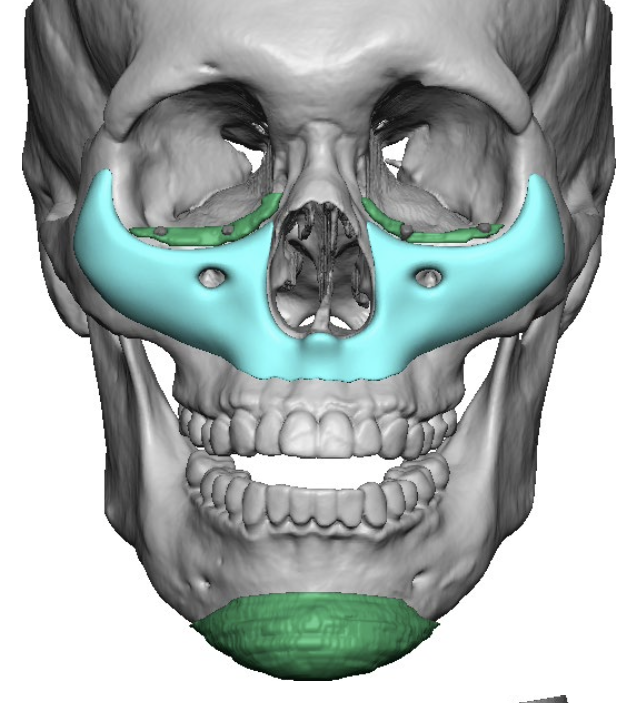
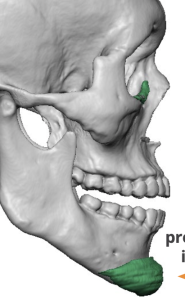
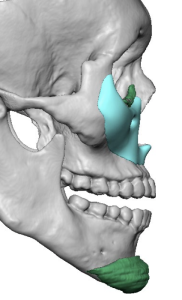
 Custom midface mask implants are a specialized form of facial augmentation designed to enhance the central midface (infraorbital rims, anterior maxilla, and cheek area as a continuous unit) rather than using separate cheek or tear trough implants. In Asian patients, their use has some distinct considerations due to typical skeletal and aesthetic differences.
What is a “midface mask” implant?
 A single, custom-designed implant (usually solid silicone or PEEK)
- Extends across:
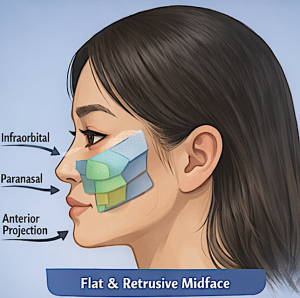
- Infraorbital rims (under-eye support)
- Paranasal region (around the nose base)
- Malar/cheek area
- Designed from 3D CT imaging for precise fit and symmetry
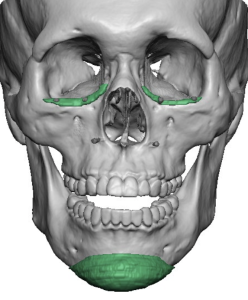
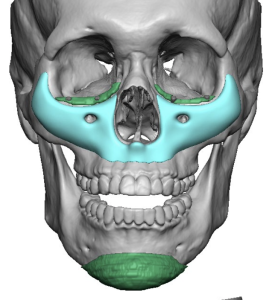 A single, custom-designed implant (usually solid silicone or PEEK)
Why consider midface mask implants in Asian patients?
Common anatomical traits (generalized)
- Flatter midface projection
- Less anterior maxillary projection
- Wider bizygomatic width but less forward projection
- Tear trough hollowing due to skeletal support deficiency
Aesthetic goals often differ from Caucasian patients
- Avoid overly lateral cheek widening
- Emphasize forward (anterior) projection, not just lateral fullness
- Maintain natural ethnic identity while improving structure
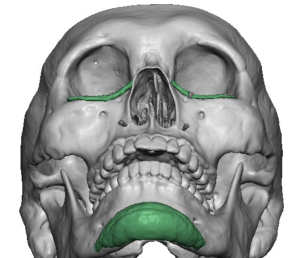
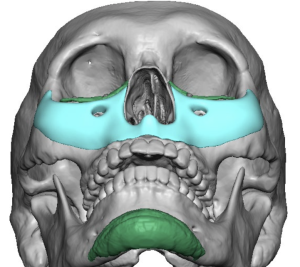 Avoid overly lateral cheek widening
Advantages of custom midface implants
- Holistic augmentation: Treats the entire midface as one unit ? smoother transitions
- Better tear trough support vs fillers or isolated implants
- Precise symmetry using patient-specific design
- Stronger structural change than fillers or fat grafting
Key design considerations in Asians
- Controlled projection
- Over-augmentation can look unnatural quickly
- Subtle anterior projection is usually preferred
- Avoid excessive lateral cheek width
 Avoid excessive lateral cheek width
-
- Many Asian patients already have adequate or wide bizygomatic distance
- Infraorbital support is critical
-
- Helps with under-eye hollowing and “tired” appearance
- Paranasal augmentation
-
- Often important to improve midface convexity and nasolabial angle
- Soft tissue thickness
-
- Thicker soft tissues can blunt definition ? implant must compensate slightly
Materials commonly used
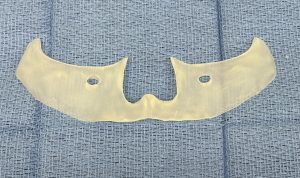
- Silicone (most common)
- Easier to insert/remove
- Smooth, well tolerated
- Can be placed as a single unified implant
- PEEK
- increasingly popular plastic material
- due to rigidity often needs to be placed in multiple smaller segments
 Smooth, well tolerated
Surgical approach
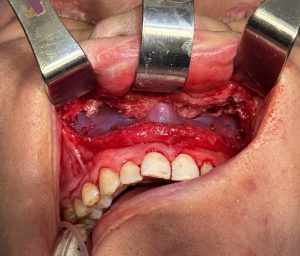
- Typically intraoral (inside the mouth) to avoid visible scars
- Sometimes combined with:
- Lower eyelid approach (for infraorbital precision)
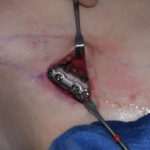
- Fixation with small screws to the zygomatic buttress is commonly done.
 Typically intraoral (inside the mouth) to avoid visible scars
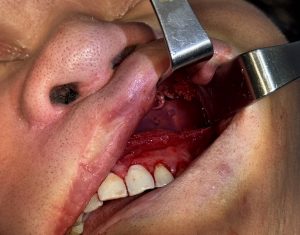 Fixation with small screws to the zygomatic buttress is commonly done.
Risks & limitations
- Infection (higher with intraoral approach vs external)
- Implant malposition (less common with custom implants)
- Nerve irritation (infraorbital nerve)
- Over- or under-correction
- Difficulty removing porous implants
Comparison to alternatives
|
Option |
Pros |
Cons |
|
Fillers |
Non-surgical, reversible |
Temporary, limited structural change |
|
Fat grafting |
Non-implant |
Variable survival, puffy bloated appearance |
|
Standard cheek implants |
Simpler |
Limited midface augmentation effect, leaves out central midface |
|
Orthognathic surgery |
Skeletal correction |
Much more invasive, does not augment upper midface/cheeks |
When they are especially useful
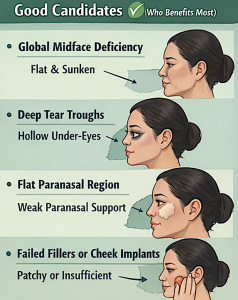 When they are especially useful
- Flat midface with global deficiency
- Prominent tear troughs due to bone deficiency
- Revision cases where fillers/cheek implants failed
- Patients wanting permanent structural enhancement
Dr. Barry Eppley
Plastic Surgeon