
“Aesthetic temporal reduction” (often called temporal narrowing surgery) is a niche craniofacial procedure aimed at reducing the width of the head in the temple region (the area above and slightly behind the eyes).
What it targets
- The temporal region (sides of the skull)
- Specifically:
- Temporal bone (outer skull)
- Temporalis muscle (a chewing muscle that can add bulk)
How it’s done
There are two main components that can be treated
1. Bone reduction (least effective)
- The outer layer of the convex part of the temporal bone is shaved down
- This physically narrows the skull width by a few millimeters on each side
- Requires an incision along the side of the head above the ears.
2. Temporalis muscle reduction (most effective )
- Muscle may be:
- Total resection of posterior muscle over convex portion of the bone, most common area treated
- Subtotal reduction of thicker anterior muscle over concave portion of the bone by transposition
Who it’s for
- People who feel their head looks too wide from the front
- Patients seeking a more:
- Oval / V-shaped facial contour
- Balanced upper-to-lower face ratio
- Common in:
- Facial feminization surgery (FFS)
- Aesthetic skull contouring
Expected results
- Subtle but noticeable narrowing
- Best improvement seen in frontal and back views
- Can be a dramatic reduction in patients with very large temporal muscles
Botox test
Before surgery, consider Botox to temporalis muscle which can temporarily slim the area non-surgically). This not only provides some temporary improvement but is also a test to prove that muscle reduction is helpful. (surgery confirmation)
Case Example
This male was bothered by the width of the sides of his head. The major source of the width was determined to be muscular in origin by a wide mouth opening test in which the sides of the head become less wide and the presence of a prominent masseter muscle width. (companion masticatory muscle)
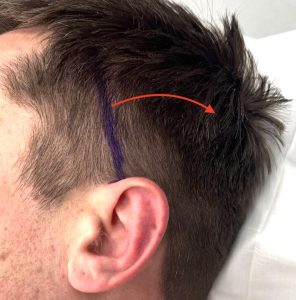
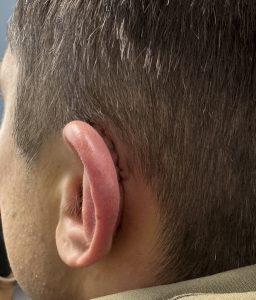 Through a postauricular incision the posterior temporal muscle was removed behind an oblique muscle cut line. Such incisional access heals with no visible scar.
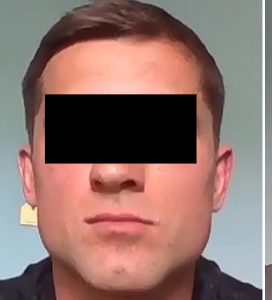
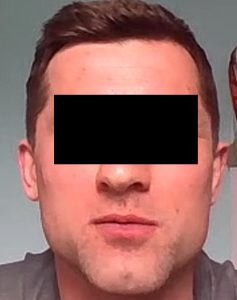 His six week result showed a noticeable reduction in his head width.
Discussion
The first important question in a wide head concern is what is the
anatomic cause. Is it due to bone, muscle, or both, or is it just a visual proportion issue.
Here’s a practical way to figure out which category you likely fall
into:
1. Bone (skeletal width)
Signs it’s mostly bone:
- Your head looks wide even when very lean
- Width is most noticeable at the upper sides of the head (above ears/temples)
- The shape looks firm/structured, not soft
- No change with:
- Weight loss
- Clenching vs relaxing your jaw
- From the front, your head outline looks more square or boxy at the top
Reality:
- This is the hardest to change
- Surgery = only modest narrowing (a few mm per side of bone can be reduced
- Not to mention the incision along the side of the head to do it)
2. Temporalis muscle (very common)
This is often overlooked. because it is commonly believed that it is not possible to reduce it.
Quick self-test:
- Clench your teeth hard
- Put your fingers on your temples (above and slightly ahead of your ears)
If you feel a bulge pop out strongly, that’s your temporalis muscle.
Signs it’s muscle-driven:
- Temples look wider when you clench
- You grind your teeth or have a strong bite
- Width looks more rounded/full, not angular
- Can fluctuate slightly over time
Reality:
- This is the most treatable cause
- Botox can shrink this area noticeably over a few months on a temporary basis.
- Surgical removal (posterior segment) and transposition of the muscle (anterior segment) provides a permanent narrowing effect.,
3. Visual proportion
In a minority of cases some wide heads are actually an optical illusion from imbalance.
Common causes:
- Narrow jaw / chin ? makes upper head look wide
- Flat cheekbones ? less midface projection
- Large forehead relative to lower face
- Hair shape (big sides, flat top)
Signs:
- Your head looks wide only from certain angles
- When you:
- Push hair inward ? looks narrower
- Add volume to chin/jaw (even mentally) ? proportions improve
- The issue feels more like lack of balance than true nusculoskeletal skull width
Reality:
- Often best treated by:
- Chin/jaw enhancement
- Cheek augmentation
- Hairstyle changes
NOT skull surgery
Simple at-home breakdown test
Try this in a mirror:
Step 1: Hair test
- Flatten the sides of your hair
If width improves a lot ? visual/hair issue
Step 2: Clench test
- Clench teeth and watch temples
Big movement = muscle component
Step 3: Face balancing test
- Cover lower face (chin/jaw) with your hand
If upper head suddenly looks wider ? proportion issue
Step 4: Lean test
- Compare photos when lean vs heavier
No change = more likely bone
Dr. Barry Eppley
Plastic Surgeon