
Standard off-the shelf (OTS) implants exist for just about every facial area below the brow bones. This is true for the infraorbital area of the upper midface as well with the tear trough implant. It is an implant that was originally made to treat a limited or the entire infraorbital rim bone. How does this standard implant compare to custom (patient-specific) infraorbital / infraorbital–malar implants—focused on fit, aesthetics, safety, and revision burden. This is the comparison that actually determines predictability vs compromise in infraorbital work.
Key Differences
- Off-the-shelf implants adapt to the patient with limited footprints
- Custom implants are made for each patient’s anatomy with no implant restriction
With this distinction everything else flows from that.
Fit & Anatomy
|
Factor |
Off-the-shelf (OTS) |
Custom |
|
Rim contour match |
Approximate |
Exact |
|
Tear trough geometry |
Generic |
Patient-specific |
|
Malar width & height |
Fixed |
Variable |
|
Infraorbital foramen avoidance |
Estimated |
Designed-around |
|
Side-to-side symmetry |
Surgeon-dependent |
Digital |
OTS implants are built for average anatomy.
Undereye hollowing/negative orbital vector patients are not average.
Aesthetic outcome
Off-the-shelf
Strengths
 Readily available
- Acceptable for very mild rim deficiency
- Lower upfront cost
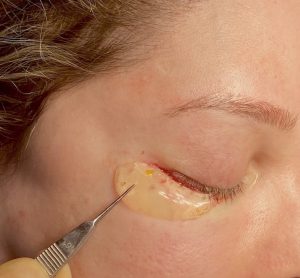 Readily available
Limitations
- Incomplete tear trough correction/rim augmentation
- Step-offs at implant margins
- Does not saddle the rim (no vertical augmentation)
- Over/under-projection compromise
- Greater risk of a “surgical” look, implant appearing like a bump in thin tissue patients
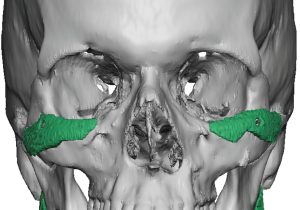 Incomplete tear trough correction/rim augmentation
OTS means there will be some compromises it is only a question of which one(s) will occur. This is a matter of trying to make an implant fit the problem. Patient selection is critical.
Custom
Strengths
- Smooth lid–cheek transition
- Saddles the rim and blends smoothly into the malar area
- Correct projection and shape
- Better lower-lid support
- Natural look in animation
- Creates a ‘bone expansion’ effect rather than just a spot implant on the bone
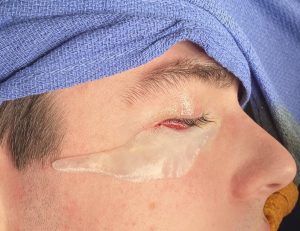 Smooth lid–cheek transition
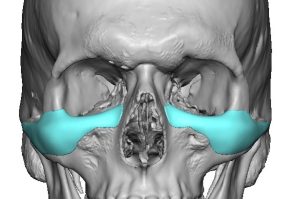 Creates a ‘bone expansion’ effect rather than just a spot implant on the bone
Custom allows preoperative precision implant shape control
Dynamic performance (where customs dominate)
|
Feature |
OTS |
Custom |
|
Smile animation |
Hollow often persists |
Stable |
|
Lid closure |
Edge visibility risk |
Smooth |
|
Aging over time |
Relapse likely |
Durable |
OTS implants correct static photos.
Custom implants correct living faces.
Limitations
- Higher upfront cost
- Design dependent, its benefits are based on a good design for the patient’s anatomy and aesthetic needs.
Safety & complication profile
Off-the-shelf risks
- Implant visibility in thin skin
- Edging along rim
- Malposition due to poor conformity
- Higher revision rate for inadequate correction
Custom risks
- Design errors if over-aggressive
- Longer planning phase
Once implanted, custom actually reduces complications because it better conforms to the bone and avoids focal edges.
Indications
Custom implants shine in:
- Filler-damaged lower lids
- Prior failed infraorbital implants
- Asymmetric hollows
- Negative vector midfaces
- Thin-skin patients
OTS implants struggle here.
Cost reality
While custom implants cost more upfront:
- Fewer revisions
- Less need for filler latyer
- More durable result
Lifetime cost is often lower with higher satisfaction rates
When OTS can be reasonable
- Isolated, mild infraorbital rim deficiency
- Thick lower lid skin
- Strong malar projection
- Patient understands limitations
These are select cases, not the norm.
Bottom line
- Off-the-shelf = compromise solution for narrow indications
- Custom = definitive solution for significant undereye hollowing and/or negative orbital vectors
In infraorbital aesthetics, millimeters and surface area coverage matter greatly—and these are both areas where off-the-shelf fails.
Dr. Barry Eppley
World-Renowned Plastic Surgeon