
Fat grafting by injection is one of the most common aesthetic surgeries performed for a wide variety of soft tissue augmentation or contouring effects. While there are many variables involved in the success of such injection procedures the first one is adequate donor tissue. In cases of lack of donor tissue or exhausted donor sites from prior harvests they have been historically no other soft tissue options other than synthetic fillers.But more recent innovations from the use of allograft tissu science has led to fat injection grafting substitutes.
Commercial Off-The-Shelf Fat Injection Substitutes-What They Are / How They Work
 Renuva
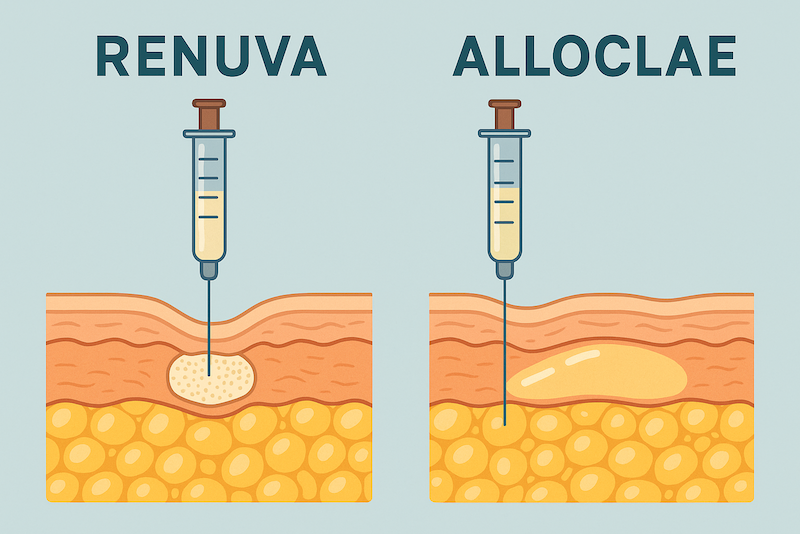
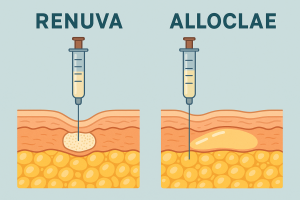
- Renuva is an allograft adipose matrix, derived from donated human fat tissue that has been processed to remove actual fat cells — leaving behind a scaffold (extracellular matrix with growth factors, collagen, proteins) that your body can naturally repopulate with its own fat cells over
- Once injected, Renuva doesn’t provide instant “fat volume” itself; instead, it stimulates the body’s own fat regeneration. Over weeks to a few months the matrix integrates, and your native fat grows into it.
- It’s often described as a “gradual, regenerative” option.
 AlloClae
- AlloClae is a newer allograft-derived fat filler that uses processed donor fat tissue (with fat-cell membranes and extracellular matrix) — not just the matrix scaffold.
- Because there is actual (though processed) adipose tissue involved, AlloClae tends to provide a more immediate and structural volume increase — more akin to a fat transfer or filler rather than a waiting-for-fat-to-grow solution.
- It’s marketed for body contouring, butt/hip/breast enhancement, post-surgery contour corrections, and larger volume needs — rather than subtle facial volume loss.
Pros & Cons — Renuva vs AlloClae
|
Feature / Consideration |
Renuva |
AlloClae |
|
How volume is gained / when results appear |
Gradual — relies on your body growing new fat into the matrix; visible results often over several weeks to months. |
More immediate — because of the structural donor fat tissue, you get volume sooner after injection. |
|
Best for |
Small-volume corrections (face, hands, small contour irregularities), subtle soft-tissue rejuvenation, patients without large volume needs. |
Larger volume restoration (hips, buttocks, breasts, body contour, post-surgical corrections), patients wanting more “oomph” and structure. |
|
Invasiveness / downtime |
Minimally invasive injectable; no liposuction, minimal downtime, office-based procedure. |
Also minimally invasive; avoids liposuction and major surgery, but because of larger volumes sometimes may need more careful injection / recovery planning. |
|
Look / Feel of results |
More natural-looking over time; integrates with your own fat, subtle results. |
More noticeable and immediate — more volume “per cc,” giving more shape and structure. |
|
Longevity / permanence |
Once your own fat fills in, results are relatively long-lasting (though depends on body changes). |
Early reports suggest good retention (some surgeons report ~90–100% of injected volume “sticks”), but long-term data and large-scale studies are still limited. |
|
Typical use cases |
Facial hollows, age-related volume loss, small defects, minor contour irregularities, hands, neck. |
Buttocks/hips/breasts enhancement, body contouring, hip-dip correction, post-surgical/corrective work, where more substantial volume is desired. |
|
Clinical history / evidence base |
More established as a regenerative adipose-matrix filler with growing clinical acceptance. |
Newer — promising, but long-term safety, efficacy, and standardized protocols are still emerging. |
Which Should You Choose? It Depends on Your Goals
- If you want subtle, natural-looking volume restoration for the face, hands, or minor soft-tissue loss, and you’re OK with gradual results over weeks/months, then Renuva tends to be the safer, softer, lower-volume, regenerative choice.
- If you’re seeking more dramatic volume gains, particularly in body areas (hips, butt, breasts) or want immediate contouring/shape, and don’t require liposuction — AlloClae may suit you better.
- If you have limited body fat, don’t want surgical fat-transfer, or want a compromise between implants and fillers — AlloClae presents a newer “middle path.”
Trade-Offs & Considerations
- Because AlloClae is newer, long-term data — especially over many years — is more limited compared with techniques like fat grafting
- Renuva’s “wait-for-your-body-to-grow-fat” approach means results aren’t instant — you need patience and realistic expectations.
- Both procedures depend heavily on who injects them — skill, technique, and patient-specific anatomy are critical.
- Ethical and personal considerations: since both derive from donor human tissue, some people may prefer or avoid based on their views about allograft-derived products.
Dr. Barry Eppley
World-Renowed Plastic Surgeon