
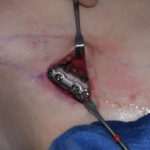
Chin implants are notorious for causing a deepening effect on the labiomental fold. Does using a custom chin implant rather than an off-the-shelf design decrease that risk? The following is a fold-centric, design-specific discussion of custom chin implant strategies aimed at minimizing labiomental fold worsening. This assumes you’ve already decided an implant is appropriate and want to avoid predictable fold problems.
1. Core Principle (most important)
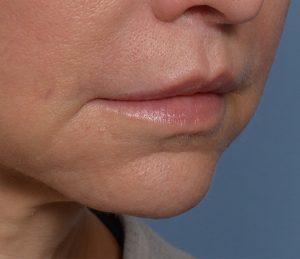
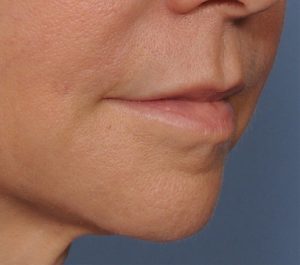 Custom implants do not improve the labiomental fold.
They can only preserve it in most cases. Rarely do they improve it.
The goal of custom design is to avoid increasing mentalis tension or creating a step-off, not to improve a deep fold.
2. Implant Geometry: what matters most
A. Minimal Superior Vertical Height (critical)
 Vertical height of the implant toward the muscle’s origin is the single biggest contributor to fold worsening
- Even 2–3 mm of added vertical height into the superior concavity of the bone can deepen the fold
- Vertical chin lengthening, if aesthetically tolerated, always protect the fold from deepening and may even make it look less deep in some cases.
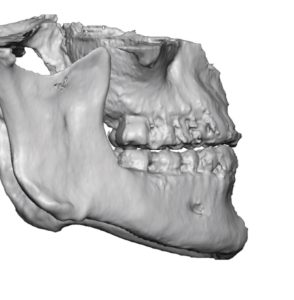
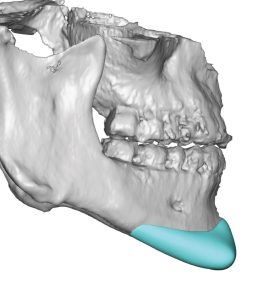 Vertical height of the implant toward the muscle’s origin is the single biggest contributor to fold worsening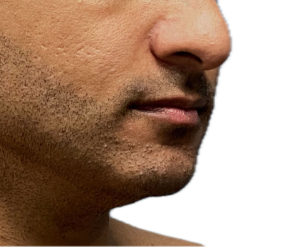
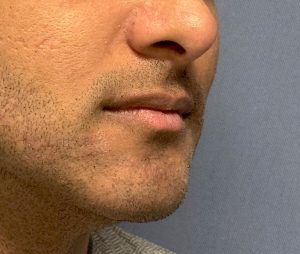 Vertical chin lengthening, if aesthetically tolerated, always protect the fold from deepening and may even make it look less deep in some cases.
Design rule:
- Use zero or near-zero superior vertical augmentation
- Let projection occur anteriorly, not superiorly
Avoid “wrap” designs that climb superiorly toward the incisor root level.
B. Inferior border–based seating
- Implant should sit on the inferior mandibular border
- Upper edge should remain well below the mental foramen level
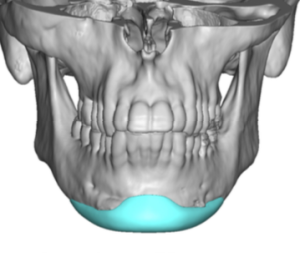
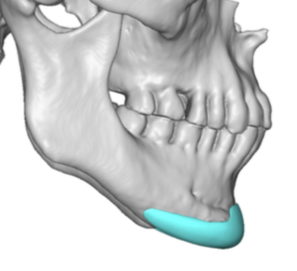 Implant should sit on the inferior mandibular border
Why it helps:
- Keeps the mentalis reattachment point unchanged
- Prevents fold “hinging” over the implant edge
Design trick:
- Slight inferior flare to lock onto the border
- Thin superior edge (knife-edge taper)
C. Long, shallow anterior projection
- Short, bulbous implants push the fold forward
- Long, gradual ramps distribute soft-tissue stretch
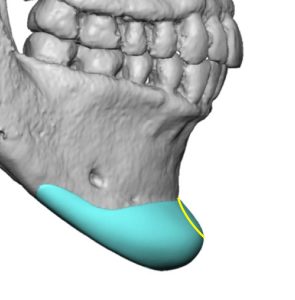 Long, gradual ramps distribute soft-tissue stretch
Ideal shape:
- Horizontally elongated
- Low profile
- Smooth anterior curvature
- Make it concave when in doubt
Think “ski jump” not “button.”
3. Superior Edge Management (often overlooked)
The superior edge is where most fold problems originate.
Design features:
- Ultra-thin superior margin (<1 mm)
- Extended posterior taper
- No abrupt transitions
This reduces:
- Soft-tissue buckling
- Visible step-off
- Crease accentuation during animation
4. Lateral extension as a fold-protective strategy
Counterintuitive but important:
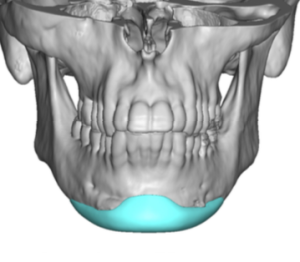
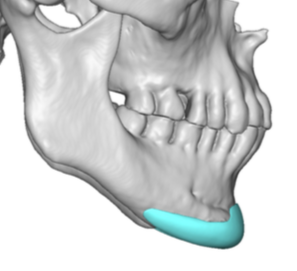 Wider implants worsen folds less than narrow ones.
Why?
- Lateral extension redistributes projection forces
- Reduces central soft-tissue tension
- Improves chin–jawline continuity
Design tip:
- Extend laterally to at least the canine root level
- Avoid sharp lateral drop-offs
5. Avoid these implant design mistakes
|
Mistake |
Fold Effect |
|
Vertical lengthening via implant |
Deepens fold |
|
High-riding implant |
Increases crease |
|
Centralized projection |
“Button chin” |
|
Thick superior edge |
Step-off deformity |
|
Overcorrection (>6 mm) |
Mentalis strain |
If the software preview looks good but violates these rules, the fold will worsen clinically.
6. Material choice considerations
While material is secondary to design:
- Solid silicone: predictable edges, easiest to thin superiorly
- Porous polyethylene: harder to taper precisely, bulky, almost always worsens the fold depth
- Titanium/PEEK: excellent precision but unforgiving of design errors, can not modify intraooperatively
Implant design dictates fold outcome not the material.
7. Surgical Execution Still Matters
Even a perfect implant design fails if:
- Implant placement too high
- Muscle is overly tightened
- Pocket is dissected too far superiorly
- Implant migrates upward, not fixed
Fold-protective technique pearls:
- Low pocket
- Secure inferior fixation
- Exact midline placement
- Submental incisional approach
8. Who is still a poor candidate—even with custom implants
Custom design cannot overcome:
- Deep preoperative labiomental fold
- Short lower facial height
- Hyperactive mentalis
- Lip incompetence at rest
In these cases, custom design is not the solution.
Practical takeaway
Custom implants can:
- Preserve a good labiomental fold
- Minimize worsening
- Reduce revision risk
They cannot:
- Soften a deep fold significantly
- Replace vertical lengthening genioplasty
- Correct mentalis dysfunction
If fold improvement is required a custom implant design is not going to improve it.
Dr. Barry Eppley
World-Renowned Plastic Surgeon