
Introduction
V-line surgery is a facial contouring procedure designed to create a slimmer, more tapered lower face—often forming a soft “V” shape from the cheeks to the chin. It’s especially popular among patients who feel their jawline looks wide, square, or heavy.
V-line surgery usually combines changes of all three segments of the lower jaw including:
- Mandibular Angle Reduction
-
- Reduces the jaw angles (back corners of the jaw)
- Softens a square or wide jawline
- Chin Surgery (Genioplasty)
-
- Narrows, shortens, or advances the chin
- Done with a sliding genioplasty, often with a midline ostectomy to narrow it.
- Jaw Body Contouring
-
- Removing the lower border of the jaw for a smoother taper
All incisions are typically made inside the mouth, so there are no visible scars.
But despite very successful lower facial narrowing effects, some patients may feel the effect is too strong (over reduced) and desire a partial or total reversal. Such “V-line reversals” refers to softening or undoing an overly sharp, narrow, or pointed lower face/jawline that resulted from the bone reduction. They can be done for the chin, jaw angles or the entire jawline.
In the vast majority of cases the most effective way to restore jaw contour is with implants. While V-line reversal is often thought about as “making the face wider” it is more about and re-establishing pre surgical jaw shape or finding a happy medium between their original jaw shape and the current over reduced one they have now.
Case Study
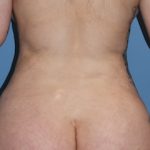
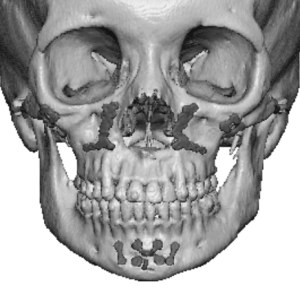 This young female had V line surgery with chin narrowing by a midline wedge resection. While the chin healed well with good bony healing she felt that it was too narrow and there were side indentations.
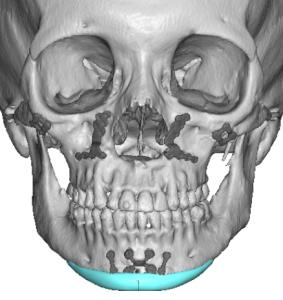
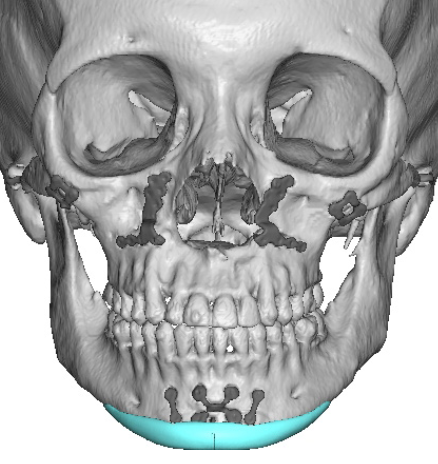
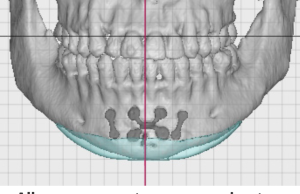 Her goal was to restore some roundness to the chin and fill in the side indentations. Using her post V line surgery scan an extended custom chin implant was designed to create the desired shape change. It rounded out the chin with long thin wings back along the inferior border of the jawline.
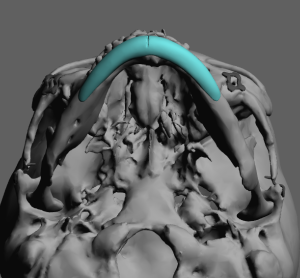
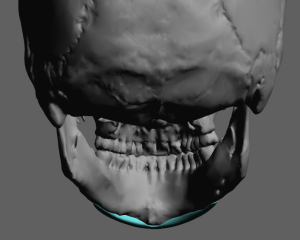 The 3D viewer file of the chin implant design shows how the implant reversed the chin narrowing effect by inferolateral border augmentation.
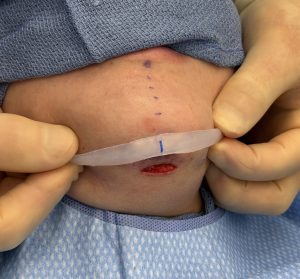
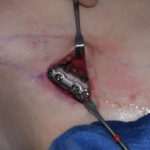
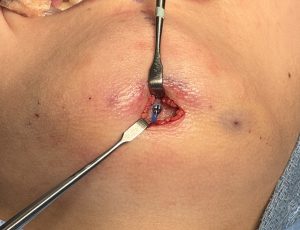 Through a small submental incision a subperiosteal pocket was created through which the implant was introduced and positioned. A single microscrew was placed for fixation. A few resorbable sutures closed the incision.
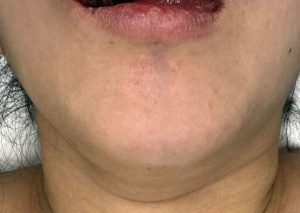
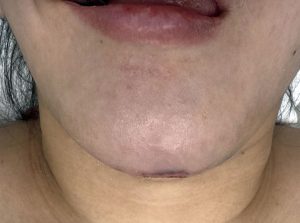 The immediate rounding effect of the chin was achieved.
Discussion
Mini V-line surgery narrows and reshapes the lower jaw/chin by bone reduction and contouring. While it may be possible in some cases to undo these bony changes by recutting the bone and repositioning or bine grafting, a custom chin implant after mini V-line surgery provides the most reliable method of partial or complete restoration of chin shape
A custom implant can provide a broad range of chin shape changes including:
- Restore or enhance projection lost during bone reduction
- Improve vertical length if the chin became too short
- Wide the V-line shape without widening the jaw
Why custom instead of a standard implant?
After V-line surgery, the chin bone is no longer a “normal” shape.
A custom implant is preferred because it:
- Fits the post-surgical bone anatomy precisely
- Avoids pressure points on thinned or altered bone
- Allows asymmetry correction
- Can be designed for vertical, horizontal, or combined changes
- Reduces risk of implant shifting or visibility
Custom chin implants are made from a post op 3D CT scan. A preop V line surgery scan for comparison would be ideal but this is rarely available. Often times pictures of the before scan his available but the scan data is needed for accurate comparison
Restorative custom chin implants can be placed .6–12 months after V-line surgery. This allows full bone healing and stabilization. The most commonly used implant material is solid medical-grade silicone (Silastic) as it offers fine edging to feather into the surrounding bone. It is also easily reversible if needed.
Surgical approach
- While V line surgery may have been done intraorally the submental approach provides the accurate placement and the lowest risk of infection.
- Implant is secured to bone with micro screws for permanent fixation.
- Surgery time: ~1 hour or less
- Outpatient
Recovery
- Swelling: 2–4 weeks, subtle residual swelling up to 3 months
- Tightness/numbness: common early, usually improves
- Return to normal activities: ~7–10 days
- Final contour: 3–4 months
Key Points
1) Partial or full restoration of mini V line changes is most reliably done by a custom chin implant design.
2) A preop V line 3D CT scan is ideal for chin implant planning but often not available.
3) As most implant reversals involve augmentation along the inferior border a submental approach is best for accurate implant placement in a scarred tissue bed.
Barry Eppley, MD, DMD
World-Renowned Plastic Surgeon