
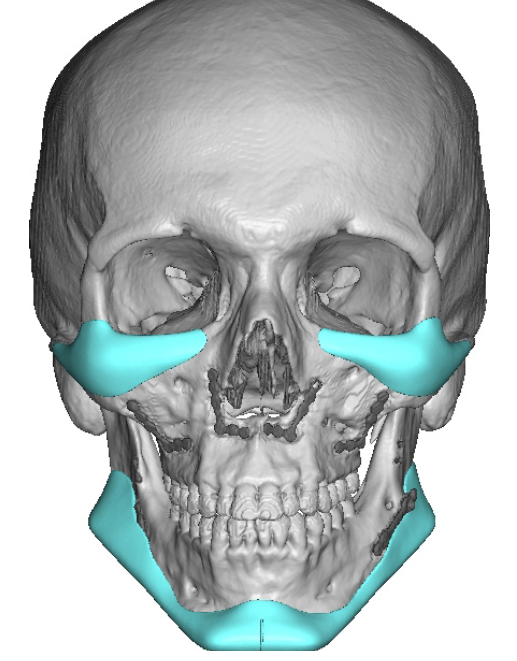
Custom facial implants can be an excellent adjunct to double jaw surgery when skeletal movements alone don’t fully achieve the desired facial shape or proportions. Double jaw surgery mainly affects bone projection and some degree of vertical length. But it can not increase width or make changes in the shape of the bones moved.
Here’s how they fit into the treatment plan and what to consider.
Why implants may be needed after double jaw surgery
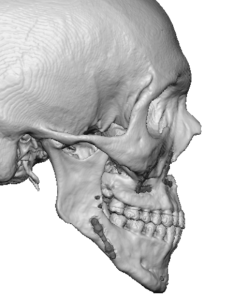 Even with ideal maxillary and mandibular repositioning, some patients are left with:
- Flat or deficient midface / infraorbital support
- Weak malar (cheek) projection
- Insufficient jawline or chin width/definition
- Asymmetries that become more noticeable once occlusion is corrected
Orthognathic surgery corrects bite and global jaw position; implants refine contour, width, and projection.
Common Custom Implant Options
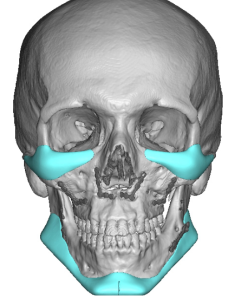
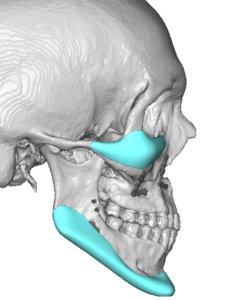 Custom facial implant areas are designed from a postop 3D CT scan and fit precisely to the bony anatomy.
- Cheek / Malar implants – enhance cheekbone projection and midface fullness
- Infraorbital–malar implants – improve under-eye hollowing and midface support
- Jaw angle implants – add width and definition to the lower face
- Chin implants – refine shape, vertical length, or asymmetry (beyond sliding genioplasty results)
- Wraparound jawline implants – continuous contour from angle to chin
Timing: Staged vs. combined
- Most commonly staged: implants placed 6–12 months after jaw surgery
- Allows bone healing, swelling resolution, and stable soft tissue position
- Occasionally combined with jaw surgery
- Only in highly planned cases (virtual surgical planning) of both osteotomies and custom implant designs.
Advantages of custom implants
- Exact fit to healed skeletal anatomy
- Lower risk of shifting or malposition
- Ability to correct subtle asymmetries
- More natural transitions compared to stock implants
Material Options:
- Silicone (easiest to place and revise)
- Porous polyethylene (Medpor) (tissue ingrowth, hard to revise)
- Titanium (small structural areas)
- PEEK (rigid, not available in U.S.)
Key planning considerations
- Post-orthognathic 3D CT scan is essential
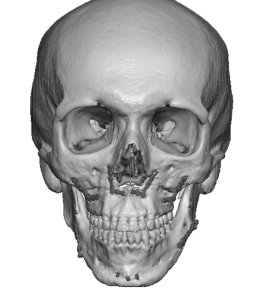
- Must account for plates, screws, and bone cuts
- Soft tissue response matters as much as bone position
- Experience with both orthognathic surgery and custom implants is the ideal surgeon
Who is a good candidate?
- Patients happy with their bite but not overall facial balance
- Those seeking refinement rather than major skeletal movement
- Patients with residual bony asymmetries
- Upper facial areas left behind from the upper and lower jaw advancements
Bottom line
Custom facial implants are often the finishing step after double jaw surgery—transforming a functionally correct result into a harmonious, well-shaped face. When properly planned and timed, they can dramatically improve facial aesthetics without altering the bite again.
Dr.Barry Eppley
World-Renowned Plastic Surgeon