
Introduction
Improving the appearance of the jaw angle region after prior implant augmentation is not uncommon and is usually very fixable. The correct solution, however, depends on the specific failure pattern of the original implant. Key questions include: Where is the current implant positioned? and What additional dimensions are needed to achieve an improved jaw angle appearance?
Below is a structured, problem-based approach I use to enhance jaw angle aesthetics after prior augmentation. This discussion assumes the original procedure involved a custom jawline implant and that a postoperative 3D CT scan is available to fully evaluate implant position relative to the external appearance.
1. Malposition or Asymmetry (Too High or Too Low)
Problem
- Jaw angle fullness is misplaced
- Poor angle definition
- Jaw angle asymmetry
Best Strategy
- Implant repositioning
- Intraoral or external incisional approach
- Screw fixation is mandatory
Key Point
A jaw angle implant that is positioned too high or too low can often be corrected through implant manipulation alone. This frequently involves adjustment of only one side of a wraparound jaw implant.
2. Inadequate Size or Shape
Problem
- Implant design underperformed
- Insufficient width and/or vertical drop
- Desired masculine angle shape not achieved
Strategy Options
1) Custom Jawline Implant Replacement
- A newly designed custom implant that expands or modifies the existing design
- Addition of a posterolateral flare, which is critical for true angularity
- In some cases, increasing implant width alone may be sufficient
- Often the best option if other portions of the jawline implant would also benefit from redesign
2) Overlay Implant Augmentation
- Placement of a custom implant that builds on the existing implant footprint
- Vertical lengthening and/or width increase may be required
- Posterolateral flare is most commonly needed
- Usually requires an external incisional approach for more reliable placement
- Screw fixation must pass through both implants and into bone to ensure stability
Key Point
Overlay implants are ideal for patients who wish to avoid a repeat intraoral approach and the increased infection risk associated with intraoral access. The trade-off is a small external scar hidden just behind the jaw angle.
This approach is typically indicated when the desired improvement does not require a major or radical change. If the amount of shape enhancement does not justify complete implant removal, redesign, and replacement, an overlay implant is often the preferred solution.
Case Study
This male patient previously underwent placement of a custom jawline implant. While the procedure improved overall jawline contour, it did not achieve the degree of jaw angle definition he desired.
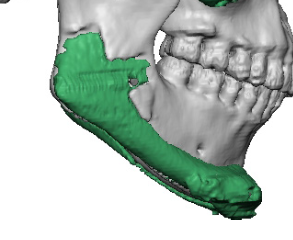
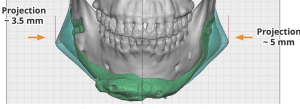
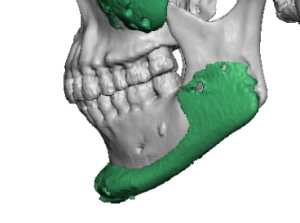 A postoperative 3D CT scan demonstrated generally good implant positioning. The right side was ideally placed, while the left implant stopped short of the posterior border of the mandibular ramus—a discrepancy that was not externally noticeable to the patient.
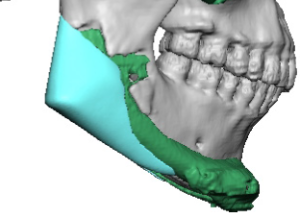
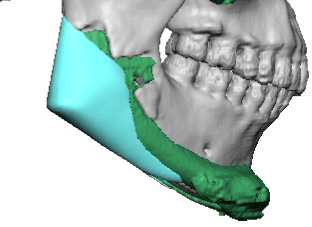
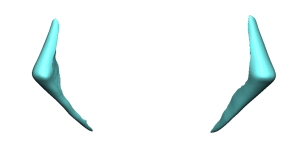
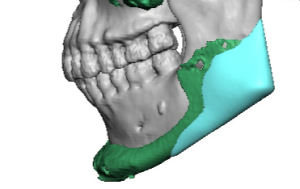 Custom jsw angle implant overlays were designed to sit on top of the existing jaw angle portions of the wraparound implant. These overlays added a downward and outward flare, enhancing angular definition. Each overlay implant had a total volume of 3 cc per side.
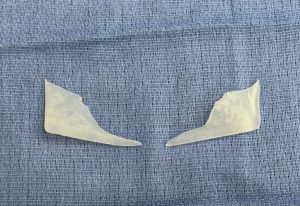
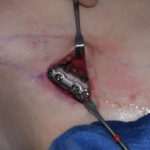
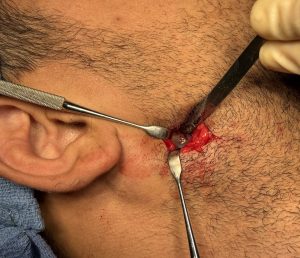 Placement of the custom jaw angle implant overlays were done throigh a 2.5cm incision placed directly over the back end of the existing implants. Once the implant pocket was opened the implantys were slide into position and secured with a long drilled screw through both implants into the bone.
Discussion
Custom jaw angle implant overlays are patient-specific implants designed to sit on top of an existing mandibular angle implant rather than replacing it. They are used to enhance jaw angle definition and/or correct asymmetry resulting from limitations in the original implant’s design, size, or placement.
What “Overlay” Means
- The implant adds volume externally to the existing mandibular angle implant
- Often referred to as “toppers” or topper implants
- No removal of the underlying implant is required
- Precisely designed using CT-based 3D modeling to match the existing implant
 Design Priorities (in Order)
- Inferior drop (defines the angle)
- Posterior corner definition (creates the angle point)
- Lateral flare (sets squareness)
- Anterior taper and blend (prevents step-off)
- Superior feathering (prevents palpability)
Revision Guardrails
- Keep the thickest portion posterior, not anterior
- Feather anterior and superior edges to a “disappearing” margin (often ~1 mm)
Result: An overlay implant that appears angular while blending smoothly with surrounding anatomy.
Key Takeaways
- Jaw angle overlay implants avoid the need to replace an entire existing implant, reducing surgical risk and recovery time.
- Custom overlay implants solve over 90% of jaw angle revision shape issues.
- Direct external access provides the most reliable positioning and fixation for overlay jaw angle implants.
Dr. Barry Eppley
World-Renowned Plastic Surgeon