
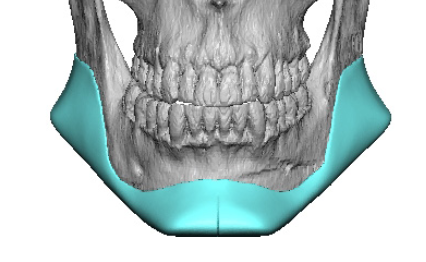
A custom jawline implant replacement is often a smart move for patients who already have standard (off-the-shelf) chin and jaw angle implants but want a continuous, connected and enhanced jawline result.
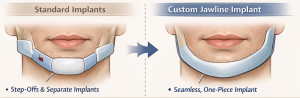 Why replace standard chin + jaw angle implants with a custom jawline implant?
Standard implants:
- Come in fixed sizes and shapes
- Treat the chin and jaw angles as separate units
- Often leave:
- Step-offs or gaps between implants
- Asymmetry
- Over- or under-projection in certain areas
- A less smooth mandibular border
A custom jawline implant:
- Is designed from a 3D CT scan
- Treats the jawline as one continuous structure
- Precisely matches the patient’s bone anatomy
Case Example
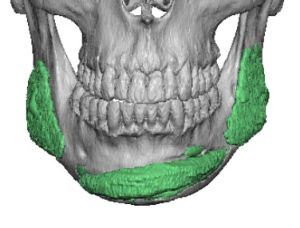
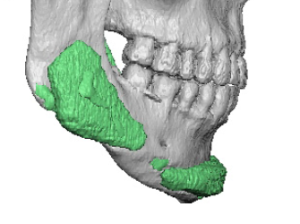
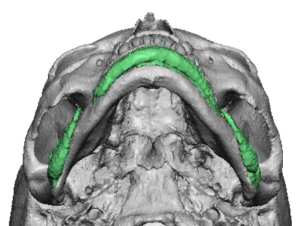 This young male had standard chin and jaw angle implants placed five years previously.While it was an improvement over his natural jawline size and shape he always wished it was an ever more pronounced enhancement. He also felt that the chin implant was asymmetric in placement. A 3D CT scan showed the location of his implants with chin implant asymmetry and jaw angle implants that were placed too far anterior compared to his bony jaw angles.
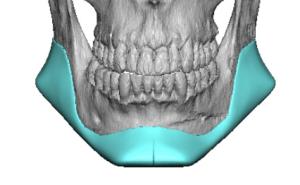
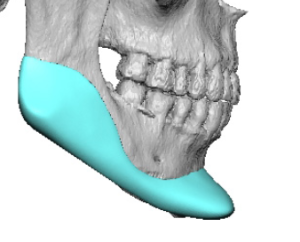
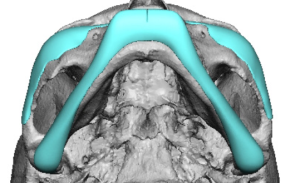 A one-piece custom jawline was designed that not only addresses the standard implant issues but added greater augmentation effects at the three corners.
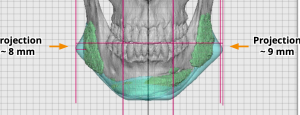
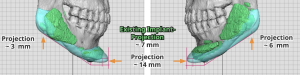 An important consideration in custom implant replacements for existing implants is to compare them by an overlay of both implants to see and understand the differences.
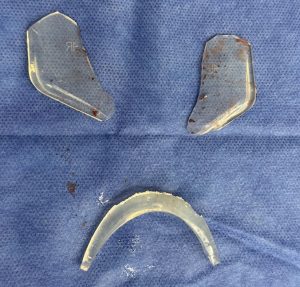
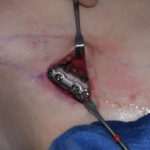
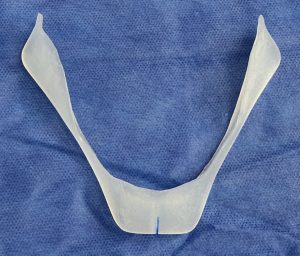 At the replacement surgery a comparison of the standard implants removed to it’s custom replacement showed their significant differences.
Discussion
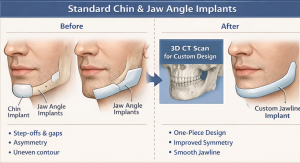 A custom jawline implant offers these advantages over any off the shelf implant(s).
1. One-piece or integrated design
- Replaces chin + jaw angles + mandibular body in a single implant
or - Uses interlocking custom segments that align perfectly
This eliminates visible transitions and irregular contours.
2. Improved symmetry
- Corrects pre-existing asymmetries that standard implants can’t address
- Especially useful if:
- One jaw angle is more prominent
- Chin is off-center
- Prior implants shifted or healed unevenly
3. More natural mandibular contour
- Smooth inferior border from angle ? body ? chin
- Better control over:
- Width vs. projection
- Masculinization or soft definition
- Vertical jaw height if desired
4. Predictable replacement surgery
- Existing implants are removed
- Custom implant is designed knowing the prior implant footprints
- Allows:
- Pocket correction
- Improved fixation (screws)
- Reduced risk of migration compared to standard implants
Common indications for replacement
- “Disconnected” look between chin and jaw angle implants
- Visible implant edges
- Asymmetry after healing
- Desire for stronger or smoother jawline
- Revision after implant malposition or dissatisfaction
Material & design considerations
- Solid silicone is most common (predictable, removable)
- Designed to:
- Avoid mental nerve and inferior alveolar nerve
- Match occlusion and mandibular curvature
- Screw fixation is standard for stability
Recovery considerations
- Often similar to or slightly longer than original implant surgery
- Swelling may last longer due to broader dissection
- Final contour assessment usually at 8–12 weeks
Dr,. Barry Eppley
Plastic Surgeon