
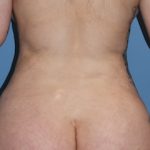
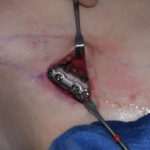
The midface is a unique facial implantation area because it is a combination of a high bony convexity (infraorbital-malar) and a large more inferior maxillary concavity. This creates well known midfacial augmentation areas for which numerous standard implants have been designed with an extensive clinical history of use. But such standard implant styles and sizes do not work for every patient’s midface needs. As a result custom implant designs are available which can address what standard implants can not achieve.
Stock or Standard Midface Implants
What they are
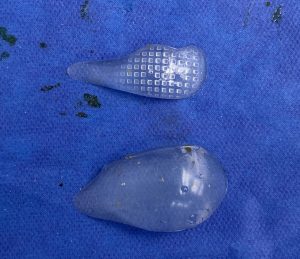
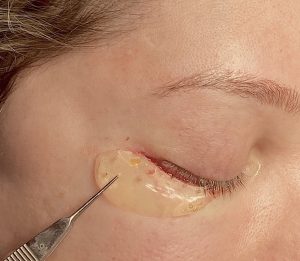
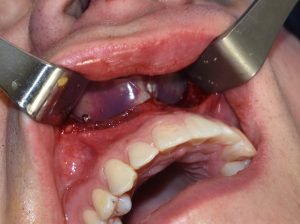 Pre-manufactured implants in standard shapes and sizes (small/medium/large) and are typically perceived as cheek implants of different styles (malar, submalar, malar-submalar combo). But there are also smaller implants (tear trough, paranasal, premaxillary) for spot areas of midface augmentation as well. the
Materials
- Solid silicone (most common)
- Porous polyethylene (Medpor)
Advantages
- No preoperative CT scan required
- Lower cost
- Immediately available
- Straightforward surgery
- Easy to remove or revise (silicone)
Limitations
- One-size-fits-many, not one-size-fits-you
- May require intraoperative trimming
- Less precise fit to complex anatomy
- Higher reliance on surgeon positioning skill for symmetry
Best suited for
- Mild to moderate volume or projection needs
- Patients with fairly symmetric midfaces
- Subtoe or modest cosmetic enhancement rather than reconstruction
- First-time cheek augmentation
Custom Midface Implants
What they are
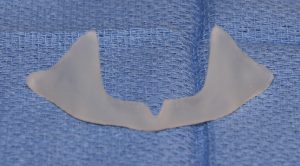
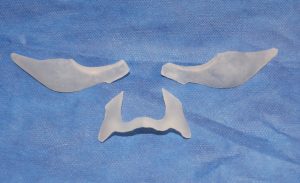
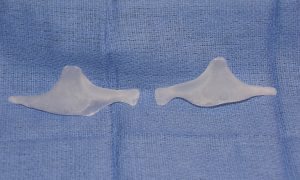 Individually designed implants created from the patient’s 3D CT scan, tailored to the patient’s skeletal anatomy and an understanding of their aesthetic goals.
Materials
- Solid silicone (custom-milled)
- Porous polyethylene (Medpor)
- PEEK (not available in U.S.)
Advantages
- Exact anatomic fit to the bone
- Superior symmetry and contour control
- Ability to control projection, width, and shape in millimeters
- Can correct asymmetry, deficiencies, or post-traumatic deformities
- Less need for intraoperative adjustment
- Screw fixation for implant position maintenance and optimal implant adaptation to the bone
Limitations
- Higher cost
- Six to eight weeks for design and manufacturing
Best suited for
- Significant midface deficiency
- Noticeable facial asymmetry
- Prior implant or filler complications
- Revision implant cases
- Need for unique or specific contour outcomes
- Patient need for preoperative knowledge/control of implant dimensions
Key Differences at a Glance
|
Feature |
Off-the-Shelf |
Custom |
|
Design |
Standard sizes |
Patient-specific |
|
Imaging |
Not required |
CT-based |
|
Fit |
Approximate |
Exact |
|
Symmetry control |
Moderate |
Excellent |
|
Cost |
Lower |
Higher |
|
Lead time |
Immediate |
6–8 weeks |
|
Revision ease |
material dependent |
material dependent |
|
Precision |
Surgeon-dependent |
Design-driven |
A practical way to choose
- “Enhancement” goal ? Standard implant
- “Correction” goal ? Custom implant
- Asymmetry or skeletal deficiency ? Custom implant
- Desire for reversibility ? stock or custom silicone
- Revision surgery ? Almost always custom implant
- Specific augmentation effect – custom implant
Dr. Barry Eppley
World-Renowned Plastic Surgeon