
Why replace standard cheek implants with a custom midface implant?
Standard cheek implants (malar, submalar, or combined) are one-size designs. They work fine for isolated cheek augmentation, but they often fall short when:
- There is midface deficiency (infraorbital rim, paranasal, maxillary support)
- The implant looks “stuck on” rather than skeletal
- There’s aging-related midface collapse
- The patient has asymmetry
- Prior implants look artificial, migrate, or feel palpable
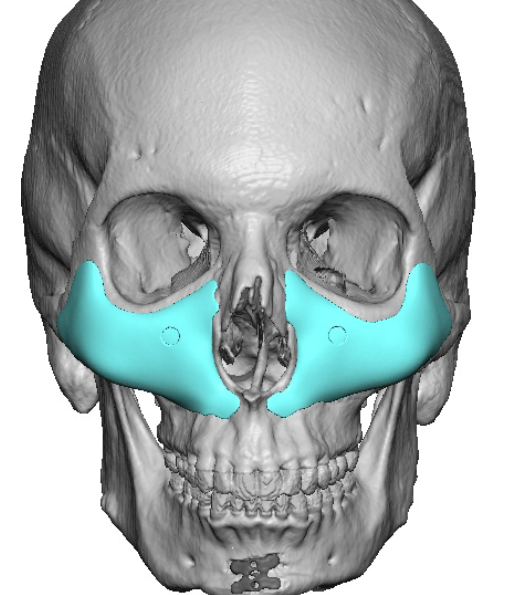
A custom midface implant treats the cheek as part of a continuous skeletal unit, not a single bump or isolated area of midface augmentation.
What makes a custom midface implant different?
Coverage
- Extends beyond the malar eminence into:
- Infraorbital rim
- Maxillary body
- Paranasal region (if needed)
- Can replace malar-only or malar + submalar implants with one piece
Design
- Built from a CT-based 3D model
- Designed to sit flush on bone
- Controlled projection vectors (lateral, anterior, inferior)
Fixation
- Screw fixation (usually 1–2 screws per side)
- Lower risk of placement asymmetrythan standard implants
Case Study
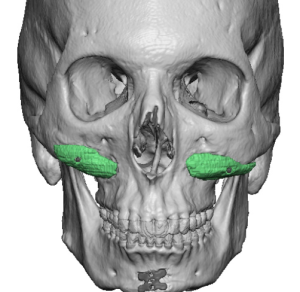
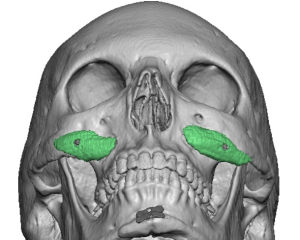
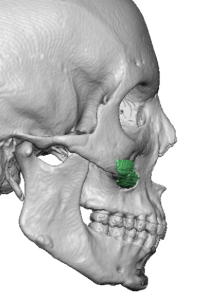 This young female wanted a more complete and fuller moidcace augmentation effect than what the localized cheek implants she initially had. She had submalar implants placed over the maxilla just under the infraorbital nerve. Their effect was limited to increasing fullness above the nasolabial folds.
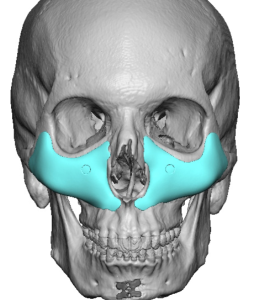
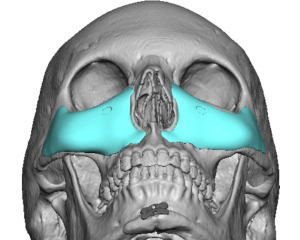
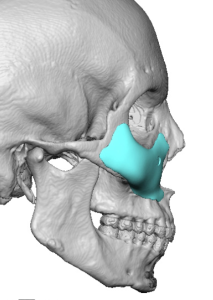 A custom midface mask implant was designed that covered the entire midface with the exception of the premaxillary which she felt did not need to be augmented.
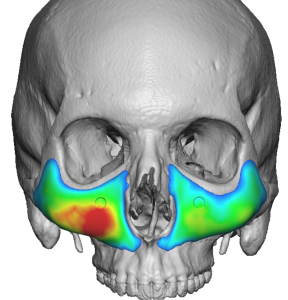 She had significant midface asymmetry with the right maxilla and cheeks more recessed than that of the left which required more material as seen in the color thickness mapping. This also accounted for why the right implant had 7.5ccs off volume while the left had 5.0ccs of volume.
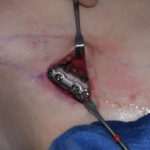
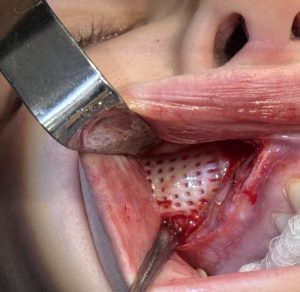 In her replacement surgery an intraoral approach was used to remove the existing cheek implants. The capsule on the bone was very thick and had grid pattern to it as a result of the mesh style cheek implant. This necessitated that the thick capsule be removed along with the implants.
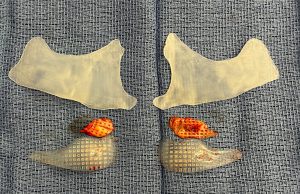 Comparing the custom midface mask implant replacements to the standard cheek implants showed the large surface area difference.
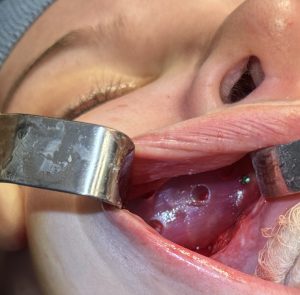
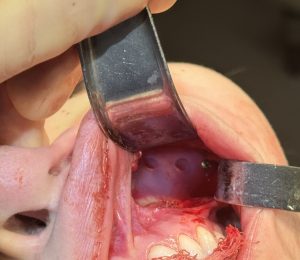 The custom implant replacements were inserted after further pocket surface area was extended. This require a hole to be made for the infraorbital nerve as well as the placement of numerous perfusion holes to allow for tissue ingrowth. Two screws were used in each side for fixation.
Discussion
There are many examples of when a custom midface implant would be a good cheek implant eplacement.
1. Standard malar implant ? Custom midface implant
Best when:
- Cheek projection is okay, but the midface looks flat or aged
- There’s infraorbital hollowing or poor lid–cheek transition
Result:
More natural cheek contour + smoother lower eyelid support
2. Submalar implant ? Custom midface implant
Best when:
- The face looks heavy or “sagged”
- The submalar fullness is too low or medial
Result:
Lifted, skeletal definition instead of soft-tissue bulk
3. Combined malar + submalar ? Single custom implant
Best when:
- Two implants look disconnected
- Edges are visible or palpable
Result:
Unified contour, fewer edges, cleaner anatomy
4. Failed or malpositioned cheek implants
Best when:
- Asymmetry
- Insufficientt augmentation effect
- Implant show
- Chronic dissatisfaction despite correct placement
Result:
Precision correction rather than trial-and-error revisions
Materials typically used
- Solid medical-grade silicone
- Still the gold standard for facial custom implants
- Predictable, removable, modifiable
- Occasionally:
- Porous polyethylene (less common for large midface spans due to bulky designs without feather edging)
- PEEK (not available in the U.SO)
Surgical considerations
- Approach: Intraoral (most common) + lower lid if infraorbital rim component significant
- Pocket: Existing implant pocket often reused and expanded
- Timing:
- Immediate replacement is common
- Delayed replacement if infection or severe capsule issues
 Advantages over standard cheek implants
 Advantages over standard cheek implants
? More natural contour
? Better lower eyelid support
? Improved facial balance
? Reduced revision risk
? Long-term stability
Downsides
- Higher cost
- Requires CT scan + design time
- Less intraoperative flexibility (but better pre-op control)
Bottom line
If the goal is true midface enhancement rather than just “bigger cheeks,” custom midface implants are a clear upgrade over standard cheek implants—especially for replacement cases.
Dr. Barry Eppley
World-Renowned Plastic Surgeon