
A custom wrap-around jawline implant is one of the most effective surgical options for correcting jaw asymmetry, particularly when the asymmetry involves:
- Uneven mandibular angles
- One side of the jaw that is flatter or smaller
- Chin deviation with posterior jaw deficiency
- Hemifacial skeletal underdevelopment
- Imbalance from prior surgery
What “Wrap-Around” Means
A wrap-around implant is a single-piece, custom-designed implant that:
- Extends from one mandibular angle
- Follows the inferior border of the jaw
- Crosses the chin
- Continues to the opposite angle
Unlike separate chin and angle implants, this design:
- Creates a continuous, seamless contour
- Eliminates step-offs between components
- Allows precise three-dimensional asymmetry correction
In asymmetry cases, the implant is intentionally uneven — thicker on the deficient side and thinner (or minimal) on the stronger side.
Why Custom (Not Standard) Implants Are Essential
Standard implants are symmetrical. Jaw asymmetry is not.
Effective correction requires:
- 3D CT scan–based design
- Digital mirroring of the stronger side
- Differential vertical and horizontal augmentation
- Precise correction of chin deviation
A custom implant allows:
- Vertical lengthening on one side
- Widening of one angle
- Centering of the chin midline
- Straightening of the lower border
What It Can and Cannot Correct
It Can Correct:
? Lower border cant
? Jaw width asymmetry
? Posterior angle underdevelopment
? Chin off-center appearance
? Mild vertical jaw height differences
It Cannot Correct:
? Significant occlusal (bite) cant
? Severe skeletal rotation
? Functional jaw discrepancies (these require orthognathic surgery)
Ideal Candidates
- Skeletal asymmetry without major bite problems
- Good skin elasticity
- Realistic expectations
- Desire for structural correction rather than soft tissue fillers
Case Study
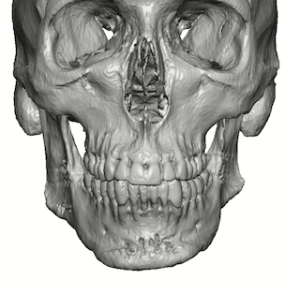
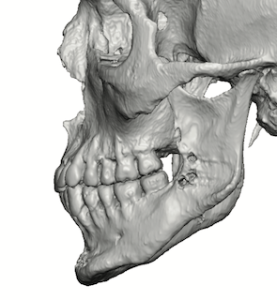 This male desired an improved lower jaw shape with mmoer visible definition and correction of a jaw angle asymmetry. He had prior history of double jaw surgery. His 3D CT scan showed the higher left jaw angle by about 1 cm.
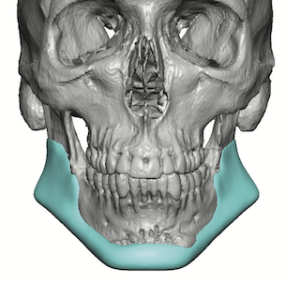
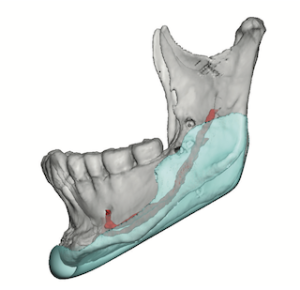 A custom jawline implant was designed that corrected angle asymmetry with an increased vertical length on that side.
Surgical Approach
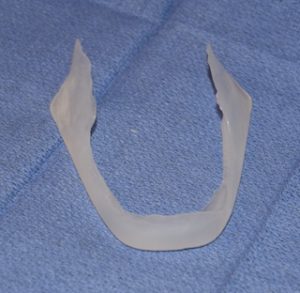 Implant placement was performed using:
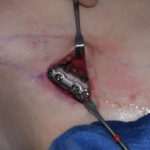
- A combined intraoral and limited external approach
- Single external submental incision
- Bilateral intraoral incisions
- Subperiosteal pocket creation along the entire jawline
- Implant fixation with titanium screws
Surgery time: Approximately 2 hours
Anesthesia: General
Recovery
- Swelling: 3–6 weeks (most improves by 4 weeks)
- Jawline tightness is common
- Temporary lower lip numbness is possible
- Return to work: 10–14 days (depending on swelling tolerance)
- Final definition: approximately 3–4 months
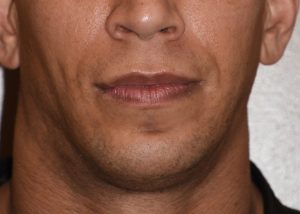
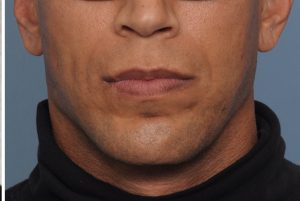 Long-term follow-up shows significant improvement in asymmetry with enhanced jawline definition.
Discussion of Risks
While custom jawline implants are ideal for many aesthetic asymmetry patients, they carry specific risks, including:
- Under- or over-correction
- Persistent soft tissue asymmetry despite skeletal correction
- Mental nerve irritation
- Infection (low risk but slightly higher than chin-only implants)
- Implant palpability in patients with thin soft tissue at the jaw angles
Proper 3D planning significantly reduces these risks.
Important Concept: Skeletal vs. Soft Tissue Asymmetry
In many patients, jaw asymmetry is primarily skeletal. However, a soft tissue component may also contribute, including:
- Muscle hypoplasia or hyperplasia
- Fat distribution differences
- Soft tissue thickness variation
A CT scan helps differentiate these components. Implant surgery corrects bone framework asymmetry — not soft tissue imbalance. As a result, skeletal correction may not always produce perfect external symmetry.
Dr .Barry Eppley
Plastic Surgeon