
If an ear “sits too low,” you’re usually talking about vertical malposition of the ear, not projection (how far it sticks out). That’s a more specialized issue than a standard otoplasty.
Here’s the reality: there isn’t a simple “ear lift” like there is for the face. Fixing a low-set ear typically means surgically repositioning the ear higher on the head, and that’s more complex.
What determines ear position
Ideally, the ear sits:
- Between the brow level (top of ear) and
- The base of the nose (bottom of earlobe)
If it’s lower than that, it can look slightly “dragged down” or off-balance with the face.
By regardless of the ideal position of the ear on the side of the head when one ears sits lower than the other (vertical ear asymmetry) the higher ear is the ‘ideal’ position.
Vertically elevating the ear is far different than a standard otoplasty procedure. Rather than reshaping part of the outer ear through cartilage folding/excision in vertical ear elevation the entire cartilage framework is released and shifted superiorly.
Case Example
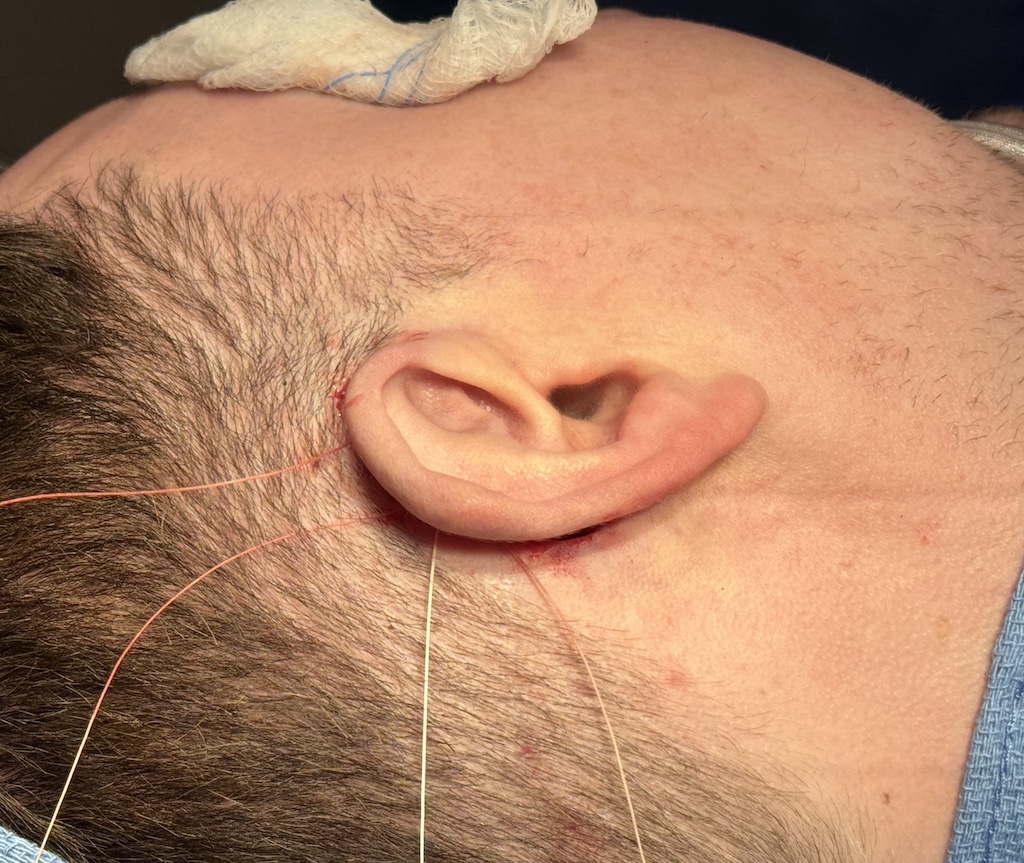
This male had a congenital right facial hypoplasia with all facial features on that side sitting lower. This included the right ear which was 7mms lower than that of the left.
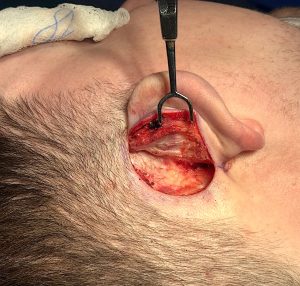 Under anesthesia a postauricular incision was made the full length of the crease. The carilage framework was undermined and released from the fascia.
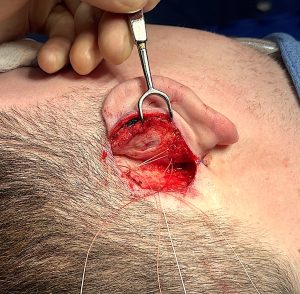
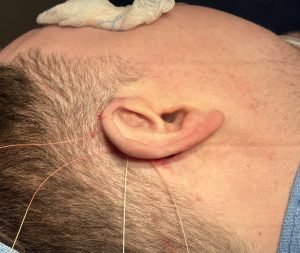 Multiple sutures were placed between the concha of the cartilage framework and high above the ear into the deep temporal fascia. Once tightened the ear was lifted vertically until it reached the level of the opposite higher ear.
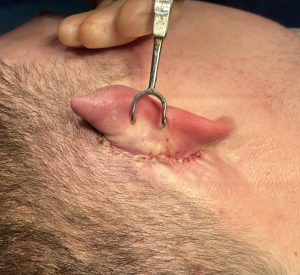 The postauricular incision was close with resorbable sutures taking into account the shifted position of the two sides of the incision.
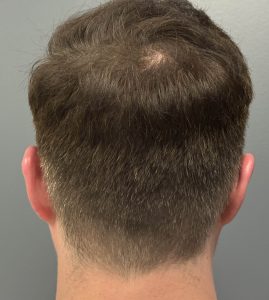
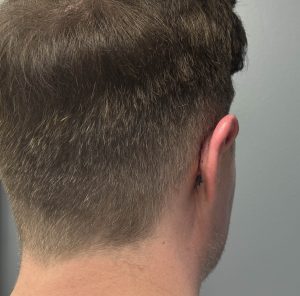 Near vertical leveling of the two ears was now achieved.
Discussion
Does a low set ear create any physical problems
On their own, low-set ears don’t usually cause any physical problems. They’re mainly a difference in appearance, not a functional issue.
When low-set ears are isolated
- Hearing: Typically normal
- Balance: Not affected
- Ear function: No impact on ear canal or inner ear
- Pain/discomfort: None
In short, if it’s just ear position, there are no physical limitations or health problems.
But there can be subtle practical issues (less medical, more functional/cosmetic):
- Glasses or masks may fit slightly differently
- Some helmets/headgear may sit differently
This is usually the motivation for the request for a vertical ear lift. While an ear lift can provide improvement it has limitations
Important limitations
A vertical ear lift produce subtle improvements only—you can’t move it dramatically higher without looking unnatural
- You can’t raise the ear a large distance safely
- Overcorrection looks unnatural fast
- Blood supply and skin tension limit how much movement is possible
- It’s a precision procedure, not a dramatic transformation
Bottom line
Vertical elevation of the ear is a more complex type of otoplasty in which the low set ear(s) may not be fully correctable.
Dr. Barry Eppley
Plastic Surgeon