
Introduction
Female forehead augmentation is designed to enhance a forehead that is flat, concave, irregular, or under-projected by creating a smooth, gently convex, feminine contour. Unlike forehead feminization surgery (FFS), which primarily reduces or sets back bone, forehead augmentation adds volume to refine shape and curvature.
The goal is not exaggeration, but subtle refinement. In many female patients, modest changes produce the most aesthetically pleasing and natural results.
Aesthetic Goals (Female Forehead Ideals)
- Smooth, continuous, slightly convex curve from hairline to brows
- Absence of sharp angles or step-offs
- Soft transitions into the brow and temporal regions
- Balanced projection without bulging
Female forehead augmentation is fundamentally about shape refinement rather than size increase.
Main Techniques
1. Fat Grafting (Easiest To Do)
Best for:
- Mild concavity
- Minor contour irregularities
- Subtle soft-tissue feminization
Fat is harvested from the abdomen or thighs and injected in layered planes to improve contour.
Advantages
- Minimally invasive
- Natural feel and appearance
- Uses autologous tissue
Limitations
- Unpredictable fat survival
- Risk of asymmetry or irregularities
- Difficult or impossible to reverse
2. Bone Cement (PMMA or HA-Based)
Best for:
- Moderate forehead projection and contour enhancement
Bone cement is sculpted directly over the frontal bone to create permanent shape change.
Advantages
- Stable, predictable contour
- Greater projection than fat grafting
Limitations
- Requires a long scalp incision
- Placement and shaping must be done under direct visualization
3. Custom Forehead Implant (Most Effective)
Best for:
- Significant congenital flatness
- Precise and specific shape changes
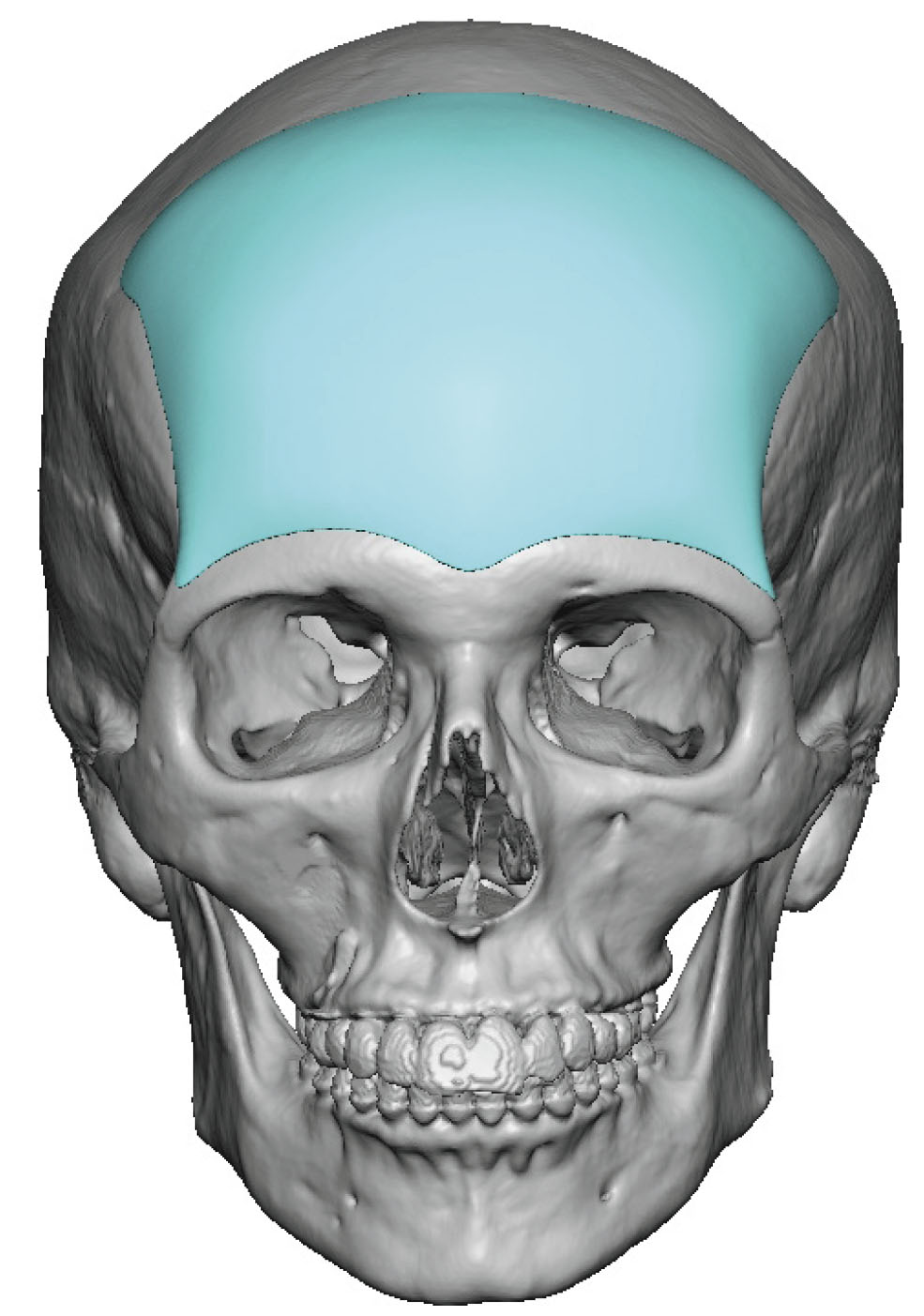
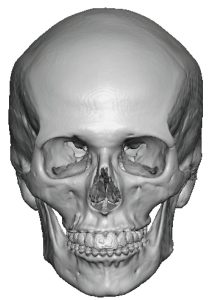
A patient-specific implant is designed from a 3D CT scan of the skull.
Advantages
- Exact preoperative shape control
- Most powerful and predictable method
- Can be placed through a smaller scalp incision than bone cement
Limitations
- Higher cost
- Implant-related considerations
Recovery Comparison
|
Method |
Downtime |
Swelling |
Final Result |
|
Fat grafting |
5–7 days |
Mild–moderate |
~6 weeks |
|
Bone cement |
10–14 days |
Moderate |
~3 months |
|
Implant |
2–3 weeks |
Moderate–high |
~3 months |
How This Differs From Forehead Feminization Surgery (FFS)
- Forehead augmentation adds volume, while FFS usually removes or sets back bone
- Used in cisgender women and transgender women who already have a feminine skeletal framework
- Can be combined with brow lifting, hairline advancement, or temple augmentation
Key Point: Forehead augmentation emphasizes curvature, softness, and continuity—not size.
Case Study
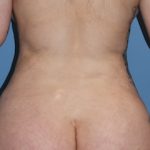
This female patient sought forehead augmentation for a recessed and vertically short forehead. She had a low frontal hairline with a vertical forehead height of approximately 5 cm. Her goals included increased convexity, a more vertical forehead slope, and subtle vertical lengthening of the forehead.
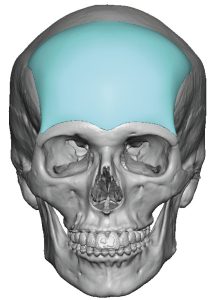

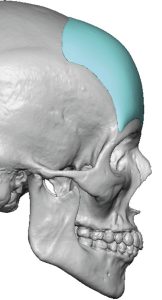 A custom forehead implant was designed to begin just above the brow bones and extend well behind the frontal hairline. Peak projection measured 5 mm in the upper forehead, tapering laterally to the bony temporal lines.
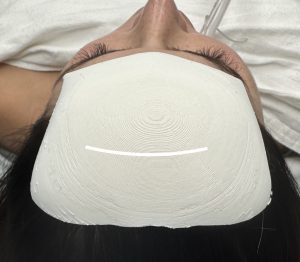
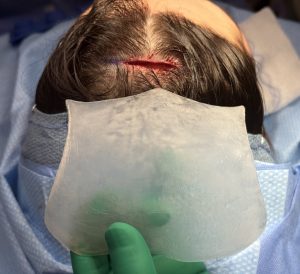 Under general anesthesia, a horizontal scalp incision was made approximately 5 cm behind the frontal hairline, based on the posterior extent of the implant. A 3D-printed model of the implant was used for intraoperative reference.
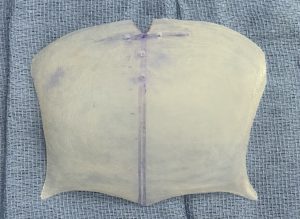
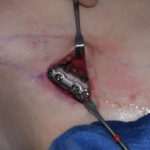
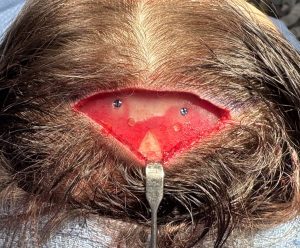 Through this incision, a subperiosteal pocket was developed across the entire forehead. Due to limited visibility, the implant was prepared with midline markings to ensure accurate positioning. The implant was placed, precisely positioned, and secured with two microscrews. The incision was closed with resorbable sutures, and no drain was required.
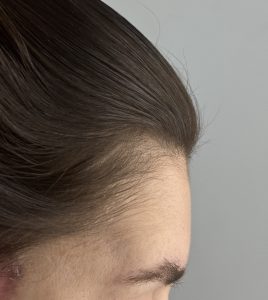

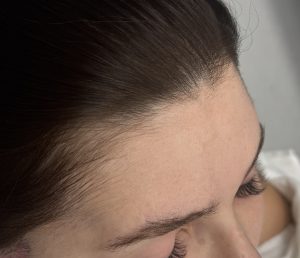
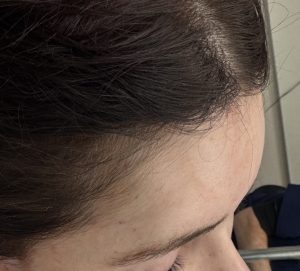 Immediate postoperative results demonstrated a visibly improved but natural forehead contour, without an over-augmented appearance.
Discussion
All methods of female forehead augmentation can be effective, but each addresses different anatomical problems. The correct choice depends on the degree of skeletal versus soft-tissue deficiency—not simply the desire for more volume.
1. What Each Method Accomplishes
Fat Grafting
- Adds soft-tissue volume
- Smooths mild concavities and surface irregularities
- Works in subcutaneous and subgaleal planes
- Best described as surface refinement
Structural Augmentation (Bone Cement or Implant)
- Alters the skeletal contour
- Corrects true bony flatness or indentation
- Creates a stable, architectural curve
- Best described as shape creation
2. Indications (Key Distinction)
|
Forehead Anatomy |
Best Choice |
|
Mild concavity |
Fat grafting |
|
Diffuse bony flatness |
Structural augmentation |
|
Sharp bony step-off |
Structural augmentation |
|
Soft-tissue deficiency only |
Fat grafting |
|
Post-trauma or congenital defect |
Structural augmentation |
|
Minor asymmetry |
Fat or combination |
If the forehead remains flat when the skin is pulled taut, fat grafting alone will be insufficient.
3. Precision and Predictability
|
Factor |
Fat Grafting |
Structural |
|
Shape control |
Moderate |
High |
|
Predictability |
Variable |
Very high |
|
Revision rate |
Higher |
Lower |
|
Permanence |
Partial |
Permanent |
4. Aesthetic Outcomes
Fat Grafting
- Softer, more organic appearance
- Ideal for subtle feminization
- Limited projection (a few millimeters)
Structural Augmentation
- Crisp, continuous curvature
- Improves profile silhouette
- More effective in side and photographic views
5. Incisions and Invasiveness
|
Aspect |
Fat Grafting |
Structural |
|
Incision |
Needle-sized |
Scalp/hairline |
|
Surgery time |
Short |
Longer |
|
Recovery |
Faster |
Longer |
|
Swelling |
Less |
More |
6. Risks and Trade-Offs
Fat Grafting
- 20–40% resorption
- Possible need for touch-up procedures
- Risk of lumpiness if overfilled
Structural Augmentation
- Implant or material-related risks
- Inadequate shape correction requires replacement
Key Takeaways
- A custom forehead implant provides a preoperatively designed, precisely controlled augmentation with known dimensions and volume, offering the highest level of predictability for significant forehead shape correction.
- A custom forehead implant can be placed through a remarkably small scalp incision which requires technical strategies to ensure proper positioning on the forehead.
- Most custom forehead implants must extend much further back on the top of the skull than the frontal hairline for a smooth transitional contour.
Dr. Barry Eppley
World-Renowned Plastic Surgeon