
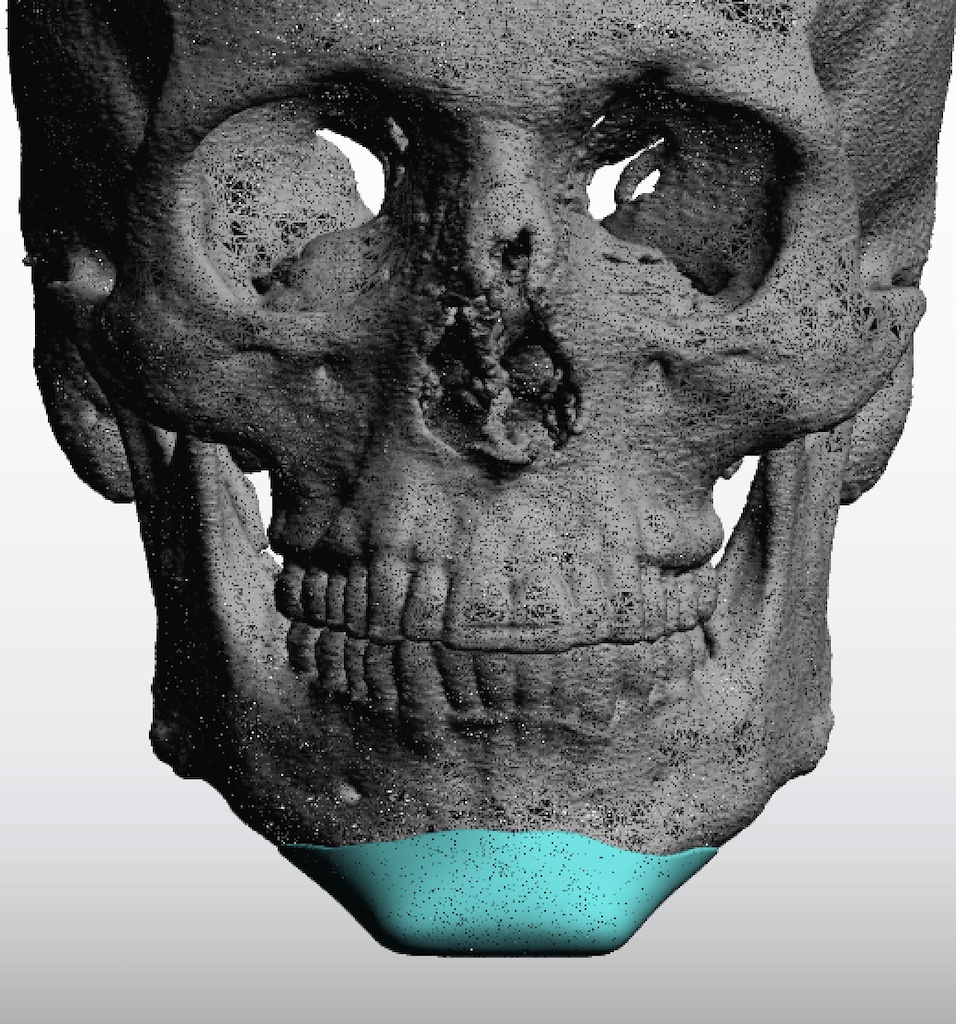
 While some men that request custom chin implants may not desire a more square chin appearance, many do.Here are some surgeon-experienced guidelines for designing a custom square chin implant (male or masculinizing focus).
1. Aesthetic Objectives (Square ? Wide)
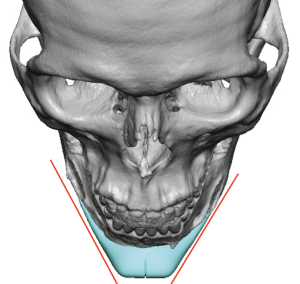 Primary goal: angularity and vertical definition, not excessive transverse width.
- Emphasize a flat or gently convex anterior face
- Create distinct inferolateral corners (boxy chin point)
- The width should not stick further out than the converging lines of the jawline
- Maintain harmony with:
- Mandibular body width
- Bigonial width
 Lower lip–chin balance (avoid labiomental overprojection)
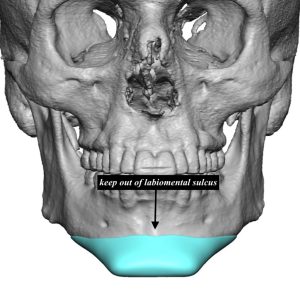 Lower lip–chin balance (avoid labiomental overprojection)
Common pitfall: over-widening the chin to achieve “square,” producing a boxy unnatural look.
2. Projection & Vertical Height
Projection
- Typical anterior projection: 5–12 mm. Determined by preoperative imaging.
- Men often tolerate slightly more projection than vertical height
- Avoid steep anterior convexity—think plateau, not button
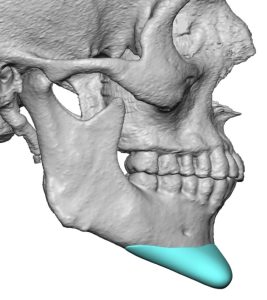 Vertical lengthening
- Ideal increase: 3–6 mm if aesthetically tolerated
- Inferior lengthening improves squareness more reliably than width
- Maintain a flat inferior border, not pointed or teardrop-shaped
Rule of thumb:
A square chin is created more by inferior edge geometry than by frontal bulk.
3. Inferolateral Corner Design (Key Feature)
- Corners should be:
- Sharp but blunted (not knife-edge)
- Symmetric but not exaggerated
- Avoid wrapping corners too posteriorly—this encroaches on prejowl territory and risks asymmetry
- Ideal angle: ~95–105° between anterior and inferior surfaces
4. Width Control
- Lateral extension should usually stop:
- Just medial to the mental foramen
- Or at the vertical midline of each canine root
- Excessive width creates:
- Masculinization beyond patient intent
- Palpable implant edges
- Mental nerve proximity issues
If width is requested:
consider combined chin + jawline strategy rather than chin alone.
5. Bone Interface & Fit
Posterior surface
- Full 3D bone conformity to the symphysis
- No point-loading zones
- Smooth transitions at all edges
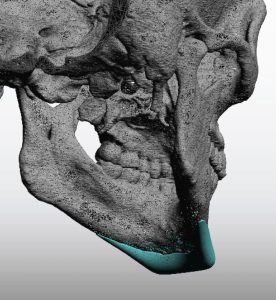 Full 3D bone conformity to the symphysis
Thickness
- Central thickness usually 4–7 mm
- Taper to <1mm at all margins
- Avoid abrupt transitions—these cause palpability
6. Mental Nerve & Soft Tissue Safety
- Maintain:
- >5 mm clearance from mental foramen
- Gentle lateral taper near nerve exits
7. Fixation Planning
- Screw locations do not need to be designed into the implant
- Their locations are determined intraoperatively
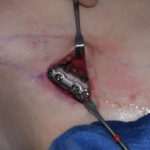
- Typically 1 midline or 2 paramedian screws are needed
- Any implant with over 5mms horizontal projection requires drilled screw placement
8. Material Selection
- Solid silicone (Silastic)
- Preferred for square chins
- Easier contouring, lower cost, reversible
- Porous polyethylene (Medpor)
- Use cautiously
- Higher rigidity, less forgiving for sharp angles
Avoid: overly rigid materials when sharp corners are designed.
9. Design Limitations
Avoid square chin implants alone if patient has:
- Weak jaw angles
- Narrow mandibular body
- Long lower face with lip incompetence
? Consider chin + jawline implants or genioplasty hybrid approach.
Dr. Barry Eppley
World-Renowned Plastic Surgeon