
 Are implants or jaw surgery better for jaw asymmetry? This is the most important decision point in jaw asymmetry treatment.
The choice between a custom wrap-around implant and orthognathic (double jaw) surgery depends entirely on what is actually asymmetric:
- Bone shape?
- Bone position?
- Bite?
- Entire jaw rotation?
- Or just contour deficiency?
Below is a structured way to determine which is better for your type of asymmetry.
Step 1: The Core Question
Is your bite normal?
This is the dividing line.
 IMPLANTS Are Better When:
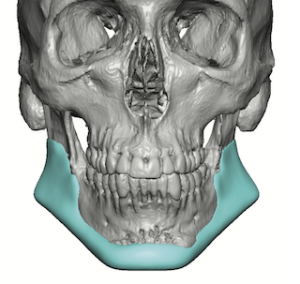 IMPLANTS Are Better When:
1. Your bite is normal (or very close)
- Teeth align well
- No major crossbite
- No open bite
- No major midline discrepancy in occlusion
2. The asymmetry is mostly:
- One jaw angle smaller
- One side flatter
- Chin slightly off-center
- Lower border uneven
- Cosmetic contour imbalance
3. The jaw is positioned correctly — just underdeveloped on one side
In these cases, a custom wrap-around implant is usually the better option because:
- It corrects contour without changing occlusion
- No braces required
- Less recovery than jaw surgery
- Lower overall risk
- More predictable cosmetic outcome
This is often called “volume deficiency asymmetry.”
ORTHOGNATHIC SURGERY Is Better When:
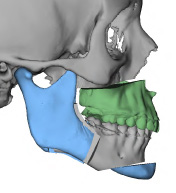 ORTHOGNATHIC SURGERY Is Better When:
1. Your bite is not normal
- Crossbite
- Open bite
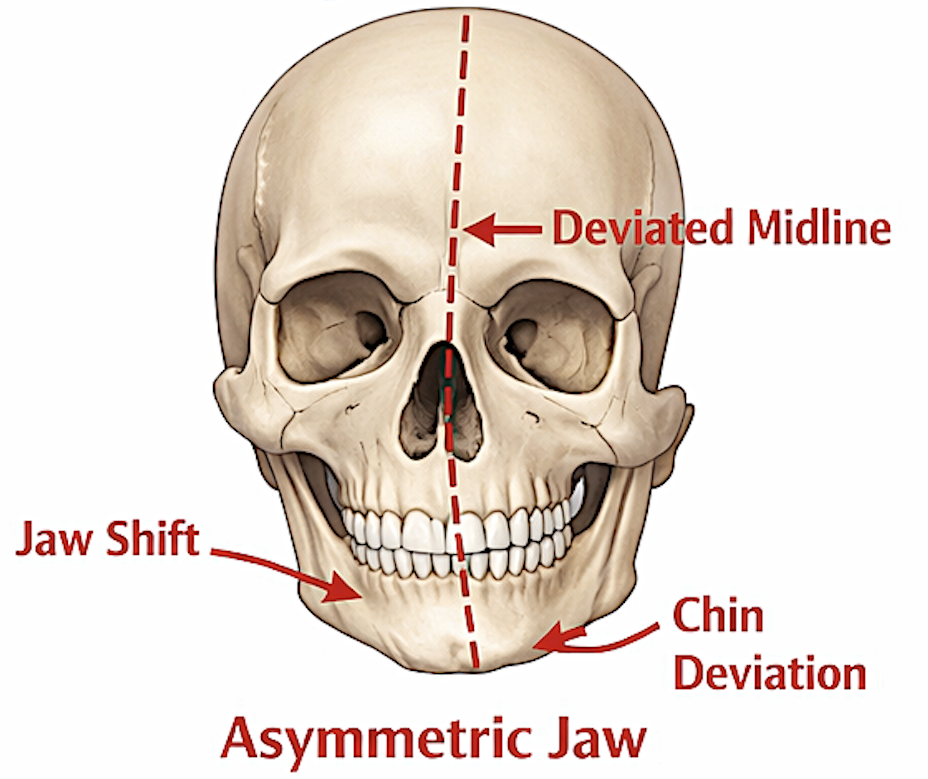
- Significant midline shift
- Functional chewing issues
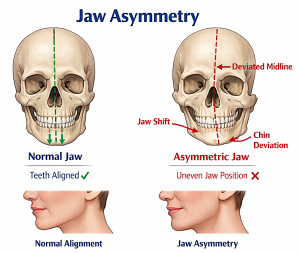
2. The entire jaw is rotated or shifted
- Mandible is twisted
- Occlusal plane is canted
- Chin deviation is part of skeletal rotation
- One side of the jaw sits lower than the other structurally
3. The asymmetry is positional, not just volume-based
This is called “skeletal positional asymmetry.”
Implants cannot reposition a jaw.
They only add structure.
If the base bone is rotated or malpositioned, implants can sometimes camouflage — but not truly correct — the issue.
When Implants Alone Are NOT Enough
Implants will not fix:
- Occlusal cant (tilted bite plane)
- Mandibular rotation
- Severe vertical asymmetry
- TMJ-related functional shifts
- Facial asymmetry caused by upper jaw position
In these cases, jaw surgery (often combined with orthodontics) is the proper correction.
The Gray Zone (Very Common)
Some patients have:
- Mild bite asymmetry
- Moderate contour asymmetry
- No functional complaints
In these cases:
You have two options:
Option A: Camouflage with Custom Implant
Pros:
- Less invasive
- Faster recovery
- No braces
Cons:
- Bite remains slightly asymmetric
- Not a “true skeletal correction”
Option B: Full Orthognathic Correction
Pros:
- True structural correction
- Functional improvement
Cons:
- Braces 12–18 months
- Larger surgery
- Longer recovery
- Higher cost
Quick Self-Assessment
Answer these:
- Do your teeth fit together comfortably?
- Do you have chewing issues?
- Is your chin off-center but your teeth midlines match?
- Is one jaw angle visibly smaller but your bite is fine?
If:
- Mostly cosmetic ? Implant likely better
- Functional + cosmetic ? Jaw surgery likely better
Important Reality
Many patients assume they need jaw surgery when:
They actually have:
- Unilateral angle underdevelopment
- Hemimandibular hypoplasia without occlusal issues
- Mild chin deviation from growth difference
Those are often excellent implant cases.
The Only Way to Know for Sure
You need:
- 3D CT scan
- Occlusal evaluation
- Frontal facial analysis
- Assessment of occlusal plane cant
Without imaging, even experienced surgeons can guess wrong.
Simplified Rule
If the problem is where the jaw sits ? bone repositioning surgery.
If the problem is how much jaw you have ? implant.
Dr. Barry Eppley
Plastic Surgeon