
Male brow bone reduction is a cosmetic bone-contouring procedure used to soften a prominent supraorbital ridge while still keeping a masculine look if that is the goal. In practice, the amount of reduction depends far more on your frontal sinus anatomy than on sex; men with strong brow bossing often want a less aggressive contour rather than a fully flat or feminized forehead.
There are two main surgical approaches. If the outer table over the frontal sinus is thick and the sinus is small, limited burring/shaving may be enough. If the sinus is larger or the anterior table is thin, surgeons usually need an osteotomy with frontal sinus setback, where the front wall of the sinus is removed, reshaped, and fixed back in a less projecting position. Pre-op imaging, often a CT or similar facial imaging study, is used to decide which technique is actually possible.
The key limitation is that simple shaving only gives a modest change—often just a few millimeters—because the brow ridge is frequently the front wall of the frontal sinus. That is why most men with more prominent bossing usually need setback rather than just burring.
Typical goals in a male patient are:
- reduce the harshness of the brow ridge, primarily central bossing
- keep some brow definition so the forehead does not look feminized
- Correct any brow asymmetry
Case Study:
This young male had very prominent brow bones that created a hypermasculine prominence. The forehead slope above out was normal for a male and did not contribute to excessive brow bone appearance.
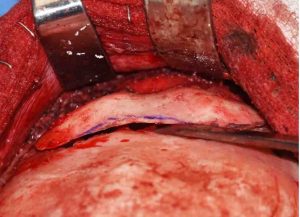
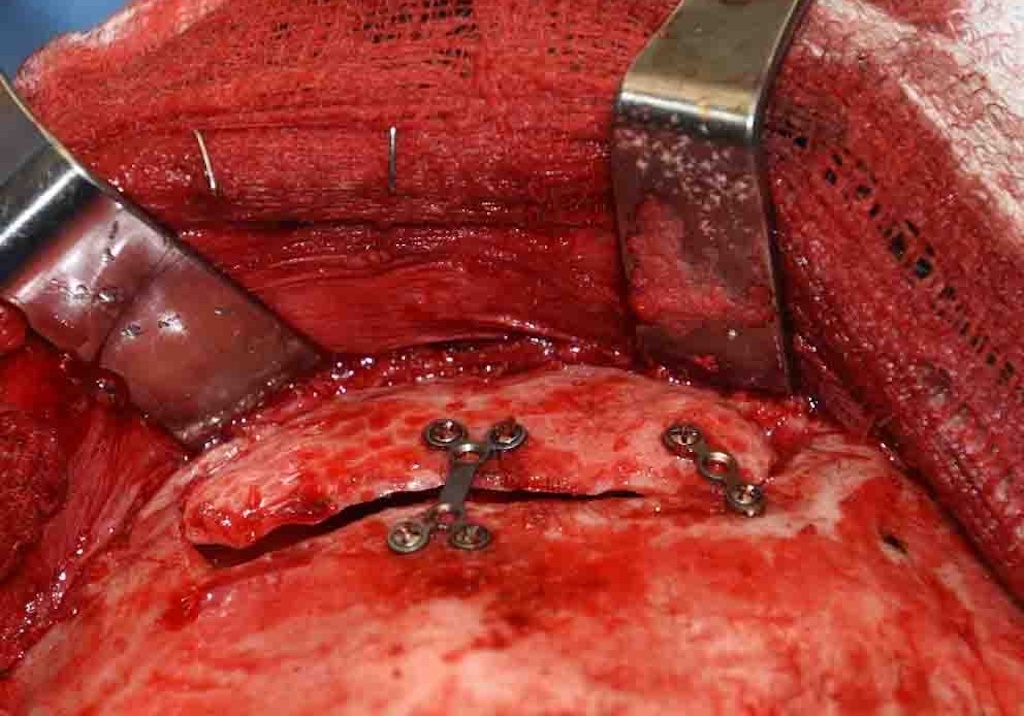
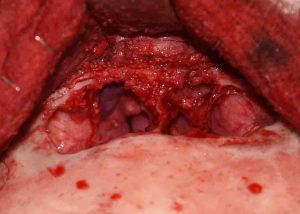 Through an extended incision behind his frontal hairline the brow bones were exposed and an osteotomy cut made through the superior and inferior sides of the prominence through the frontal sinus. Lifting up the bone flap exposed the underlying frontal sinus.The bone flap was lifted up and the entire frontal sinus exposed.
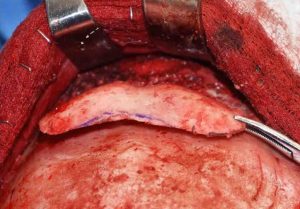
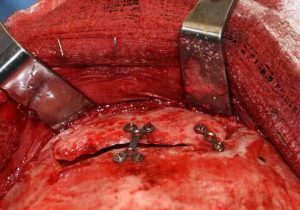 On the back table the bone flap was prepared by removing the inner surface irregularities to make it flatter and more smooth.Plates were applied to the bone flap which applied the flap to be replaced and secured back over the frontal sinus.Due to some incomplete small openings at some flap-bone interface it was covered by resorbable collagen mesh.
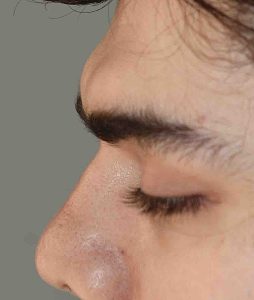
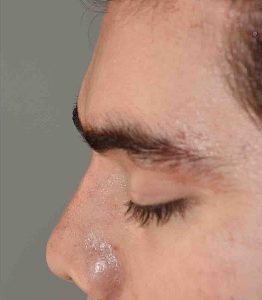 The intraoperative change in the projection of the brow bone projection could be immediately appreciated …less projection but not flat or over reduced.
Discussion
The realistic amount of brow projection reduction in men depends almost entirely on the frontal sinus anatomy, which determines whether the surgeon can only burr bone or must perform a frontal sinus setback. In practice, the achievable change falls into fairly predictable ranges.
1. Brow Bone Shaving (Burring Only)
Typical reduction: ~1–3 mm
Reasons for the limitation:
- The brow ridge in most men is the anterior wall of the frontal sinus
- Excessive burring risks entering the sinus
- Bone thickness over the sinus is often only 2–4 mm
What this achieves:
- Softens sharp bossing
- Improves asymmetry
- Produces subtle contour smoothing
What it cannot do:
- Eliminate a strongly projecting male brow ridge
2. Frontal Sinus Setback
Typical reduction: ~4–8 mm
Occasionally: up to ~10 mm in very prominent cases.
Reasons greater reduction is possible:
- The anterior sinus wall is removed
- The bone plate can be repositioned posteriorly
- Additional contouring of the supraorbital rims can be performed
What this achieves:
- Significant flattening of the brow ridge
- Major reduction of central bossing
- Ability to reshape the entire supraorbital contour
3. Realistic Male Aesthetic Targets
Most male brow reductions aim to reduce projection without eliminating masculine structure.
Typical goals:
- Moderate reduction: 3–5 mm (common)
- Large reduction: 6–8 mm (less common)
- Extreme reduction: 9–10 mm (rare anatomy)
4. Why Some Brows Cannot Be Reduced Much
Limiting factors include:
- Frontal sinus depth
- Supraorbital nerve location
- Forehead slope and orbital rim anatomy
5. Clinical Reality
Across large clinical series of forehead contouring procedures:
- Average reduction: ~4–6 mm
- Small reductions: 2–3 mm
- Large reductions: 7–8 mm
Reductions greater than 8–10 mm are uncommon and usually require very prominent preoperative bossing.
A practical rule I often use:
If the brow projects >5 mm beyond the forehead plane, shaving alone rarely produces a meaningful aesthetic change—setback surgery is usually required.
Dr. Barry Eppley
World-Renowned Plastic Surgeon