


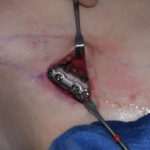
Earlobe reduction is a minor cosmetic procedure used to make large, elongated, or drooping earlobes smaller and more proportionate. Common reasons patients seek it include:
- Naturally large lobes
- Age-related stretching and thinning
- Heavy earrings causing elongation
- Gauged/stretch-pierced ears
- Asymmetry between lobes
Procedure
The surgery is typically performed under local anesthesia if done alone
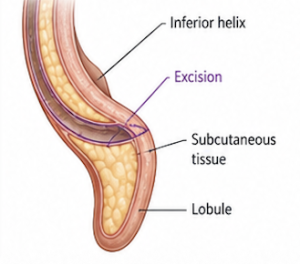 Techniques vary depending on the problem:
- Vertical reduction shortens a long lobe
- Wedge excision decreases bulk or width
- Peripheral trimming reshapes the contour
- Gauge repair techniques close stretched piercing defects
The incision is carefully designed so scars heal along natural borders and become minimally visible over time.
Recovery
- Mild swelling and soreness for several days
- Sutures usually removed in about 1 week
- Most patients return to normal activity immediately
- Earrings can often be re-pierced after 6–8 weeks if desired
Scarring
Scars are usually very discreet once healed, especially when placed along the lower edge or natural crease of the lobe.
Ideal Candidates
Good candidates are patients bothered by:
- Excessively large lobes
- Torn or stretched piercings
- Aging changes of the ear
- Lobes disproportionate to facial features
Combination Procedures
Earlobe reduction is frequently combined with:
- Facelift surgery
- Otoplasty
- Earlobe repair
- Facial rejuvenation procedures
Case Example
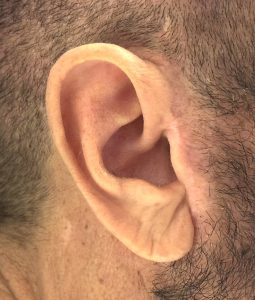
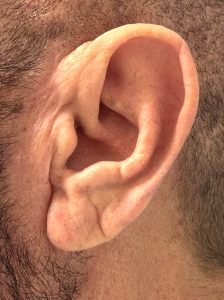 This middle aged male was bothered by his large (long) ears of which the earlobes were the most disproportionate component of the ear at 78mms on length.
As part of numerous other face procedures being done earlobe reduction were performed though an inferior helical rim excision technique.
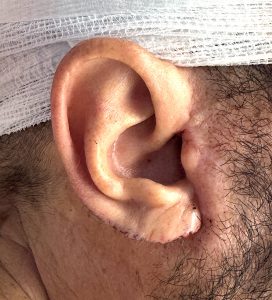
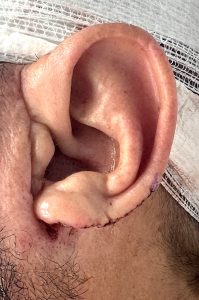 The effect of the excision reduced the length of the ear to 65mms.
Discussion
An inferior helical rim excision earlobe reduction is a useful technique for patients with elongated or vertically excessive lobules as it preserves a natural free edge and avoids a conspicuous transverse scar across the central lobule.
Concept
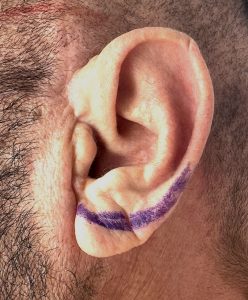 The reduction is performed by excising a wedge or crescent from the inferior helical rim–lobule junction, essentially shortening the lobule from above rather than taking tissue from the central free margin.
This works especially well for:
- Long attached or partially attached lobules
- Aging-related lobular elongation
- Patients wanting subtle reduction
- Cases where preservation of the inferior contour is important
- Combined facelift/ear rejuvenation cases
Advantages
Scar concealment
Scar lies in:
- helical-lobular junction shadow
- less visible than transverse wedge excision
Natural contour
Preserves:
- inferior lobule arc
- soft rounded free edge
Less “operated” appearance
Compared with:
- central wedge reduction
- free-edge excisions
Limitations
Not ideal for:
- extremely wide lobules
- marked transverse excess
- major gauge deformities
In those cases:
- free-margin wedge
- V-plasty
- peripheral excision
may be better.
Pearls
Avoid overresection
Even 2–3 mm overcorrection is noticeable.
Maintain lobule taper
Do not create:
- boxy inferior lobule
- sharp helical-lobular angle
Slight undercorrection preferable
Postoperative contraction further reduces size.
Symmetry
Measure:
- lobular height
- facial reference
- piercing position
before closure.
Comparison to Other Earlobe Reduction Techniques
|
Technique |
Best For |
Scar Visibility |
Shape Preservation |
|
Inferior helical rim excision |
Vertical elongation |
Low |
Excellent |
|
Central wedge |
Large reductions |
Moderate |
Good |
|
Free-edge excision |
Hanging lobules |
Visible edge scar |
Fair |
|
Peripheral excision |
Wide lobules |
Low |
Good |
A particularly elegant modification is the posteriorly biased inferior helical excision, where most of the scar is hidden behind the lobule while preserving anterior curvature. This is often my preference in aesthetic male patients.
Dr. Barry Eppley
Plastic Surgeon