
A pretrichial brow lift is a surgical technique used to raise the eyebrows while preserving the natural hairline, making it especially useful for patients with a high forehead.
What “pretrichial” means
- Pretrichial = in front of the hairline
- The incision is placed right at the hairline, not behind it
Key goals of a pretrichial brow lift
- Elevate drooping or heavy brows
- Improve forehead wrinkles and upper eyelid heaviness
- Avoid raising the hairline (unlike coronal or endoscopic lifts)
- In some cases, slightly shorten a long forehead
How it’s done (overview)
- A finely beveled incision is made along the irregular border of the hairline
- The forehead skin and brow tissues are elevated
- Excess upper forehead skin and deeper tissues is removed
- The incision is closed in a way that allows hair to grow through the scar, helping camouflage it
Ideal candidates
- Patients with:
- High or tall foreheads
- Brow ptosis (drooping brows)
- Good hair density at the hairline
- Pre-existing frontal hairline scar
- Often preferred in:
- Women
- Men with stable hairlines (not progressive recession)
Advantages
- Precise control of brow shape and height
- Does not lengthen the forehead
- Direct, powerful lift
- Scar fan heal well in properly selected patients
Disadvantages / considerations
- A visible scar is possible (though usually minimal)
- Not ideal for patients with:
- Receding or unstable hairlines
- Very thin frontal hair density
- Temporary or, rarely, permanent numbness near the incision
Comparison to other brow lifts
- Endoscopic brow lift: smaller incisions, less scarring, but can raise the hairline
- Coronal brow lift: strong lift but significantly raises the hairline
- Direct brow lift: incision above the brow; effective but more visible scarring
Case Study
This male had been though prior efforts at brow lifting (endoscopic, frontal hairline) but they have not been ideally successful. He wanted a browlift that affected the medial half of the brows mainly. With an existing frontal hairline scar the decision for further efforts at a frontal hairline browlift wasn’t unquestioned.
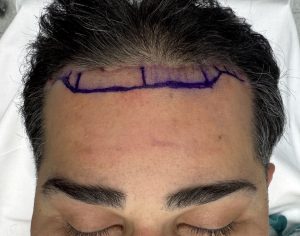
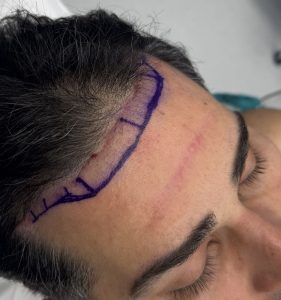 In marking for the brow lift the majority of the planned upper forehead tissue removal was central (between the vertical mid-pupillary lines)
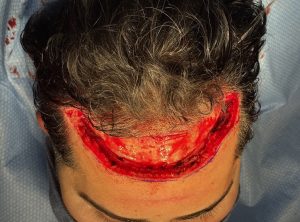
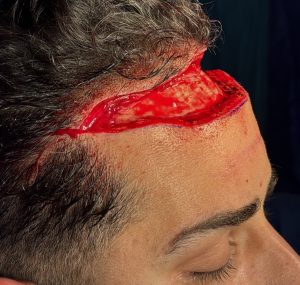 The upper forehead tissue was excised in a full-thickness fashion down to bone. The forehead flap was then elevated down to the brow bones were a suboperiosteal release was done.
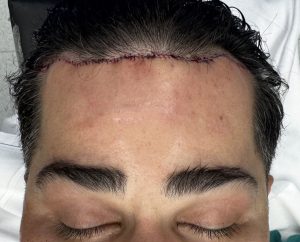
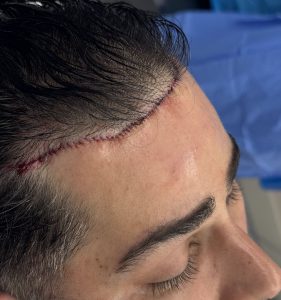 This allowed the forehead flap to be centrally mobilized which was elevated and secured to the bone at the frontal hairline with bone tunnels in which large sutures were placed. Smaller resorbable sutures were used to close the intermediate and skin layers.
Discussion
For men, a pretrichial (hairline) brow lift requires more caution and selectivity than in women because of hairline stability, scar visibility, and aging patterns.
In considering men for the procedure these are the key male-specific considerations, clinically and surgically:
1. Hairline Stability (Most Critical)
- Only appropriate if the patient has a stable, non-receding hairline
- Early male-pattern hair loss = relative contraindication
- A good rule:
- Norwood I–II, age ?40 ? reasonable candidate
- Younger men or Norwood III+ ? high risk of future scar exposure
- Always assess:
- Family history of androgenetic alopecia
- Miniaturization at the frontal hairline
If there is any doubt, avoid pretrichial incision
2. Scar Visibility
- Male hairlines are:
- Straighter
- Less irregular
- Less forgiving of scars
- Men often wear short hairstyles, increasing scar exposure
Technical strategies to reduce visibility
- Beveled incision (30–45°) to allow hair growth through the scar
- Irregular, broken-line incision—not a straight line
- Meticulous layered closure with minimal tension
- Use trichophytic closure
Even with perfect technique, the scar is less camouflaged in men than women
3. Forehead Aesthetics & Brow Position
- Ideal male brow:
- Lower and flatter than female brow
- Peak usually at the lateral limbus, not the arch
- Over-elevation leads to:
- Feminized appearance
- “Surprised” look
Surgical planning
- Conservative elevation
- Emphasize lateral brow support
- Avoid medial over-lift
4. Skin Thickness & Healing
- Male forehead skin is:
- Thicker
- More sebaceous
- Pros:
- Scars may mature well
- Cons:
- Higher risk of:
- Scar erythema
- Hypertrophy if tension is present
- Higher risk of:
5. Alternative Procedures Often Preferred in Men
When pretrichial lift is risky, consider:
Endoscopic brow lift
- Incisions behind the hairline
- Avoids visible frontal scar
- Acceptable if mild hairline elevation is not an issue
Direct brow lift (select cases)
- Especially in older men
- Incision placed in deep forehead rhytids
- Powerful lift but visible scar risk
Upper blepharoplasty alone
- Many men actually need brow support, not lid skin removal
- Over-resection of lid skin without brow elevation causes heaviness later
Men must understand:
- Scar trade-off is permanent
- Hair loss can unmask the incision years later
- Revision options are limited if hairline recedes
Bottom Line for Men
? Best for:
- Stable, low-risk hairlines
- High forehead + true brow ptosis
- Existing frontal hairline scars
? Avoid in:
- Young men
- Any signs of frontal recession
- Family history of aggressive alopecia
Barry Eppley, MD, DMD
World-Renowned Plastic Surgeon