
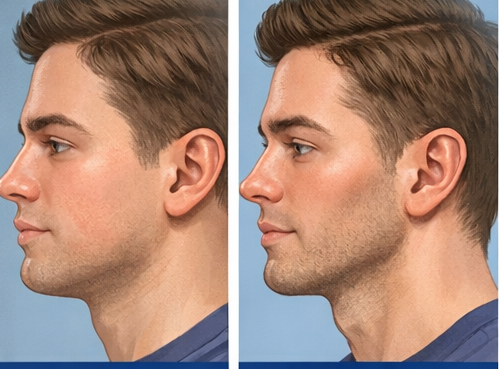
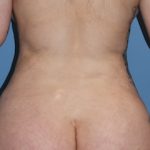
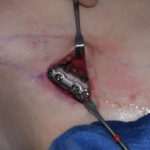
Soft tissue cheek reduction refers to procedures that slim the soft-tissue volume of the cheeks (not the cheekbone itself) to create a leaner, more contoured facial appearance—often aiming to reduce “chubby,” “full,” or “puffy” cheeks.
What tissue is being reduced?
Primarily fat and soft tissue, not bone. The main targets are:
- Buccal fat pad (deep fat in the lower cheek)
- Subcutaneous cheek fat
- Intraoral mucosa/submucosal fat
Common Soft Tissue Reduction Procedures
1. Buccal Lipectomy
- Most well-known cheek-slimming procedure
- Removes part or most of the buccal fat pad through a small incision inside the mouth
- Aggressive fat extraction in thicker tissue patients, more conservative or subtotal approach in thinner tissue patients
- Permanent reduction
Pros:
Dramatic lower-cheek slimming
No external scars
Cons:
Can cause over-hollowing with aging if done aggressively in thinner tissue patients
Affects only the upper soft tissue cheek area, its effects stays north of a line drawn from the mouth corner to the tragus of the ear.
2. Perioral Liposuction (Lower Cheek / Jowl Area)
- Removes subcutaneous fat above the buccinator muscle
- Often combined with neck or jawline liposuction
- Provides for a complete soft tissue cheek reduction by reducing fat below a line drawn from the mouth corner to the tragus of the ear.
- Less known soft tissue cheek reduction procedure
3. Buccinator Mucosal-Fat Excision
- Intraoral removal of a horizontal ellipse of mucosa and fat opposite the external perioral area
- Complements the perioral lipsuction.
- Reduces cheek tissue on both sides of the buccinator muscle
- Not a widely recognized procedure but still effective
Case Study
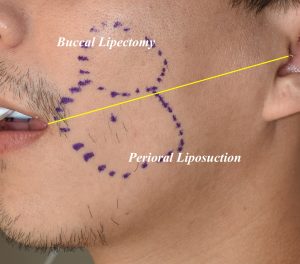 This young male wanted to reduce his cheek fullness for i creased facial definition.He was at a low body weight. In surgery a line was drawn from the mouth corner to the tragus of the ear to show the treatment areas externally.
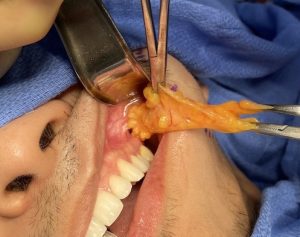
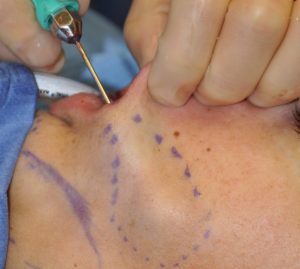 Through an intraoral approach the buccal fats were accessed in a subtotal removal technique. Then through a small incision just inside the mucosa perioral liposuction was done using a three hole 2.5mm cannula.
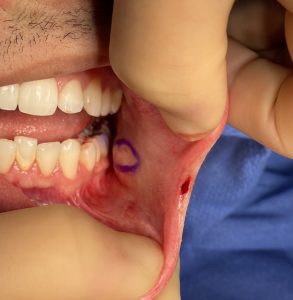 Lastly a horizontal ellipse of buccal mucosa and fat was excised intraorallyand closed paralleling the occlusal plane.
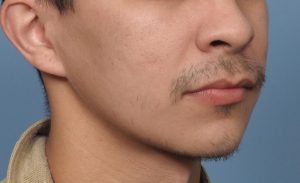
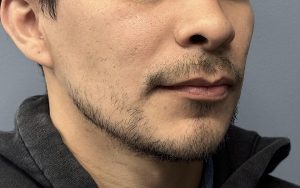
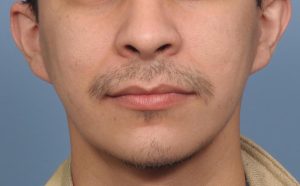
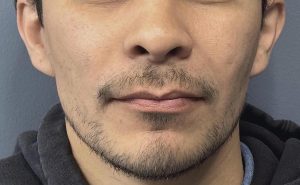 When seen several years later the facial thinning effects could be appreciated.
Discussion
The cheek soft tissue area lies between the bony cheeks and the jawline. It is essentially a trampoline area that lacks skeletal support. Because of the lack of bony support it usually has a flat or concave shape in patients of normal weight and average weights. A convex facial shape can result in thicker tissue patients, higher body weights or patients with naturally higher fat content facial tissues.
As a result the ideal candidates for soft tissue cheek reduction procedures are:
- Naturally full or rounded lower cheeks
- Thick facial soft tissue
- Stable weight
- Good skin elasticity
- Understand potential long-term aging effects
Not ideal for:
- Very thin faces
- Older patients with existing hollowing
- Patients who primary motivation is in creating cheekbone definition (that’s usually requires filler or implants)
Of the three cheek area soft tissue reduction procedures the question is which ones should be used and when.
Key Consideration
Cheek fat naturally atrophies with age. Being overly aggressive in thin patients can make someone look:
- Gaunt
- Aged
- Skeletal later in life
A balanced approach is critical. A maximum approach (all three procedures) is effective in thicker tissue patients with rounder faces. In less round faced patients or patients with thinner tissues a less aggressive approach is warranted (e.g., subtotal buccal lipectomies + perioral liposuction only).
Dr Barry Eppley
Plastic Surgeon