
Introduction
A metopic skull ridge refers to a prominent midline bony elevation that runs down the center of the upper forehead. It originates from the metopic suture, which allows the infant skull to expand during early brain growth. This suture normally closes between 3 and 12 months of age. As it fuses, a temporary bony ridge may form along the forehead, often visible or palpable as a raised midline contour. Most infant metopic ridges are normal, tend to diminish with age, and require no treatment.
Features of a Benign (Normal) Metopic Ridge
- Normal suture closure
- Rounded forehead shape
- No bitemporal narrowing
- No developmental issues
- Usually resolves or softens naturally
Occasionally, however, the ridge remains visible into adulthood. This is known as a persistent metopic ridge.
Is a Metopic Ridge in Adults Normal?
Yes. In most adults, a subtle metopic ridge represents a normal anatomic variant—the remnant of the healed metopic suture.
Key Points
- It does not indicate skull growth abnormalities.
- It does not affect brain function.
- It may remain visible depending on bone thickness, forehead soft-tissue volume, and underlying facial structure.
Despite being benign, some individuals experience aesthetic concerns such as:
- A sharply defined midline contour
- The appearance of a narrowed forehead
- A visible central ridge under certain lighting conditions
For patients who desire improvement, bone burring reduction is the standard treatment.
Case Study
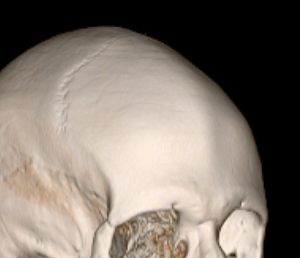 An adult male presented for sagittal ridge skull reduction, and a 3D CT scan was obtained to evaluate sagittal bone thickness. Incidentally, the scan also revealed a persistent metopic ridge. The patient was aware of a longstanding midline forehead prominence, which corresponded to his naturally narrow forehead shape.
His history included submuscular temporal augmentation with PMMA bone cement placed in the deep temporal fossa. As a result, he did not exhibit significant temporal hollowing, but the augmentation contributed to the perception of a narrow forehead—accentuating the appearance of the midline ridge. In effect, some features of a persistent metopic ridge had been previously recognized and partially addressed through temporal augmentation.

 The CT scan demonstrated an adequate 8 mm bone thickness, permitting a safe and effective reduction.
Surgical Technique
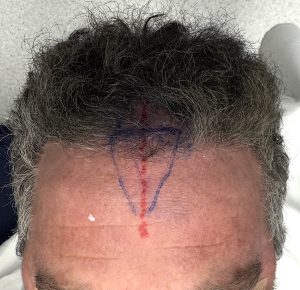
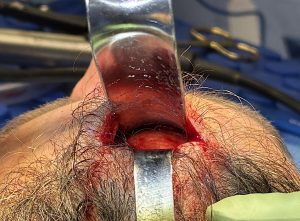
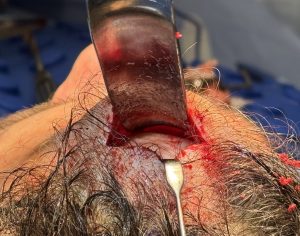 Through a small incision just behind the frontal hairline, the metopic ridge was exposed. Using a high-speed handpiece and burr operating at 8,000 rpm, the ridge was carefully reduced to create a smoother, more uniform forehead contour.
Closure was performed with resorbable sutures, and no drain was required.
Discussion
Persistent metopic ridges—similar to sagittal skull ridges—can be successfully reduced in nearly all adult patients. These prominences exist because the underlying bone is thicker along the fused suture line.
A critical component of successful reduction is incision placement. The incision must align closely with the forehead’s linear plane to ensure direct visualization and permit the use of straight instruments and powered equipment. As with all forehead bony procedures, working from a scalp incision farther back on the head is ineffective; one simply cannot “work around the corner.”
Key Points
- A persistent adult metopic ridge is benign and primarily an aesthetic concern.
- The raised bone can be effectively reduced using a small frontal hairline incision and high-speed burring.
- A 3D CT scan with bone thickness analysis is recommended to confirm adequate bone thickness for safe contouring.
Barry Eppley, MD, DMD
World-Renowned Plastic Surgeon