
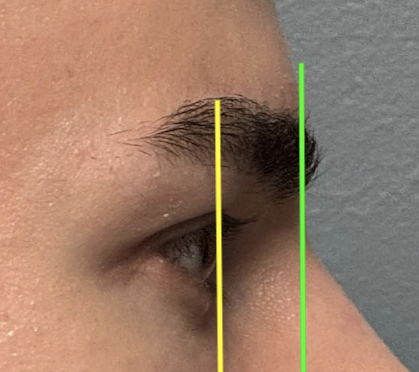
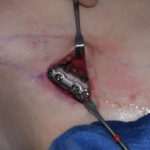
Designing brow bone implants is more than a subjective artistic endeavor as there are some objective measurements that can be used. One of the most useful is reference lines on the profile view as a way to turn what seems subjective (“does this look right?”) into something measurable and repeatable. These lines are applied to photos and CT-based simulations before deciding something like 4 mm vs 7 mm.
1. Brow–Cornea Relationship (most important)
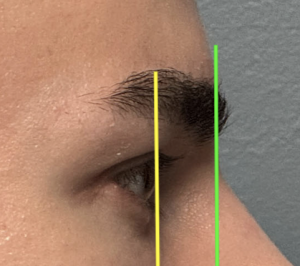 How it’s drawn:
- A vertical line is dropped from the most anterior point of the cornea (the front of the eyeball)
- Then you compare where the brow ridge sits relative to that line
Ideal positioning:
- Neutral / natural: brow sits slightly anterior the cornea (2-3mms)
- Masculine: brow sits notoeable anterior (4–7mms sn front of the cornea
- Excessive: brow sits well in front of the cornea (> 8 – 10mms)
This is one of the main “stop signs”:
- If the planned implant pushes the brow way past the cornea it will likely look overbuilt
It is important to recognize that the most anterior brow position seen in profile is not that of the central glabella but of the medial brow bone area.
2. Brow–Nasal Bridge Alignment
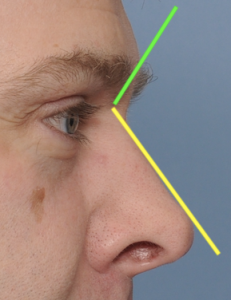 How it’s drawn:
- A line is drawn along the dorsum (bridge) of the nose
- A second line is drawn down from the brow prominence which connects with the dorsal nasal line creating an angle
- The brow-nasal dorsal angle will usually be 90 degrees or less.
- Very low projecting or flat brows may have a 120 degree angle
What happens if you exceed it:
- Overprojecting brows create a leaa than 90 degree angkle which nakes it look disconnected and heavy
- Especially noticeable in profile
This is critical in patients with:
- Smaller or flownasal bridges (limits how much brow you can add)
3. Forehead–Brow Bone Break Angle
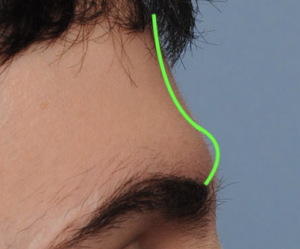 This isn’t really two straight lines that intersect but a transition area from a straight line.
What is assessed:
- The angle between:
- Forehead slope
- Brow prominence
Ideal:
- Smooth transition with a visible but not abrupt “break”
Too much projection:
- Creates a sharp ledge
- Looks artificial or “shelf-like”
The slope of the forehead impacts the brow bone break. In more vertical foreheads excessive brow bone projection can male for an overly sharp transition.
4. Glabella–Nasion Relationship
Landmarks:
- Glabella = most prominent central forehead point between the medial brow prominences
- Nasion = root of the nose
Ideal:
- Smooth, continuous transition from brow-nasal root
Overprojection:
- Brow juts out while nasion stays recessed,
creates a step-off deformity look
Sometimes you may have to adjust BOTH brow and nasal radix for balance
5. Vertical Facial Thirds
Even though this isn’t a direct “brow line,” it matters:
- Upper third (forehead height)
- Middle third (brow ? base of nose)
Why it matters:
- A very large brow projection in a short forehead looks exaggerated
- Same projection in a taller forehead may look balanced
6. How these lines guide the actual millimeters
This is where it becomes practical:
Step-by-step:
Baseline measurement
Current brow vs cornea (e.g., 2 mm behind)
Target position
Decide desired relationship (e.g., 1 mm in front of cornea)
Calculate difference
That might mean adding ~3 mm projection
Cross-check with nasal line
If that same 3 mm pushes brow too far beyond nasal bridge ? reduce plan
Simulate on CT
Try 4 mm vs 6 mm vs 7 mm
See which one satisfies ALL reference lines
Example
Patient:
- Brow sits 3 mm behind cornea
- Wants a masculine result
Plan:
- Target: ~1–2 mm in front of cornea
Requires ~4–5 mm implant
BUT:
- If 5 mm pushes brow beyond nasal line ? reduce to 4 mm
Key Insight
No single line determines the number.
Implant design must balance::
- Brow–cornea (forward limit)
- Brow–nasal (proportion check)
- Forehead transition (aesthetic smoothness)
The final projection is the largest number that still satisfies all three without conflict.
Bottom Line
Reference lines act like guardrails:
- Brow–cornea = prevents overprojection
- Brow–nasal = keeps facial harmony
- Forehead transition = ensures natural contour
The chosen projection is essentially:
“the maximum that looks right across all these checks”
Dr. Barry Eppley
Plastic Surgeon