
Rib 11–12 vs Rib 10–12 Resection
Advanced Waist Contouring — Indications, Impact, and Risk Escalation
This comparison applies to advanced, carefully selected aesthetic cases. Rib 10 involvement changes the operation from flank refinement to structural waist narrowing.
1. Anatomical Importance
Ribs 11–12
- Both are floating ribs
- Influence the lower third of the waist
- No role in chest wall stability
Effect zone
- Lower flank
- Back and rear oblique views
Ribs 10–12
 Rib 10 is a false rib loosely attached to the costal margin via cartilage
- Major contributor to true waist width along with rib 11
- Still has a significant downward inclination but turns horizontally at its anterior costal attachment
- Functionally integrated with:
- External oblique
- Costal margin stability
- Upper abdominal wall
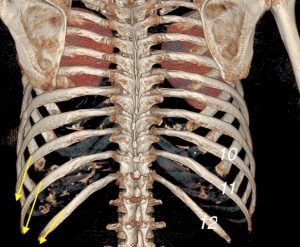 Rib 10 is a false rib loosely attached to the costal margin via cartilage
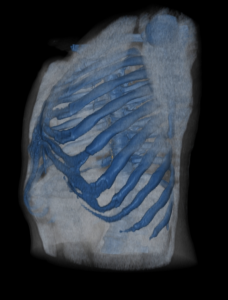 Still has a significant downward inclination but turns horizontally at its anterior costal attachment
Effect zone
- Entire waist cylinder
- Frontal, oblique, and back views
2. Visual Contour Difference
|
Feature |
Rib 11–12 |
Rib 10–12 |
|
Lower flank smoothing |
?????? |
?????? |
|
True waist narrowing |
???? |
???????? |
|
Frontal silhouette |
Mild–moderate |
Moderate–significant |
|
Ribcage width change |
Minimal |
Definite |
|
“Hourglass” effect |
Limited |
Achievable in select patients |
Key distinction
- Rib 11–12 reshapes the lower waist
- Rib 10–12 reshapes the rib cage itself
3. Surgical Complexity & Risk
Rib 11–12 (Type 1)
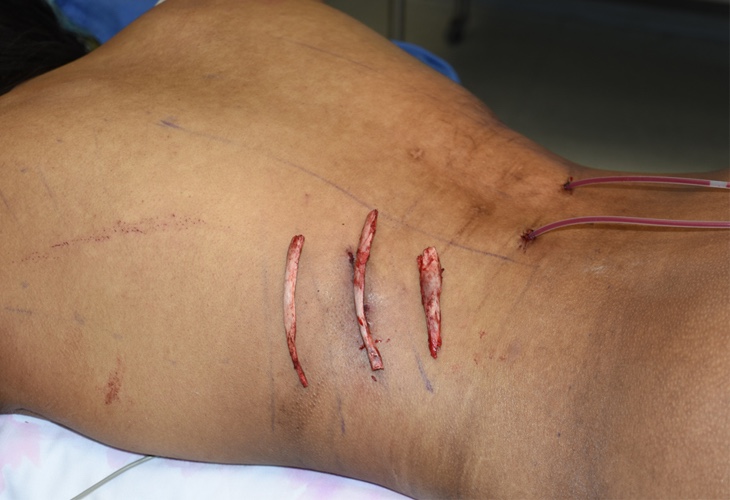
- Posterolateral or wavy vertical incisional approach
- LD muscle-splitting for access
- Low risk of encountering lung pleura
Rib 10–12 (Type 2)
- Wider thicker rib
- Is more stiff once mobilized due to the anterior subcostal attachments
- Higher likelihood of encountering the lung pleura on the backside of the rib
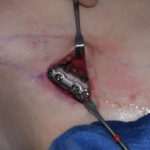
- Can be treated by three different methods: partial resection (out to anterior costal attachment), limited resection (bridge collapse technique) and segmental resection and shortening with plate fixation
- Allows for greater latissimus dorsi muscle resection/plication
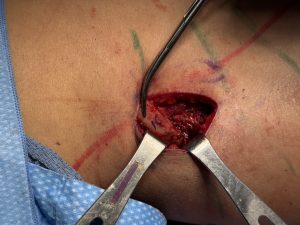 Wider thicker rib
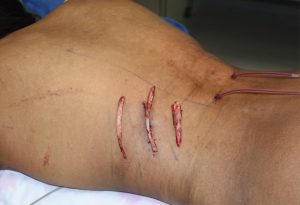 Can be treated by three different methods: partial resection (out to anterior costal attachment), limited resection (bridge collapse technique) and segmental resection and shortening with plate fixation
4. Functional Considerations
11–12
- No measurable impact on respiration
- Oblique strength preserved
10–12
- Temporary reduction in core comfort
- Long-term function typically normal
5. Patient Selection (Critical)
Appropriate for Rib 11–12
- Boxy lower waist
- Long floating ribs
- First-time rib contouring
- Patient interested in more ‘limited’ surgery
Appropriate for Rib 10–12
- Very wide or flared lower rib cage
- Short-waisted torso
- Athletic / low-BMI patients
- Interested in maximal waist reduction approach
- Revision cases with inadequate narrowing
Not ideal for rib 10–12
- Thick subcutaneous fat
- Loose skin
- Unrealistic expectations
- Desire for “corset-like” effect
6. Combination Strategy
Rib 10–12 cases almost always require:
- High-definition flank lipo
- Careful symmetry control
- Conservative bilateral planning
Lipo without rib 10 removal cannot substitute for rib cage narrowing.
7. Rib Removal Concepts
- Rib 11–12:
“Reshaping the lower waist without changing the rib cage.” - Rib 10–12:
“Actual narrowing of the lower rib cage”
Bottom-Line Rib Removal Surgical Philosophy
- 11–12 = Advanced refinement
- 10–12 = Improved results more structural reconfiguration
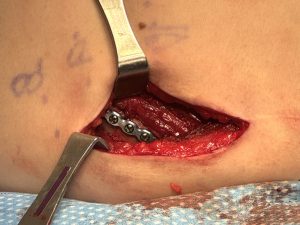 Rib 10 can be treated with multiple techniques of which the most superior effect on waist/torso reshaping is not yet clear. The newer technique of rib shortening by segmental resection and plate fixation pulls its costal attachments more inward.
Dr. Barry Eppley
World-Renowned Plastic Surgeon