
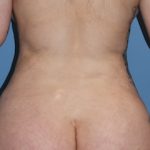
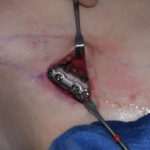
Rib removal for waist narrowing refers to a cosmetic procedure designed to create a slimmer, more tapered waist by removing portions of the lower ribs.
Which Ribs Are Removed?
Only the semi (rib 10) or fully free floating (ribs 11 and 12) are removed.
- These ribs are not attached to the anterior subcostal ribcage
- They provide some protection to the kidneys but are not structurally required for breathing mechanics
- They have musculoligamentous attachments at their cartilaginous ends which when released helps the waist collapses inward.
- The best incision to ensure rib 10 can be treated is vertically oriented.
Goal of the Procedure
- Reduce lower rib cage width
- Increase visible waist indentation
- Enhance hourglass contour
- Often combined with liposuction to the flanks
How the Surgery Is Done
- Performed under general anesthesia in the prone position
- Incisions typically placed along the back (posterior approach)
- The outer portions of ribs 20, 11 and 12 are removed
- The intercostal neuromuscular bundle is preserved.
- The latissiumius dorsi muscle width is removed.
- Closure done over a drain on each side
- Usually done as an over nite procedure
Surgery time: 3 to 3.5 hours
Recovery
- Compression garment: 4–6 weeks
- Significant soreness for 2–3 weeks
- Return to light activity: ~2 weeks
- Full healing: 3 months
- Final contour visible after swelling resolves
Risks & Considerations
Like any surgery, risks include:
- Bleeding
- Infection
- Seroma
- Chronic pain
- Numbness
- Asymmetry
- Scarring
- Very rare: pneumothorax (has not occurred in my experience)
Proper patient selection and surgical experience are critical.
Important Considerations
- Drastic waist size reduction is not unusually seen, visible but not drastic in most cases.
- Best results occur in:
- Naturally narrow rib cage patients
- Patients combining it with flank liposuction and/or hip augmentation
- Dramatic “corset waist” results seen online are often:
- Combined procedures that re augmenting above or below it
- Photoshopped/altered images
Is It Safe?
When performed by a board-certified plastic surgeon experienced in thoracic anatomy, rib removal is considered safe in properly selected patients.
Case Study
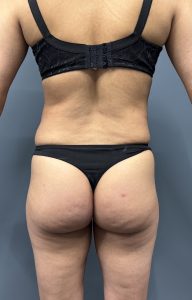 This female sought rib removal surgery to give her some shape to her straight line torso shape. She was at a good lean weight but that did not change her boxy shape. She pursed structural reduction surgery as there were no soft tissues reduction procedures that would have been of benefit.
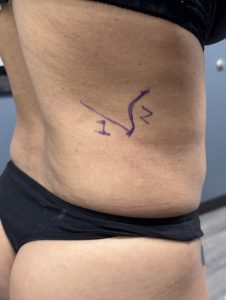 In choosing between an oblique and vertical incision the latter was chosen to ensure rib 10 could be adequately treated.
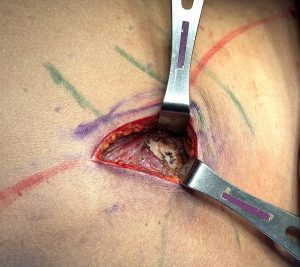
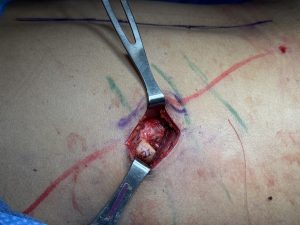 In the prone intraoperative position through a split LD muscle approach, ribs 11 and 12 were removed in a subtotal fashion .
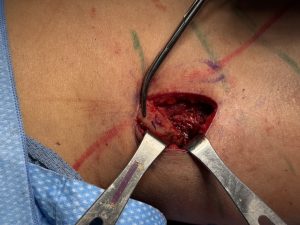 Rib 10 was cut and dissected all the way around to its mid-shaft portion where it was extracted by a tunnel technique.
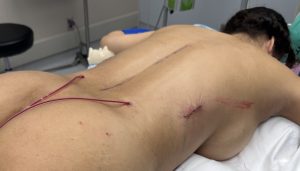 The outer border of the LD muscle was reduced and the incisions closed over a drain.
B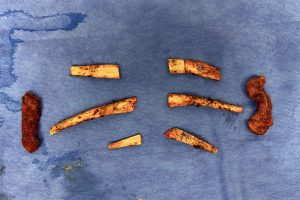 one and muscle specimens showed the amount of tissue removal.
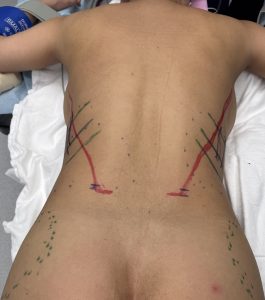
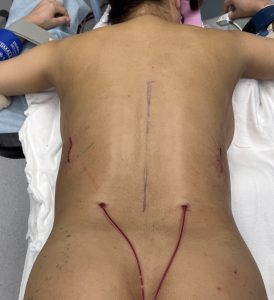 The immediate intraoperative results showed some shape improvement but the real outcome was months away in the standing position.
Discussion
Rib removal for waist contouring is a highly specialized procedure. The best outcomes depend heavily on patient anatomy, goals, and psychological readiness. Considerations are as follows::
Anatomical Suitability
Best candidates typically have:
- Prominent or flared lower ribcage
- A relatively low body fat percentage
- Stable weight
- Good skin elasticity
- A short distance between lower ribs and iliac crest (hip bone), limiting waist taper naturally
Patients with a very wide lower rib cage often see more noticeable improvement.
Realistic Expectations
Ideal candidates understand:
- Rib removal creates subtle to moderate narrowing, not extreme corset-level changes.
- Average waist reduction from rib removal alone is often 1–2 inches.
- Dramatic results usually require combination procedures:
- Liposuction (abdomen/flanks/back)
- Fat grafting to hips
- Abdominoplasty (if excess skin exists)
Patients seeking extreme, unnatural proportions are not good candidates.
Good Overall Health
Candidates should:
- Be medically healthy
- Be non-smokers (or willing to stop well before and after surgery)
- Have no bleeding disorders
- Have no significant pulmonary or kidney issues
- Be psychologically stable
Psychological Readiness
Because this is an elective aesthetic procedure:
- Motivation should be personal (not external pressure)
- No active body dysmorphic disorder
- Understanding that this is permanent and irreversible
- Acceptance of surgical scars (usually placed along the back)
Poor Candidates
Rib removal is generally not appropriate for:
- Patients seeking extreme “cartoon-like” waist proportions
- Patients with significant obesity
- Patients with untreated psychological instability
- Individuals who expect surgery to dramatically change life outcomes
- Those unwilling to accept scars
 Ideal Profile Summary
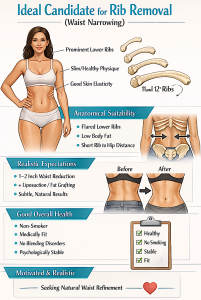 Ideal Profile Summary
The most ideal candidate is:
A healthy, realistic, anatomically suitable patient seeking refinement of waist contour as part of an overall body contouring plan.
But a good candidate is always those that have no other option, either by lean body type or having been through prior soft tissue reduction procedures, than to pursue structural modifications.
Dr. Barry Eppley
Plastic Surgeon