
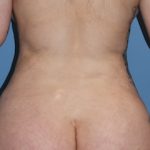
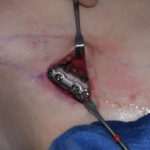
Rib removal in petite females is a niche but real request in aesthetic surgery, tied to waist narrowing or body contouring. But it’s important to separate what’s actually done, what’s safe, and what’s more myth than modern practice.
What people usually mean by “rib removal”
Most are referring to removal of the 11th and 12th ribs (floating ribs) to create a narrower waistline. These ribs:
- Don’t attach to the sternum
- Have less structural role than upper ribs
- Sit in the flank/back area
In petite females specifically
Petite patients (shorter frame, smaller torso) present some unique considerations:
1. Proportional impact is greater
- Removing even a small amount of rib can create a more noticeable waist change
- The margin for overcorrection is smaller ? easier to look unnatural if overdone…although a natural look in not what they are usually trying to achieve
2. Less soft tissue coverage
- Thinner patients = ribs are more visible/palpable
- Surgery must be very precise to avoid contour irregularities
3. Organ proximity
- In smaller frames, kidneys and surrounding structures are relatively closer
- Requires meticulous surgical planning and imaging
Is full rib removal done?
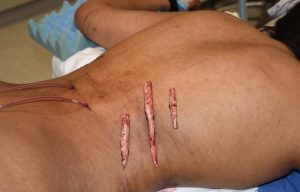 Full rib removal for aesthetic purposes has rarely if ever been done. Anatomically what is done is subtotal rib removal, removing the outer third of the rib. There is no benefit to removing the whole rib when done for aesthetic waist reduction.
What are the alternatives to rib removal?
Rib removal should be used as a last resort body contouring procedure when traditional techniques have not worked or one is not a good candidate for them. These include:
- Waist contouring liposuction (360 lipo)
- Tummy tuck with wide midline fascial plication
- Corset training (non-surgical adjunct)
- Inffective RibXcar
Risks (especially relevant in petite patients)
- Pleural violation/pneumothorax (collapsed lung)
- Injury to kidneys or surrounding organs
- Chronic pain or nerve damage
- Contour asymmetry (more obvious in thin patients)
- Scarring in the posterior flank
The only one of the risks mentioned that I have ever seen in contour asymmetry.
Bottom line
“Rib removal” for waist narrowing exists, but:
- In petite or think females it may be the only effective waist narrowing option for them
- Petite females can see dramatic results—but also have a higher risk for an unnatural or overdone result.
Case Example
This petite thin female (5’4”, 106lbs) had been through large breast augmentation and buttock implants previously. She wanted an even smaller waistline than she naturally had, and due to her low body fat, had prominent visible iliac crests
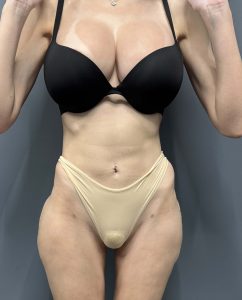
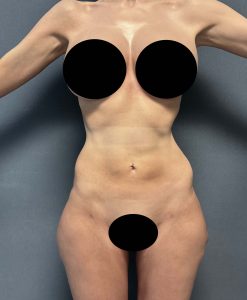
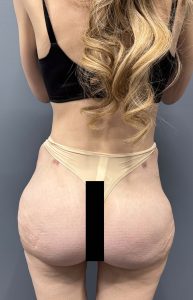
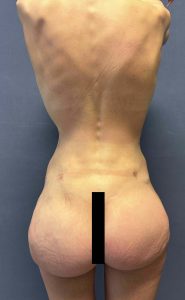 She subsequently underwent a type II rib removal procedure (subtotal removal of ribs 10,11 and 12) and bony iliac crest reductions.
Discussion
Aesthetic rib removal surgery has evolved into several techniques primarily divided into open vs. minimally invasive procedures. Anatomically this means rib excision vs rib fracture methods. This is how they compare:
1. Open Approach (Subtotal Excision)
How it’s done (conceptually)
- Small incision (typically posterior flank/back, ~3–5 cm)
- Latissimus dorsi (LD) muscle split for access
- Ribs 10, 11 and 12 are exposed directly
- The outer lengths of the ribs are excised
- He outer border of the exposed LD muscle is plicated medially
- The overlong soft tissues are is closed in layers
Key characteristics
- Direct visualization ? highest control and precision
- Allows true removal of rib segments
- More predictable structural change
- Maximizes whatever narrowing effects can be achieved from surgery
Pros
- Precise shaping
- Ability to remove larger portions of rib
- More predictable structural change
Cons
- More invasive
- Visible scar (although usually heals well)
- Longer recovery
- Higher risk of:
- Pain
- Pneumothorax
- Nerve irritation
2. Minimally Invasive /Rib Fracture
How it’s done (conceptually)
- Smaller incisions (often 1 cm) or percutaneous
- Limited dissection to access the rib
- Use of piezotome for rib corticotomies (direct vision vs ultrasound guided)
- Manual external pressure for green stick rib fracture
- Postoperative binder/corset to change rib shape
Key characteristics
- Reduced tissue disruption
- Indirect visualization (ultrasound-guided)
Pros
- Smaller scars
- Less soft tissue trauma
- Potentially faster recovery
- Less postoperative pain ??
- Often combined with other body contouring procedures (tummy tuck, liposuction)
Cons
- Results highly dependent on patient compliance with postoperative garment wear
- Technically demanding
- Higher risk of pneumothora due to less direct visualization
- Outcomes can be more subtle or not at all
Key Differences at a Glance
|
Feature |
Open Resection |
Minimally Invasive |
|
Incision size |
Larger (3–6 cm) |
Small (1–2 cm) |
|
Visualization |
Direct |
Ultrasound-assisted |
|
Rib removal |
Yes (partial/full) |
None |
|
Precision |
High |
Moderate |
|
Recovery |
Longer |
Shorter |
|
Risk level |
Higher |
Lower (generally) |
Special Considerations in Low BodyFat Females
- Increased rib visibility ? small changes are very visible
- Over-resection risk ? rib removal oil more effective but can create an unnatural narrowing
- Thin tissue coverage ? contour irregularities show more easily
Dr. Barry Eppley
Plastic Surgeon