
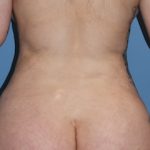
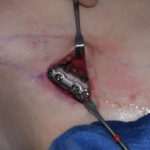
The most common surgical method of jaw angle augmentation is the use of implants. These aesthetic implants have been used for decades and, while generally successful, they carry higher risks compared to most other facial implants. Placed through intraoral incisions beneath the masseter muscle, they are associated with notable risks, including infection, temporary masseter muscle dysfunction, and implant asymmetry.
While injectable fillers and fat grafting can avoid these surgical risks, their lack of durability makes them short-lived solutions and, over time, less desirable for lasting jaw angle enhancement.
An Alternative Approach: Soft-Tissue Jaw Angle Implants
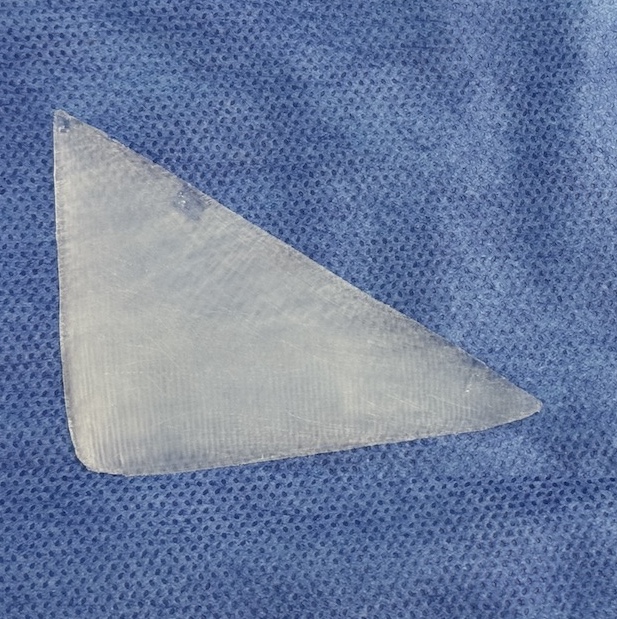
An alternative to traditional bone-based jaw angle augmentation is the use of soft-tissue (muscle-enhancing) implants. Rather than injecting materials into or around the masseter muscle and soft tissues, a specially designed implant is placed to enhance the soft-tissue contour of the jaw angle. This approach differs significantly from conventional bone-based implants in both design and surgical technique.
Key Characteristics
- Positioned on top of the masseter muscle, beneath the subcutaneous fat layer, augmenting muscle contour rather than bone structure
 Made of very low-durometer silicone, giving the implant an extremely soft consistency—best described as a cross between a liquid and a firm solid
- Produces less skeletal definition and more natural contour enhancement
- Placed through an external approach rather than an intraoral incision, reducing both surgical risks and recovery time compared to traditional jaw angle implants
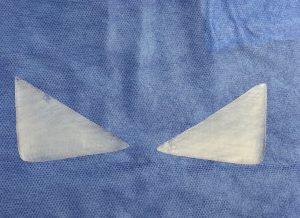 Made of very low-durometer silicone, giving the implant an extremely soft consistency—best described as a cross between a liquid and a firm solid
Best Uses
Soft-tissue jaw angle implants are best suited for:
- Patients seeking subtle widening or fullness rather than a sharply defined or “chiseled” jaw angle
- Correction of asymmetry when one side of the jaw angle is already aesthetically acceptable
- Patients who are poor candidates for bone-based implants, do not desire them, or have previously had them removed
- Revision cases where soft-tissue deficiency exists following prior jaw angle implant surgery (e.g., masseter muscle dehiscence)
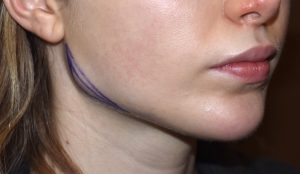 Patients seeking subtle widening or fullness rather than a sharply defined or “chiseled” jaw angle
Advantages
- More natural look and feel
- Reduced risk of an overly sharp or “stuck-on” appearance
- No risk of pressure-related bone changes or masseter muscle dehiscence
- Particularly effective in patients with thicker soft-tissue coverage
- Injectable fillers can be used preoperatively as a good predictor of the expected contour change
Limitations
- Cannot create sharply defined jaw angles
- Produces less dramatic change than solid, bone-based implants
- Not ideal for patients seeking a strong or highly angular jawline
Surgical Considerations
- Placement through a small external transcutaneous incision at or just behind the bony jaw angle
- Can be performed under local anesthesia
- Implant shapes and thicknesses can vary; currently custom-designed, though standard implants can be modified intraoperatively to meet individual patient dimensional needs
- Precise deep subcutaneous pocket control is essential for implant stability and minimizing the risk of implant visibility (particularly in patients with thin tissues)
- Results in a small scar that typically heals inconspicuously
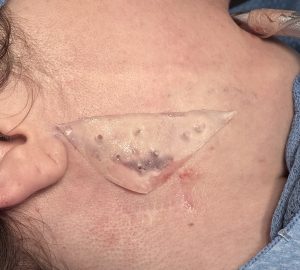 Implant shapes and thicknesses can vary; currently custom-designed, though standard implants can be modified intraoperatively to meet individual patient dimensional needs
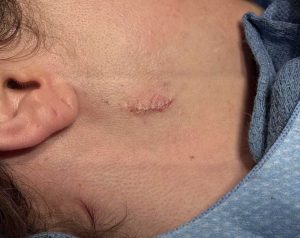 Results in a small scar that typically heals inconspicuously
Bottom Line
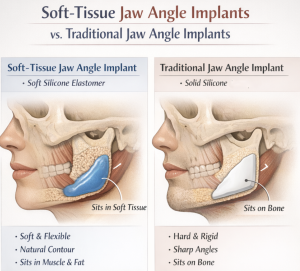 Soft-tissue jaw angle implants is a new facial implant concept that focuses on soft tissue and not bone augmentation to create its effect. They are designed to enhance contour, softness, and natural blending—not skeletal definition. They are particularly effective for subtle enhancement and revision cases, but they are not a substitute for traditional jaw angle implants when bold, structural jawline definition is the primary goal.
Dr. Barry Eppley
Plastic Surgeon