

Introduction
Men frequently request a squarer, more angular chin when undergoing chin implant augmentation. While there is a standard “square” chin implant design intended to meet this goal, it is often an imperfect solution. In many cases, aesthetic failure occurs due to inherent design limitations and technical placement issues.
Common Failure Modes of Standard Square Chin Implants
1. Implant Malposition or Rotation
Problem
- Chin appears crooked, slanted, or asymmetric
- One corner is sharper or positioned lower than the other
- Most commonly caused by inadequate fixation, intraoral placement, or imprecise intraoperative positioning on the bone
Revision Strategy
- Complete removal of the existing implant
- Submental approach (preferred for revisions)
- Creation of a new, precisely defined pocket
- Replacement with a custom implant keyed to the symphyseal contour
- Rigid fixation, typically with two screws
Pearl
Rotation rarely resolves with repositioning alone. Custom redesign combined with rigid fixation provides the most predictable and durable solution.
2. Over-Widened or “Blocky” Square Chin
Problem
- Chin wider than the mandibular body
- Box-like or cartoonish appearance
- Poor taper into the jawline
Revision Strategy
- Reduce anterior width rather than projection
- Redesign implant with:
- Narrower width while maintaining non-rounded inferolateral corners
- Improved blending into the parasymphysis and jawline
- Consideration of vertical lengthening to support width
- Avoid lateral extension beyond the mental foramen
Pearl
A square chin does not mean a wide chin. The mandibular body should always remain wider than the chin itself.
3. Over-Projection or “Jutting” Chin
Problem
- Artificial or excessive forward prominence
- Deepened or distorted labiomental fold
- Chin dominates the facial profile
Revision Strategy
- Reduce anterior projection
- Redistribute enhancement to vertical lengthening if aesthetically acceptable
In more severe cases:
- Remove the implant entirely
- Consider a sliding genioplasty or a smaller custom implant with reduced projection
Pearl
Standard square chin implants fail more often from excessive width and projection than from under-correction.
Bottom Line
Most failures of standard square chin implants are due to:
- Excessive anterior width
- Poor lateral wing design
- Inadequate fixation
- Intraoral placement
Successful revision almost always requires a custom implant, rather than downsizing or modifying a stock implant.
Case Study
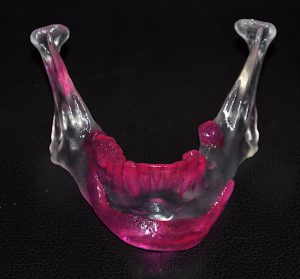
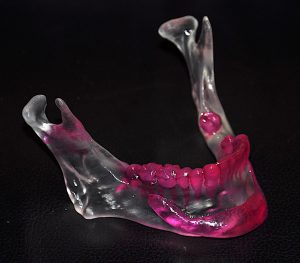
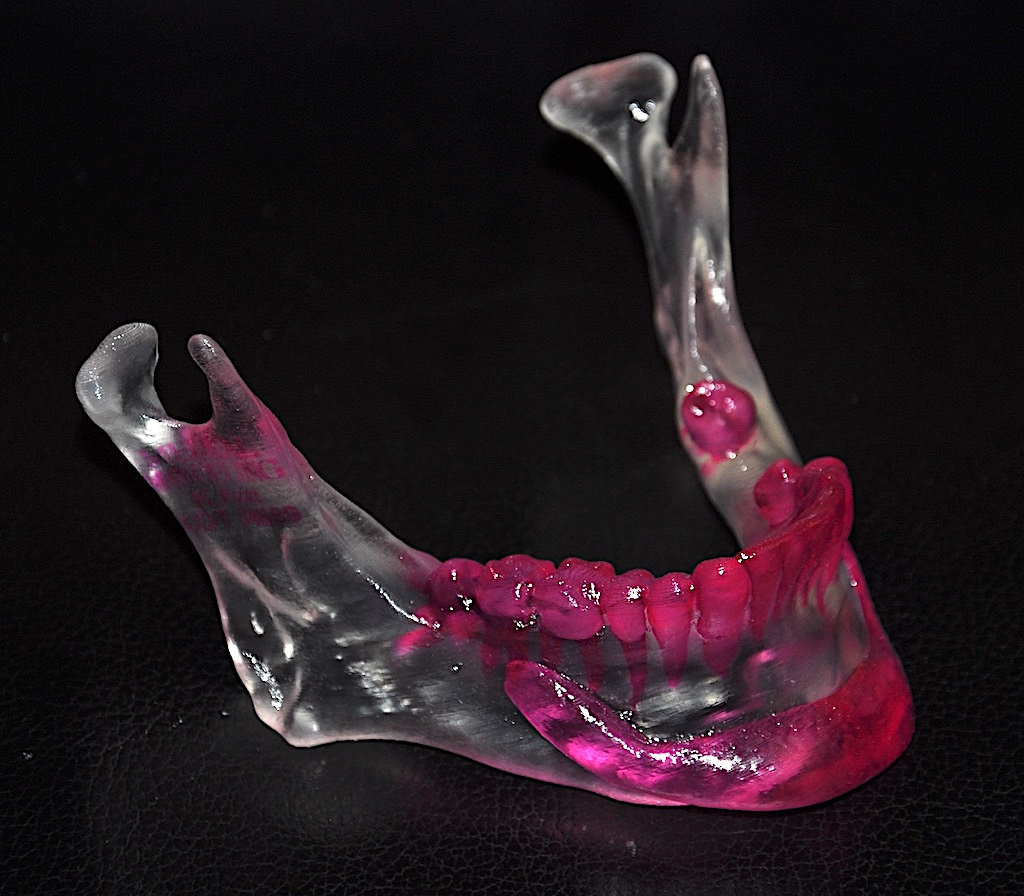
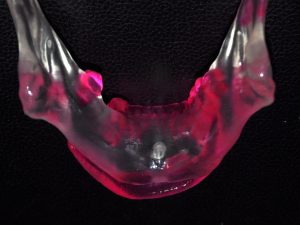 This male patient previously underwent placement of a standard square chin implant and was dissatisfied with the aesthetic result. The chin appeared asymmetric due to implant tilt, lacked a true square appearance, and did not provide sufficient horizontal projection. A 3D mandibular model demonstrated the implant’s size, shape, and malposition on the bone.
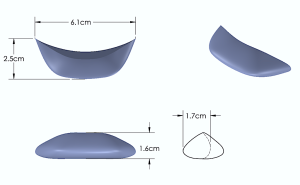
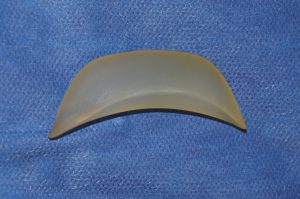
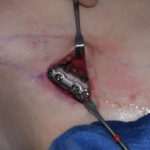
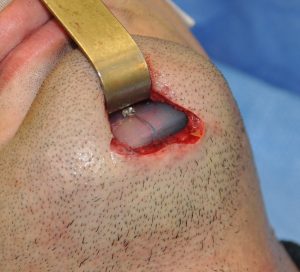 A custom square chin implant was designed with 17 mm of horizontal projection while limiting width so that it did not exceed the converging jawline contours at the chin. Through a submental incision, the existing implant was removed and replaced with the custom implant. Secure fixation was achieved using three screws (one central and two lateral).
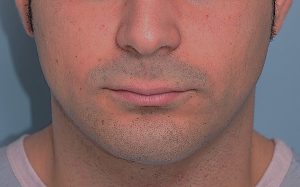
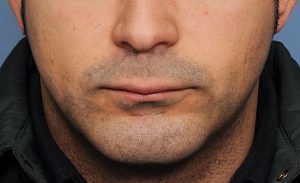
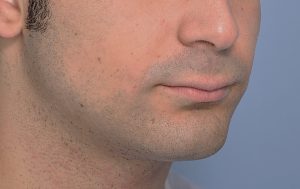
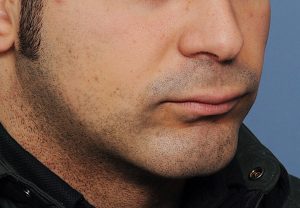 Long-term results showed significant improvement in chin projection and controlled width. Given the substantial increase in horizontal projection (from 7 mm to 17 mm), deepening of the labiomental fold occurred as expected. The patient did not consider this an adverse outcome.
Discussion
Custom square chin implants are designed to create a broader, flatter, and more angular chin—an aesthetic most commonly requested by male patients or those seeking a stronger lower-face appearance that standard anatomic implants cannot reliably achieve.
Why Custom Design Is Critical for Square Chins
Limitations of Stock Implants
- Excessive anterior width
- Lateral wings bent superiorly
- Limited control of vertical dimension
Advantages of Custom Implants
- Precise control of width versus projection
- Ability to correct asymmetry
- Improved edge blending to avoid step-offs
- Anatomically contoured to cup the symphyseal bone
Key Design Characteristics
- Square (non-tapered) anterior face
- Flat or mildly convex anterior surface rather than a rounded contour
- Increased width at the pogonion level
- Sharper inferolateral corners for a masculine appearance
Lateral Extensions (Wings)
- Extend onto the parasymphysis (and occasionally the anterior mandibular body) at the inferior border
- Prevent the “button chin” appearance
- Provide a smooth transition into the jawline
Vertical Control
- Can add vertical length when needed
- Helpful for a short lower third or deep labiomental fold
Implant Materials
Solid Silicone (Most Common)
- Easier insertion despite increased width
- Easily removable or revisable
- Preferred when large vertical and width changes are required
PEEK
- More difficult placement
- Less forgiving and harder to revise
- Not FDA-approved for facial applications in the U.S.
Medpor
- Less favored for large square designs due to rigidity
- Difficult removal
- May require two-piece designs for insertion
Surgical Approach
Submental Approach (Preferred)
- Superior visualization
- Safer placement of lateral wings
- Easier and more reliable fixation
Intraoral Approach
- Possible but technically more demanding
Fixation
- Always rigid screw fixation to prevent rotation or malposition
Key Points
- Standard square chin implants have significant aesthetic design limitations.
- Custom implant design is the optimal solution when a standard implant fails aesthetically.
- Successful square chin augmentation in men requires strict adherence to specific design principles.
Barry Eppley, MD, DMD
World-Renowned Plastic Surgeon